

English
In the history of the development of a symbolism of space, so important for Polish culture, the most important part has been played by images of the plains or hills that stretch broadly between the Baltic and the Carpathians, an expanse of fields, meadows, woods and steppe. It was only Romanticism that was to make the aesthetic discovery of sea and mountain, while cityscapes would take on greater significance even later, in the era of positivism. Society, composed mainly of gentry and peasantry, directed its imagination mainly towards the land and the vegetation that covered it. The most important literary figure was the country gentleman. In times of peace a landowner living on his country estate, in times of war he became a knight who fought for his homeland. In contrast, sailors as discoverers of foreign lands, as merchants or as fishermen, appeared only infrequently on the pages of Polish literature. It was not the ship but the horse that served my ancestors in overcoming space and symbolised the dream of freedom, the exhilaration of speed. In those works in which they appeared, the literary topoi of sea, ship, sailor and journey often had more in common with Greek and Latin literature than with the personal experiences and observations of the writers.
Even in the nineteenth century the place where the various Baltic neighbours met, both literally and metaphorically, was Rome, thanks to their common love of antiquity. To illustrate this, I have taken an example not from literature, but from the history of art. The Danish sculptor Bertel Thorvaldsen made the acquaintance of Polish artists and patrons of art in the Italian capital, and it was as a result of this that he visited Poland. Many of his works found a permanent home here, several of them in the places that are most important to our culture. At Wawel Cathedral in Cracow, where Polish kings were crowned, there is a gravestone of one of the country’s leading aristocrats, made by Thorvaldsen, while Warsaw is graced by two of his famous statues, those of Copernicus and of Prince Józef Poniatowski. The latter of these has a special eloquence. Poniatowski, nephew of the last king of Poland and one of the outstanding military leaders in Napoleon’s service, came to a tragic end in Germany during the battle of Leipzig. Wounded, he mounted his horse in the currents of the Elster while leading his soldiers into attack, and he drowned. In the Polish collective imagination he immediately became an almost mythical figure, a development favoured indeed no less by the emotional aura that surrounded him than by his heroism in battle. The prince was an exceptionally handsome man and was famous for his numerous affairs. He was thus an ideal candidate for a hero, openly adored for his manliness, but subconsciously for his masculinity, which was the admiration as much of men as of women. The patriotic and erotic ideals were combined into a whole of uniquely powerful effect. And it was to this Romantic figure that the Poles set up a monument, on which the classically inclined Danish sculptor, working in Rome, presented the hero in ancient costume. On the Warsaw monument Poniatowski is certainly not jumping into a river; far from it, he is wearing a Roman tunic and armour and sitting proudly on horseback, in a tranquil pose copied from the figure of Marcus Aurelius on the Capitol.
Hence there was a special kind of Mediterranean intermediary at work in the contacts of the Baltic neighbours, resulting from the dominant place occupied in the imagination by the Mediterranean Sea as the cultural cradle of all the nations of Europe. The imagination of Poles was also drawn, though in lesser degree, to the Black Sea because of the historical contacts with the East, which became particularly dramatic in the era of the Tartar khans’ expansion. Politics and economics joined Poland firmly with her neighbours to the east, first with Kievan Rus and Turkey, and later also with the empire of the Russian tsars, but our main cultural inspiration was of course drawn first from Italy and then from France.
Before the severe landscape of the northern sea could find an aesthetic right of citizenship in Polish literature, the cultural attractiveness of the regions outside the traditional European centre, that is the countries of the Mediterranean, had to be discovered. Romanticism brought the beginning of the changes by its discovery, through Madame de Staël, of the value of the culture of the North, as opposed to the culture of the South. As one effect of this discovery, Polish literature was encouraged to remember the existence of the Baltic. A further strengthening of this Romantic impulse came at the turn of the nineteenth and twentieth centuries. When the artists of the Young Poland period found their place among other national movements of Young Europe, together creating “Jugendstil”, contacts with artists who came from the Scandinavian countries played an important role. These contacts then began to appear not on the fringes but in the mainstream of artistic endeavour.
One of the most influential artists of the time was Stanisław Przybyszewski (1868-1927), a dramatist, novelist and essayist whose work had a bilingual character to begin with, as the author lived for many years in Berlin and wrote both in Polish and in German. In Berlin’s Bohemian international artistic circle he was regarded at the turn of the century as the most important prophet of the new art. His passionate but also stormy friendship with August Strindberg and Edward Munch left deep traces on the work of all three artists. The work of Henrik Ibsen also had great significance for Przybyszewski’s own endeavours as a playwright. His travels to Denmark and Norway as well as his contacts with their writers bore fruit in countless articles in the German and Polish press on the subject of Norwegian art, which was at the time very significantly involved in the same artistic quests as those that engaged the minds of artists in the Baltic countries.
Slightly younger than Przybyszewski, Stanisław Ignacy Witkiewicz (1885 – 1939) was also known by the pseudonym of Witkacy, which he invented himself. The significance of his work went far beyond that of his predecessor. He was a painter and one of Poland’s first photographers, as well as a philosopher, art theoretician, novelist and essayist, but his greatest achievements were in drama. After his death, in the post-war years he was recognised as a precursor of the French theatre of the absurd; his plays were translated into many languages and performed in theatres on both sides oft he Atlantic. In many of his dramas parodic allusions to Ibsen and Strindberg have considerable significance. There is also a small episode in his life that is connected not only with the culture of the Baltic countries, but also with their seaside landscape. Of course Witkacy’s interest in photography is only on the fringes of his varied creative passions, but the photographs he left behind do have a place in the history of early Polish artistic photography. Among his early work are several interesting seascapes from the Baltic town of Palanga, today part of Lithuania. At the turn of the century it was already a fashionable health resort, enthusiastically visited by Polish painters, including Witkacy’s father, Stanisław Witkiewicz, and Leon Wyczółkowski.
The focus on the North initiated by Romanticism and strengthened in the turn of the century period, acquired an entirely new character after the First World War, when Poland regained independence after more than a century of subservience, and this within borders that guaranteed access to the sea. Cultural interest in the Baltic then received very strong political support, which bore fruit in a lively development of popular and young people’s literature, as also in publicist writings on maritime themes. A particular role in popularising the history of Pomerania and the Slavonic presence on the Baltic was played by the book Wiatr od morza (Wind from the Sea, 1922), whose dimensions were not large, but which was significant because of the name of the author. Stefan Żeromski (1864 – 1925) was acknowledged then to be the greatest Polish prose-writer and at the same time an authority on matters of national culture. The writer presented selected historical episodes from remotest times to his own, concentrating especially on the moments of dramatic conflict between the Slavs who inhabited the Pomeranian coast and the incoming elements, such as the Vikings, the knights of the Teutonic Order, and the Germans. The separate parts are linked by a figure drawn from folk mythology, Smętek, who personifies the evil present in history. His name is an archaic version of the word “smutek”, sadness. At the end of his book the writer, fired with optimism because of Poland’s restored independence, shows Smętek leaving the shores of the Baltic for ever. At the time no one foresaw that Smętek would return to these parts in less than twenty years, on September 1st, 1939.
Another important work of Żeromski’s, from the same period, is entitled Międzymorze (Between the Seas). This piece of prose poetry about the Hel peninsula (to which the title refers) expresses fascination with the beauty of the coastal landscape, so different from the low-lying plains that dominate Poland’s territory, with their woods, meadows and fields. The way of describing the changing colours of the water and of the sky over the sea has a clearly Impressionistic origin. Żeromski knew the Baltic landscape from personal experience, for in the last years of his life he spent several summers living in Orłowo near Gdynia in a little house right next to the beach, at the foot of a high cliff. Today this is a museum named after him.
In the earlier novels of this writer there are many extensive and varied descriptions, written in an emotional language that is dense with metaphor and with countless sophisticated epithets that seem rather exaggerated to the present-day reader. Younger writers had already distanced themselves decidedly in the twenties from Zeromski’s mannered prose, but nevertheless the author continued to enjoy a huge readership for many years, and hence his works on the Baltic and the Coast had considerable significance for the development of the symbolism of the sea in Polish literary imagination.
Among those who entered the writers’ arena in the period between the First and Second World Wars, Jarosław Iwaszkiewicz (1894 – 1980) is particularly outstanding. Acquaintance with the culture and natural environment of the Baltic region was part of his own experience. Although it was a very short episode, it left an interesting mark on his work. Born in the Ukraine, Iwaszkiewicz spent his whole life in central Poland. He had an expert knowledge of Italy, which he adored and which he visited almost twenty times. In his private mythology of space a key role is played by the comparison of the Ukraine and Sicily. The Baltic episode was an exception connected with his work in the diplomatic service. Before the war Iwaszkiewicz had already been cultural attaché to the Polish Embassy in Copenhagen for several years. He translated several of Kierkegaard’s works into Polish, and wrote a volume of sketches about the landscape, culture and literature of Denmark, to which he gave a title taken form Andersen’s fairy tales: Gniazdo łabędzi (The Swan’s Nest). More importantly, however, he introduced Denmark and its Baltic landscape to his own creative work. In Iwaszkiewicz’s rich output as a poet, prose writer, dramatist and essayist, his most valued work apart from poetry consists of small prose forms. One of his best short stories is to be found in Słońce w kuchni (Sun in the Kitchen, 1938). This is the moving and dramatic story of a girl from the people, the daughter of Polish emigrants in Denmark. The situation of a young Polish girl working as a servant in a wealthy middle-class Danish family does not serve to expose cultural and social differences in a particular historical time and place. Although the author takes care to make the details probable, he uses these realistic details in order to open up a universal perspective beyond them, presenting a study of existential loneliness and of the helplessness of a human being in the face of the circumstances into which he has been cast. The heroes of the story, however, are not mere ciphers representing certain ideas of existentialist philosophy; the psychological portrait of the characters, though sparingly outlined, is also very important. We learn about the behaviour of the characters through a tale told by a narrator, but the interpretation of their experiences and the deeper meaning of what happens to them is signalled only indirectly, through a series of images with a symbolic subtext. The events are played out against the background of consistently constructed scenery whose character suggests more to the reader than any direct commentary could do. All the events important to the story take place by the sea, and this element accompanies the heroes unceasingly, in happiness and unhappiness, in love and in death. The time of the action is conducted in such a way that the author shows the course of all the seasons of the year on the Baltic. The story also contains descriptions of the sea at different times of day and night, in changing weather, in the port of Copenhagen and on the shores of Jutland, in the depths of the bay on which lies the small town that is the main scene of the action, as also on the western side of the peninsula where the ocean begins. In the experience of the heroine the sea represents above all her feeling of being threatened and lost, her undefined fears, helplessness and nostalgia. Ignasia, the main character of the story, lives in this state of mind throughout the autumn, winter and early spring. The sea is then grey and stormy and the sky above it cloudy. The threatening, dark winter sea is also a sign of separation and longing. Throughout this time it divides Torben, in Greenland, from those closest to him. He is the eldest son of Ignasia’s employers and the only person who has aroused her trust. He is missed not only by Ignasia, but also by his youngest brother Kai, who feels unloved by his parents and dreams of sailing away to Greenland. It is only the goodness of Ignasia, who shows him a mother’s tenderness, that protects him from the emotional coolness of his mother and the severity of his father. But in a moment of despair the boy runs away from home and drowns in the sea. After Torben returns from Greenland, a brief change in Ignasia's life brings her happy love in the setting of a beautiful summer on the beach, when the Baltic turns sky-blue and warm in the light of the sun, like the southern seas. Then even the night is lit up by the moon. Ignasia’s fear turns into a light-minded overconfidence and the girl swims far out to sea while bathing. However, the summer idyll does not have a pleasant ending. Torben’s parents will not hear of their son’s marrying a foreign servant, and besides, both heroes are really involved against their wills in other relationships. The handsome Torben arouses an ambiguous interest in his mother’s younger sister, while Ignasia is sought by a strange person, much older than she, who was once a socialist and a participant in workers’ strikes, and is now the leader of a small religious sect. The finale recalls ancient tragedy – when the complex knot is only a step away from being happily untied, a sudden, inconceivable twist brings disaster. Ignasia does not understand her own self; she would like to be somewhere other than where she is, but it is not this or that country that is her problem, but her feeling of alienation which she can neither name nor express, her neurotic wavering and existential inability to take roots in being. In the end the girl kills Torben as he is canoeing, with a pistol shot, and his body is immersed in the waters of the same bay in which his little brother drowned in the spring.
The motif of death by drowning appears regularly in the novels and short stories of Iwaszkiewicz. The writer always exploits this motif in the same interpretative perspective, for death of this kind is only met by the young and innocent, who are endowed by the writer with positive values. If death occurs by another means in Iwaszkiewicz’s fiction, for example by hanging, it involves only figures that are clearly negative. Iwaszkiewicz remained faithful to this symbolism of death in the one work whose action is entirely located on the Baltic. How firmly the seaside setting is incorporated by the writer into the tissue of the story’s meaning, its building of mood and psychological and philosophical subtexts, can be seen if we compare the descriptions included in the story with those that occur in the previously mentioned book about Denmark. In Gniazdo łabędzi we find information about the same geographical places as provided the setting for the fictional action of the story, but the writer in this earlier book did not endow them with the depth of emotion or depth of significance that characterise the descriptions of the coastal landscape in the story, where they are always linked with the experiences of the characters.
After the Second World War the agreement of Yalta forced millions of Poles to leave their homes and make a mass migration to the west, to the lands abandoned by the Germans by order of the same treaty. Among the Poles who came from the Vilnius area was Zbigniew Żakiewicz (born 1933), a prose wirter who has lived in Gdańsk for several decades. Like many others from the same parts, he found in the hilly, wooded, lakeland Kashubian landscape of Pomerania something that at least a little reminded him of his lost homeland. In the several successive volumes of his literary journal, Żakiewicz found room for many scattered notes, showing how the initial feeling of foreignness connected with life in a new place was gradually though partially replaced by a growing familiarity with the landscape of Kashubia, Gdańsk and the sea. An original characteristic of his work, both autobiographical and fictional, is the combination of seriousness and coarse humour, of the metaphysical and the everyday. Philosophical questions about death and the prospect of immortality appear in his work in the context of down-to-earth scenes in which the biological side of physical life makes its voice heard. His sense of humour and richness of style save his writing from vulgarity, while a great part is played in his narratives by the perspective of the naive narrator, a child or a person who retains a simple outlook despite being adult and educated. He knows how to make use of his learning and to draw philosophical conclusions from his observations, but he has not lost the spontaneity and carefree attitude of someone who likes to eat and drink well. This is the case for example with Żakiewicz's newest book, Gorycz i sól morza (The Bitterness and Salt of the Sea, 2000). The heroes of his works are dualistic: they know how to enjoy the sensual pleasures of life, but on the other hand there is a dangerous tendency in them to madness and melancholy. It is in this context that images of the Baltic landscape shape themselves in his writing. The sea is presented as an element symbolising infinity, in a metaphysical perspective and high poetic style; but at the same time it is the scene of trivial incidents presented in a humorous convention, almost like that of old comedies from the period of the silent movie. The narrator may jokingly compare himself or his heroes to a powerful bison or bear from the Lithuanian wilds, who when he glimpses the sea stretching to the horizon is overtaken by boundless astonishment, thinking that he has found himself at the end of the world. A metaphorical shorthand for Żakiewicz's attitude to the Baltic landscape is to be found in the title of one of his novels from the nineties, drawn from Adam Mickiewicz's poem about the Wilja river, which flows through Lithuania to join the Niemen and be lost with it "in the depths of the sea".
We can find a certain parallel to Żakiewicz's life history in some of the younger prose writers living in Gdańsk, with the difference that not they themselves but their fathers were new arrivals from the eastern borderlands of the former Republic, from Vilnius and Lviv. Pawel Huelle (born 1957) and Stefan Chwin (born 1949), for it is of these that we are speaking, did not come to Gdańsk from anywhere else, but were born here soon after the war. Without eliminating the mythology of the eastern borderlands, which is so strong in Polish literature, neither of them made it part of their writing. Instead, they created between them a new literary mythology of the northern borderlands. Their writing is evidence of their acceptance of their place of birth as their own territory, but they do not lose the memory of the complex, multinational and multicultural past of their home town, which for centuries was also the homeland of the Germans who lived here, and embraced the people of other nations besides. The image of Gdansk in the work of these writers is a separate problem which has already been discussed and analysed repeatedly. Here let us simply examine the consequences for the two writers of the fact that Gdańsk lies on the Baltic.
Huelle's prose in written in two different keys. On the one hand, his works reveal an excellent observer's instinct that a reporter might envy him. This gift of quick observation allows the writer to present the realities of time and place with unusual vividness. On the other hand, his work is characterised by a richness of imagination, by the elemental temperament of the storyteller who loves to invent the tallest of tales to entertain his listeners and himself.
Among the details presented with almost documentary faithfulness, the writer introduces the element of the unearthly, touching close on Romantic fantasy. He balances on the borderline between probability and improbability in a manner that is risky, but so skilful that the reader accepts the world he has invented without hesitation. This double existence, rooted in a specific geographical and historical context and at the same time referring to some other dimension of reality, is also evident in the scenery of sea and beach in the Gdańsk bay that appears in his work. The action of his first and most famous novel, Weiser Dawidek (1987) takes place in the course of one summer holiday, during which an eleven-year-old boy and three of his friends experience events that leave their trace on the whole of the rest of their lives. Huelle drew on the tradition of the novel of initiation, showing the transition from the child's ability to rub shoulders with the mystery of being, to the bitter adult knowledge that this mystery cannot be known.
In the realistic dimension, a particular characteristic of these extraordinary holidays is the fact that from the start, the children cannot go to the beach because the sea around Gdańsk has become ecologically infected; fish and seaweed die, covering the shallow water and sand of the beach with a stinking mass. The situation described did really occur, but more than ten years later than the action of the novel suggests, and above all not on such a scale. To begin with the poisoning of the bay is the subject of ordinary everyday grumbling on the part of the bored children, but gradually in the narrative it begins to be spoken of in an almost apocalyptic tone. The situation is aggravated by a heatwave and long-lasting drought. People begin to pray for rain; a patient runs away from the psychiatric hospital (described, incidentally, in accordance with its real location). He is like some grotesque prophet, making a spine-chilling forecast of the approaching end of the world. The hero is haunted by a nightmarish dream in which the boy sees monstrous fairy-tale animals coming up out of the sea. The huge monsters demolish the seaside homes and devour the fishermen. Both the dream scene and the prophecy of the madman are clear stylistic paraphrases of the Book of Revelation. The novel contains more of such Biblical and poetic allusions, but a colloquial style clashes with the high tone both in the narrative and in the dialogues of the boys, whom the water in the bay reminds of some disgusting fish soup.
The coastal scenery presented in the text that closes the volume Opowiadania na czas przeprowadzki (Moving House, 1991) is characterised by a similar dualism that combines particular historical realities with a universal plane of reflection. One of the characters is a man plunged into the depths of despair because he shot an angel. This is how the event presents itself to his feelings. The reader quickly becomes acquainted with another point of view. The poor unfortunate who is now a patient in a psychiatric hospital, years ago did night duty as a young soldier on guard at a Gdańsk beach. This was during the Stalinist period, when the government was obsessed with guarding national borders. At that time the town’s beaches were dragged each evening so that it would be easy to find the traces of anyone who wanted to cross the border illegally and escape, for example to Sweden. This principle is no literary fiction, invented by Huelle, but a historical fact, though it has the look of a paranoid illusion. Each morning the earnest young guard finds prints of bare feet, running over the harrowed sand from the dunes to the water. One day he finally glimpses a winged figure in the morning mist, running towards the sea, and he shoots and kills a young girl. Both the wings of the girl who has come to the beach that morning and all the older traces in the sand are merely the illusions of a sick mind; only the death of a chance stranger is real. Now grown old in hospital, the patient rakes the sand daily in front of the building and looks into it carefully, as if seeking something.
Stefan Chwin prefers to introduce extensive literary allusions to his work than to make use of dreams, the fantastic and unearthly, which are one of the poles of Huelle’s imagination. The mystical perspective, which constitutes a counterweight to the rollicking physicality of Żakiewicz’s writing, does not interest Chwin either. The intellectual attitude is what is important in his writing: the subtle and incisive reflection of the essayist. He constructs his world out of very precise descriptions that are permeated with metaphor and whose elements he gathers with the fascination of a true scholar and connoisseur. He is not interested in the ancient art of spinning fascinating tales. In his prose it is not events that matter, but what they communicate, the atmosphere that surrounds them and the scenery in which they are played out. Chwin is a painter of figures and objects, from whose appearance he draws out the metaphorical meaning, like a gypsy foretelling with cards a future that is invisible to the uninitiated eye. The Baltic landscape in Chwin’s novel Hanemann (1995; the German title is Tod in Danzig), though it remains faithful to geographical and historical realities, is opalescent with general meanings that are independent of place and time. The location of the action in Gdańsk in the period just before, during and after the Second World War and the creation of an international gallery of portraits might have encouraged the writing of a social novel of manners, soundly immersed in politics and history. These accents are of course present and have aroused the understandable interest of readers. However, it would be an impoverishment of the work to stop at such an interpretation. Chwin bent the political and historical realities to his artistic needs, writing a novel about love and death, about flights from life and returns to it. His novel speaks for the permanence - despite historical changes – of Romantic attitudes in the modern philosophy of the human being. The landscape of the Baltic is stylised in Chwin’s novel according to the spirit of Romantic melancholy not only because he several times recalls the paintings of Caspar David Friedrich, and not only because a reproduction of Friedrich’s painting Moonrise over the Sea, an ideal painter’s expression of the melancholy attitude to the world, has appeared constantly on the covers of successive editions of the novel. The titular hero, Hanemann, both as a medical student and throughout his years of work as a doctor, has been directed by the desire to find the mysterious borderline between life and death. He is also a professor whose duties include conducting lectures for students during autopsies. One day the bodies of the victims of a pleasure boat disaster that has just taken place on one of Gdańsk’s suburban beaches, are sent for him to examine. As fate would have it, when he begins his lecture he uncovers on the dissecting table the body of the woman he loves, before he has had a chance to learn of her death on the wrecked ship.
The sense of a loss from which he cannot recover crushes him through all the years that follow. Hanemann gives up his position and his medical research for good, and mentally also he remains on the fringes of life. Towards the end of the war all his acquaintances and neighbours attempt to sail away to Germany on a huge passenger ship. This episode in the novel is based on the authentic story of the disaster of the “Wilhelm Gustloff”, a ship sunk with several thousand fugitives by a Soviet submarine. Both the attempt to board the ship and the final staying in Gdańsk are carried out as if outside Hanemann’s will and decision; he behaves completely passively as he regards his fate. It is only after the war, when he receives a letter from his assistant Retz, one of the very few survivors, that Hanemann learns that his neighbours drowned together with their children. This event is described very shortly and simply, but in an exceptionally moving way. Of the author of the letter, we know from the first pages of the novel that his favourite place to walk before the war was the long pier in Sopot that runs far out into the sea. He was accustomed to stand there without regard to the cold weather or the wind that tangled his hair, gazing into the “dark line of the horizon”. Retz is several times called simply “a melancholic”. The narrator says of him that he always carries, like a weird talisman, a plaster cast of the face of the famous Romantic drowned young woman, called The Unknown of the Seine.
In Chwin’s novel the Baltic is a dark sea of death. Only once, and before the drowning of Hanemann’s beloved, does it appear as the backdrop for a lovers’ meeting, but even then it is an evening landscape, its colours already marked with the symbolism of death. The narrator shows us “dark silhouettes – the black profile of a man and the black profile of a woman on the silver background of the shimmering sea”. When, towards the end of the novel, Hanemann slowly begins to awaken to life again, this has absolutely no link with the still close presence of the sea and with the symbolism of the coastal landscape. On the contrary, some new chapter in the fortunes of the titular hero is to begin only after he has left Gdańsk, but this is something we do not find out about.
I have presented only a few examples, striving to choose views that are varied in their character and at the same time of the highest literary value. I have spoken about works whose functioning is not limited to the regional, which includes considerably more literary texts that for understandable reasons are linked with the theme of the Baltic landscape and mythology. The texts that I have dealt with here belong in terms of their subject-matter and poetics to Polish literature as a whole that stands above the various local traditions. They are so because of the potential for intellectual and artistic generalisation with which the writers endow their experiences, rooted as they are in the particular realities of time and place.
Lecture given at the Visby conference on "Landscapes of the Baltic in Literature and Art" in November 2002
The young Finland-Swedes must in retrospect be counted among the most significant modernist poets of the Eurpoean post-World War I generation. However, international critics and literary scholars have come to realize this only rather recently. For language reasons, the international recognition of the Finland-Swedish avant-garde has been belated; in the case of Gunnar Björling, it still lies in the future.In his survey of international modernism, the brilliant Danish critic and poet Poul Borum devoted three entire pages (of around totally two hundred) to Björling's "universalist dadaindividualism". The conclusion was: "Together with Mallarmé and Gertrude Stein, Björling probably stands out as the real linguistic innovator of modernism". The judgement might surprise but should rather be supplemented - e. g., with the Russian Velimir Chlebnikov - than dismissed.1
For obvious reasons, it is impossible here to give more than a few hints of the originality of the Finland-Swedish modernists.2 My article also has a second aim, besides the purely informational. The case of the Finland-Swedish "revolution from the margin" of the early 1920's, often discussed by Swedish literary historians, rises questions on the dynamics of literary space and on literary change in general.
With her first book, Dikter ("Poems", 1916), Edith Södergran, to the dismay of the small and conservative reading public in Finland, opened up doors to totally new poetic worlds. Her free, euphorically expressionistic verse was conscious and self-conscious:
beauty is not the thin sauce in which poets serve themselves,
beauty is to wage war and seek happiness,
beauty is to serve superior powers.3
In her biography an apparently marginalized person, Södergran the poet, in a few collections of poems 1916-1923, sited her poetic I as the center of a universe of new images. Writing her first poems in German, she actually never learnt the rules of Swedish poetic tradition, and hardly cared for them either. Her poetry obviously did have roots, but they were not Finland-Swedish or mainland Swedish. Taking Russian symbolists, Nietzsche, Walt Whitman and Else Lasker-Schüler as points of departure, Södergran's work "sums up a long modernist development that had passed by the
Swedish-language community almost completely unnoticed".4
Biographic reductionism has often prevented critics from seeing Södergran's poetic radicalism as an aesthetic project. Actually, it was a daring creative act, throwing a bridge between the Scandinavian margin and European post-symbolism, allied with the international 'New Woman' discourse of the time.5
On foot
I had to walk through the solar systems,
before I found the first thread of my red dress.
Already, I sense myself.
Somewhere in space hangs my heart,
sparks fly from it, shaking the air,
to other reckless hearts.6
The common goal of the Finland-Swedish modernists who followed Södergran's appearance on the literary scene was nothing less than a revolution in poetic language. It is interesting to note in which social context this revolution took place. Already in 1906, through a parlamentary reform, the Swedish-speaking minority's earlier dominating position in Finland came to an end. In the constitution of independent Finland, in 1919, bilingualism with equal rights for Finnish and Swedish was codified. Obviously this was a concession to the Finland-Swedish minority (then 12 % of the population) as a reward for its almost total allegiance to the victorious white side in the traumatic civil war of 1918. This did not mean, however, that bilingualism was practiced by most citizens. Instead, the language question remained the topic of fierce political controversies between the Swedish-speaking minority and the Finnish majority (to which the greater part of the defeated red side of the civil war, but also the new bourgeoisie, belonged) during the inter-war period. In this situation, the Finland-Swedish modernists exposed themselves as exceptions to the rule. For all of them, practical bilingualism or polyglottism was a basic experience, even if their mothertongue was Swedish. Edith Södergran had German, Russian, and Swedish from her childhood in St. Petersburg, and was actively writing in German parallell even since she had become a well-known Finland-Swedish writer. Her friend and correspondent, the critic and prose writer Hagar Olsson and the poet Elmer Diktonius wrote both in Swedish and in Finnish. Henry Parland was born in Wiborg in a family with Russian and German and only learnt Finnish and Swedish at school in Helsinki. As one critic states, "Strictly speaking, modernism was not very Finland-Swedish and strikingly un-Swedish".7
Elmer Diktonius was the first poet to respond to Edith Södergran's novelty, to her universal horizons and high intonation. Diktonius was a true internationalist modernist with contacts abroad; a composer who corresponded with Schönberg and gave lessons to and befriended Otto Wille Kuusinen, the young marxist critic; a translator who introduced Edgard Lee Masters, Carl Sandburg, Pound and the German pre-expressionist Mombert.8 If revolution had been victorious in Finland, Diktonius might have been an analogue to Majakovskij. His attitude to communism was initially sympathetic, but he saw the aesthetic revolution as primary: "I am a communist because Communism inclines in my direction". As early as in 1922, Diktonius' poem "The Jaguar" was included in Ivan Goll's global avant-garde anthology, published in Paris.9 The introduction to this striking combination of Nietzcheanism, futurist verbal montage, and revolutionarism became the poet's signature:
From green leaves sticks forth
red muggle
eyes with triangular glances
speckledly –
whiskers waving
clawpaw –
you fly indeed! – my heart's jaguar! –
then fly and bite and tear and slash to pieces!
To bite's a compulsion as long as bite gives life
to tear is sacred as long as rotten stinks
and life's ugliness must be slashed to pieces
'til beauty-wholeness from its earth can grow.
We two are thus, my poem and I: one claw
one will are we two, one maw one tooth
are we together: one machine that strikes.
We will slay the cry of the feelingless
the sympathy of the hartless
the religiosity of those false-in-faith
the impotence of what is strong
the evil weakness of what's good;
we'll give birth to slaying
we will make space
some day we will see
sunspots dance.10
In 1922 – the year of such events in European poetry as the publication of Eliot's The Waste Land and Pasternak's Sestra moja - žizn' – Finland-Swedish modernism appeared on the literary scene as a group with Hagar Olsson as the leading critic and Edith Södergran as a figurehead. Diktonius met Södergran and Hagar Olsson, and the avant-garde journal Ultra, with texts in both Swedish and Finnish, was started under the slogan, "Open up the windows to Europe!" The journal's publisher also put out Diktonius' first volume of poetry and the first book by Gunnar Björling.11 Edith Södergran translated Hagar Olsson into German and worked intensely during her last years on a volume of translations of Finland-Swedish poetry, including her own.12
Gunnar Björling made his delayed debut in 1922 with a collection of poetry coloured by a vitalist philosophy of his own. From the point of view of poetic language, this philosophy corresponded to a more and more far-going disruption of syntax and dehierarcization of speech, which makes his poetry extremely difficult to translate. In Björling's mature poetry, full-semantic words are reduced, syntax becomes ambiguous, conjunctions and particles ('and', 'that', 'as') forgrounded, and metaphors dismissed. The idiolect which is the result is immediately recognizable even in book-titles like Words and That Not Else, Air Is and Light, That in One's Eye. Björling's "linguistic turn", which only has had its decisive impact on Swedish poetry in the 1980's, disarms the logic of propositional language and its power to control reality. While the means are quite different, the goal of Björling's puzzling poetry of "not-saying" is in a way similar to that of the early Boris Pasternak: to make reality speak in spite of the restrictions of language.13
Henry Parland, who died at 22, was strongly influenced by Björling but himself also inspired the older friend and colleague. Parland had an extraordinary sense for surface, detail, and "modernity". A typical poem is entitled "Gasoline":
I am a great God
and my price is $1.40 per gallon
and men murder one another
for my sake.
Whee!
when fire has kissed me
and iron trembles: life!
Then
I know
why I have dreamt so long
under the earth.14
Parland, in theory and practice, connected the group with international criticism, die Neue Sachlichkeit and Russian formalism (one of his essays was entitled "The Uproar of Things", an obvious reference to Majakovskij).
Needless to say, the more closely one looks at the Finland-Swedish modernists, the more obvious individual differences become. But the totality of their poetic innovation and their confrontation with traditionalism make them typical exponents of the international avant-garde.15 Nothing like this happened in poetic language in Sweden, not to speak of the rest of Scandinavia, until the debut of Gunnar Ekelöf in 1932. When the young Pär Lagerkvist appeared as an expressionist poet in 1916, his Angst and violent imagery actually were more religious than Nietzschean or urbanistic, and had few problems in fitting into a rather regular post-symbolist verse. Sweden had to wait until the early 1940's for the archetypical confrontation between modernists and traditional poetry and traditionalist critics (involving polemics, parodies, and public debates).
From an "outside" European perspective, it was obviously the Finland-Swedish poets who were on time, and mainland Swedish literature which was still isolated and provincial. For Swedish literary historians, however, the neighbour has been the exception and Swedish literature the "normal". A standard explanation to the appearance of avant-garde poetry in Finland long before it came to Sweden would sound more or less as follows. The reasons for modernism to appear exactly there, in the Swedish-speaking minority in Finland, and exactly then, in the years following World War I and the civil war, are several. One "reason" is the simply coincidential arrival, in a certain place, of a series of strong talents with an oppositional attitude, together with a flamboyant propagandistic critic with a wide response (Hagar Olsson).
A second reason is the closedness of the Finland-Swedish linguistic milieu, which was easy to overview and made contacts and networking easy. A third reason given is the geographical closeness to the avant-garde movement in neighbouring Russia.16 A recent study contends that it was the newly gained independence from Russia which created a "future-oriented spirit of activity", exploding in modernism. Why such a spirit should be felt only by Swedish-speaking authors is given a somewhat strained explanation: the Finnish-language majority was totally occupied by building its new national culture.17 In all such narratives, the Finland-Swedes' minority status, their position on the margin, is underlined. What is not made explicit, however, is the dynamic interrelation between minority and surrounding majority (majorities), between margin and center(s).
In order to reformulate the question about the Finland-Swedish avant-garde's "early" appearance, one may use Jurij Lotman's concept of the semiosphere. One of the basic tenets of Lotman's semiotics of culture is the productive role of linguistic assymetry and translation. We are all familiar with the sayings that translation is theoretically impossible, but nevertheless works in practice; and that a translation's relation to the original always is one of deficiency. According to Lotman, however, translation between assymetric languages should not be defined as loss, but as creation of new information:
For the results are not precise translations, but approximate equivalences determined by the cultural-psychological and semiotic context common to both systems. This kind of "illegitimate", imprecise but approximate translation is one of the most important features of any creative thinking. For these "illegitimate" associations provoke new semantic connections and give rise to texts that are in principle new ones.18
Any culture thus evolves thanks to the continuous conquest, translation, and integration of the Other into the language of Culture. A certain overlapping between the two structures is necessary, otherwise no understanding is possible. But if the two sides were perfectly overlapping – if for example, if one culture were to completely assimilate another, or a text were to perfectly fulfil a reader's expectations, or a translation of a Björling poem into English could be re-translated into Swedish with no changes resulting – the result would be no new information. The greater the non-overlapping is, the more active the translation is and the more new information is created.
The semiosphere, according to Lotman, is the universe of cultural and semiotic languages which range from complete mutual translatability to just as complete mutual untranslatability. This semiosphere, and any cultural space within it, can be described in terms of center, periphery and boundary. If the center is the normal and normative, the periphery is the coloured and marked, opposing or challenging the center.19 The hotspots for semioticizing processes is the boundary, which both separates "us" from "the others" but at the same time creates a unity.
It is always the boundary of something and so belongs to both frontier cultures, to both contiguous semiospheres. The boundary is bilingual and polylingual. The boundary is a mechanism for translating texts of an alien semiotics into 'our' language, it is the place where what is 'external' is transformed into what is 'internal', it is a filtering membrane which so transforms foreign texts that they become part of the semiosphere's internal semiotics while still retaining their characteristics.20
If we look at some essential features of Finland-Swedish modernism in the light of Lotman's concept of semiosphere and creative cultural translation, we can note the following. Finland-Swedish literature was, and still is, not only minoritarian, but actually doubly minoritarian or doubly peripheral. The relation to Finnish-language literature in the home country is superimposed on the relation to mainland Swedish literature. Neither of these literatures was, however, actually involved in the struggle the modernists of tthe 1920's were waging. As targets for their criticism, Hagar Olsson or Diktonius had to find writers inside their own semiotic space, Finland-Swedish writers of "the old generation" (Arvid Mörne, Bertel Gripenberg, and followers), for whom modernism represented a challenge from their periphery. On the other side of the closest boundary there were almost no allies to be found. Strindberg and Gustaf Fröding, both dead, and the solitary Vilhelm Ekelund were the only Swedish exceptions to the rule; among Finns there were no allies at all. In this situation, the modernists reached for the further away foreign as sources for translation of the new – i.e., for Europe and America. It was in the international foreign, in the avant-garde of Metropolis, sometime in cosmic universe, that the young modernists found the modern alternative expression and world-view to be translated into their own semiosphere. Bringing foreign elements home, they constructed such typically polemical oppositions in relation to the center as 'female/androgyn/beast' vs. 'gentleman', 'the subconscious' vs. 'the intellectual', 'violent' vs. 'lyrical', 'spoken language' vs. 'written, "correct" language', and 'dirty/mixed/hybrid' vs. 'purely Swedish'. At the same time, being foreign at home opened (potential, one must add) channels to the outside.21
In this perspective of the semiospheric dynamics, the discussions about genetic influences – did Södergran actually read Achmatova or Zinaida Hippius, and then what; did she know of Emily Dickinson; or had Elmer Diktonius read Majakovskij, and then when? - lose some of their importance. Or, in terms of translation theory, the source texts become less interesting than the target text and its relation to the target culture. The contribution of Finland-Swedish modernism can thus to a large extent be described in terms of heteroglossia and hybridization as means for widening the cultural and linguistic horizons.
The boundary is the switchpoint for translation, through which foreign texts become part of the semiosphere while retaining some of their foreignness. Diktonius translated very early into Swedish, and Edith Södergran into German. But the Finland-Swedish modernists' bilingual or multilingual background was not only mobilized for translation proper. What they wrote as original texts also had a "foreignizing" character. Inevitably, they were attacked for "cosmopolitism" or "bolshevism" and for having allies and sources of inspiration which were not canonical: German, Russian or American poetry; Finnish language; at least not normative Helsinki Finland-Swedish. But, as Marina Tsvetaeva says, "All poetry is translation in the first place".22 What the avant-garde performed, starting from the margin of the Finland-Swedish semiosphere, was a special kind of cultural translation. Witt-Brattström quotes Gunnar Ekelöf's opinion about Södergran's "deficient" Swedish, and comments: "This 'deficiency' can equally be said to have been an advantage if one wanted to write in high style. Swedish as 'book-language' simply made it possible for Edith Södergran to take a short-cut into modernism".23 Swedish literature was thus taught to speak modernism, and the primer brought Edith Södergran's German-coloured syntax and Diktonius' compact Fennicist genitives, but also Björling's efforts to create a new, intuitive language. In retrospect, it is possible to say, with a paradox, that "much of the most durable in Finland-Swedish modernism was not written in Swedish, but it has, with time, more and more become so".24
The second part of the great two-volume Finlands svenska litteraturhistoria ('The History of Finland's Swedish Literature') offers an interesting description of the specificity of this literature, based on the Finland-Swedish minority's uneasy relation to the problem of Finland's modernization process. To the earlier mentioned semiotic divisions (center – periphery - boundary) one can add other. The minority was obviously alienated from the new wave of Finnish nationalist construction. Clas Zilliacus describes the situation of the Swedish-language writer in the new Finland, striving for independence and cultural self-determination, as one of "mimetic deficit". The main options of response to the situation were historical nostalgia, provincialism, or radical modernism. Hagar Olsson's answer, in the name of the avant-garde, was unambiguous:
If we look into the future, it is neither the flesh-pots of Sweden nor the protected domestic skerries which beckon to us – but the free international arena. By this I do not mean that we should write like they do in Paris or New York - but that we should write as if we had a Paris or a New York to conquer on Finland's soil. The more nationalistically limited our word is, the less chances does it have to gain a hearing, quite simply because in that case it does not correspond to our true essence, it does not have its source in our actual situation – on the island in the ocean. Only the oceanic winds are able to give our words wings. As nationalists we, citizens of Finland, have little or nothing to win, as internationalist – everything. As such we have a mission to fulfil here up in the North. It might prove that our last winged word was not said with Runeberg or Topelius. A poetic work like that of Edith Södergran is sympthomatic. It is international in its essence, born in a process of radical change. This is what all our Kulturkamp is about – a daring Robinsonade. In that spirit we shall prevail!25
The dynamic contribution made by Finland-Swedish modernist and avant-garde poets Edith Södergran, Gunnar Björling and Elmer Diktonius, and others was a revolt from the cultural periphery, seeking its allies in internationalism. Thus, the radicals from the periphery pointed out the direction for later changes in the still, at the time, peacefully self-sufficient and provincial mainland Swedish culture.
1 Quotation from the Swedish edition, Poetisk modernism, translated by Hans Björkegren, Stockholm: Wahlström & Widstrand 1968, p. 89. In his afterword to a collection of Björling's poetry in 1989, Borum actually rephrased his judgement thus: "Björling is one of the great innovator of modern poetry, comparable only to the Russian Chlebnikov and the American Gertrude Stein", in: Gunnar Björling, Valda dikter i två band, band 2, Bra Böcker: Höganäs 1989, p. 191.
2 For more factual information about the writers, see Per Stam's contribution to this volume: »’Old Innovations and Real Innovations in Poetry.’ Finland-Swedish Modernism». The Finlandbased English language web-site Pegasos has quite good information on the Finland-Swedish modernist writers: http://kirjasto.sci.fi/indeksi.htm. The bilingual anthology Auf der Karte Europas ein Fleck: Gedichte der osteuropäischen Avantgarde, hrsg. von Manfred Peter Hein, Zürich: Ammann 1991 situates the Finland-Swedish avant-garde in an interesting Central and East European context, from Finland through the Baltics and Poland down to Macedonia.
3 "Skönhet" ("Beauty"), in Södergran's first collection, Dikter (1916).
4 Bengt Holmqvist, Modern finlandssvensk litteratur, Stockholm: Natur och kultur 1951, p. 20-21.
5 On biographism in Södergran scholarship, which has stressed the poet's position of triple isolation (consumptive, living on the family's dacha in Karelia, finally impoverished by the Russian revolution), see Jytte Kronig's instructive "Introduction", in Edith Södergran: a Changing Image: Looking for a New Perspective on the Work of a Finnish Avant-Garde Poet, ed. by Petra Broomans, Adriaan van der Hoeven, Jytte Kronig, Groningen : Rijksuniversiteit 1993, p. 6-10. For new approaches to Södergran's conscious choice of strategy, cf. Birgitta Trotzig's seminal essay "Edith Södergran" in: Författarnas litteraturhistoria, red. Lars Ardelius & Gunnar Rydström, 2, Stockholm: Författarförlaget 1978, p. 374-401; Ebba Witt-Brattström, Ediths jag. Edith Södergran och modernismens födelse, Stockholm: Norstedts 1998; and Ulla Evers on Södergran and the literary field (in Bourdieu's terms), "Det är makten,som darrar i min sko, det är makten, som rör sig i min klännings veck", in: I klänningens veck. Feministiska diktanalyser, utg. av Eva Lilja, Göteborg: Anamma 1998, p. 85-143.
6 "On Foot I Had to Walk Through the Solar Systems" (1919), translated by Stina Katchadourian.
7 Clas Zilliacus in: Den Svenska Litteraturen, del V, red. Lars Lönnroth och Sven Delblanc, Stockholm: Bonniers 1989, p. 161. Zilliacus mentions that Södergran "all her life spoke Swedish stiffly with a clear accent", that for Olsson and Diktonius Finnish was as good as Swedish (sometimes, for polemical purposes, even better), and that Björling had to correct Parland's manuscripts. Cf. Gisbert Jänicke's study on Södergran and German language: Edith Södergran: diktare på två språk, Helsingfors: Svenska litteratursällskapet i Finland 1984.
8 Kuusinen was, after his escape to Soviet Russia in 1918, to become a gray eminence in Kremlin up to Khrushchev's time. Diktonius' book of translations was Ungt hav ('Young Ocean'), Schildts: Helsingfors 1923.
9 Les cinq continents: anthologie mondiale de poésie contemporaine par Ivan Goll, Paris: La Renaissance du Livre, 1922.
10 Translation by George C. Schoolfield.
11 Elmer Diktonius, Hårda sånger, Helsingfors: Daimon 1922; Gunnar Björling, Vilande dag, Helsingfors: Daimon 1922. – Diktonius' first book, a collection of aphorisms preceded by the introduction to "The Jaguar", quoted above, was actually published late in 1921 in Stockholm through Diktonius' political contacts but had no response whatsoever in Sweden: Min dikt, Stockholm: Bokförlaget Lyrik 1921.
12 Gisbert Jänicke, op. cit., p. 67-84.
13 Cf. Horace Engdahl's conclusion, "It is at hand to interpret Björling's grammar as a unique peace-treaty between the I and being", quoted in: Den Svenska Litteraturen, V, p. 168.
14 Translated by Peter Malekin.
15 The publication of "The Jaguar" in France was not an isolated case. On Diktonius' contribution to the multilingual avant-garde journal Zenit, edited in Zagreb, see Clas Zilliacus, "The Roaring Twenties of Elmer Diktonius", in: Gudsöga, djävulstagg. Diktoniusstudier, utg. av Agneta Rahikainen, Marit Lindqvist och Maria Antas, Helsingfors: Svenska litteratursällskapet 2000, p. 9-27.
16 The arguments are paraphrased after a well-known handbook, Erik Hj. Linder's Fyra decennier av 1900-talet (= Ny illustrerad svensk litteraturhistoria, huvudredaktör: E.N. Tigerstedt, del 5), 2nd ed., Stockholm: Natur och kultur 1952, p. 420.
17 Torsten Pettersson, Gåtans namn. Tankens och känslans mönster hos nio finlandssvenska modernister, Helsinki & Stockholm: Svenska litteratursällskapet / Atlantis 2001, p. 12-13.
18 Lotman, Yuri, Universe of the Mind: a Semiotic Theory of Culture, translated by Ann Shukman, London & New York: I. B. Tauris 1990, p. 37 (my italics, L.K.)
19 Formalist critics like Viktor Šklovskij and Jurij Tynjanov, themselves close to the Russian avant-garde, used the terms periphery and center when pointing out that literary evolution is not simply a peaceful "succession" of generations but a dynamic and often bitter struggle between the new and the old. The formalists' object was, however, the monolithic, imperial landscape of Russian literature and the struggle between genres inside it. Their use of the terms 'periphery' and 'center' only concerns hierarchy, not cultural space. Cf. Tynjanov's essay "Literaturnyj fakt" (1925), reprinted in Jurij Tynjanov, Politika - Istorija literatury - Kino, Moskva: Nauka 1977, p. 255-270.
20 Lotman, op. cit., p. 136-137
21 "From the point of view of modernist messianism, the central task was not to save Finland-Swedish culture from its outsider-position, on the contrary, this was the clue. Outsidership should be used as a spring-board out into the world, therefore the striking internationalism not only in Ultra but also in Södergran's ideas of a supermen's international of poets", Witt-Brattström, op. cit., p. 287.
22 Marina Tsvetaeva's letter to Rilke, 6 July 1926, in: Rainer Maria Rilke, Marina Zwetajewa, Boris Pasternak: Briefwechsel, hrsg. von Jewgenij Pasternak..., Frankfurt am Main: Insel 1983, p. 206: "Dichten is schon übertragen, aus der Muttersprache - in eine andere, ob französisch oder deutsch wird wohl gleich sein. Keine Sprache ist Muttersprache. Dichten ist nachdichten."
23 Witt-Brattström, Ebba, op. cit., p. 46. Tsvetaeva's words (above, footnote 21) also strongly relativize Ekelöf's formulation about how Södergran's phrasing "betrays the lack of contact with the mothertongue and its organic development".
24 Clas Zilliacus, in: Den Svenska Litteraturen, V, p. 161.
25 Hagar Olsson, "Finländsk robinsonad", Quosego 1928: 3, p. 130.
The Geographic limitation for our symposium is the Baltic Sea area or the Baltic Rim, sometimes referred to as the Baltic for short. The linguistic precision is better in German: Ostseeraum. By this we mean the water, countryside and countries around one of the world’s largest inner seas; an inner sea whose state of health is not the best. Industrial pollution, motor traffic, inadequate sewage treatment and mineral nutrients from agriculture all contribute to the clinical picture. But we should not despair and above all not begin our symposium on a minor chord. Our patient – the water of the Baltic Sea – is beginning to recover thanks to our joint national efforts.
As a geographer I consider the map an excellent aid in defining and illustrating spatial limitations. The drainage basin of the Baltic Sea is such a possible geographic limitation. This drainage basin is more than 4 times the size of the sea itself. It reaches all the way into Norway in the west. In the south it reaches as far as the northernmost parts of the Czech Republic and Slovakia and in the east far into Russia, Belarus, and the Ukraine. The Öresund Sound, Bay of Kiel, Danish Great Belt and Kattegat and their drainage basins are also counted as parts of the inner sea of the Baltic Sea. Over 80 million people live in this area.
Consider the Baltic Sea as an organism. An organism needs oxygen to live. Supplying oxygen to the Baltic takes place through a couple of narrow arteries – Oresund Sound and the Great Belt – in combination with westerly – north-westerly storms that carry in oxygen-rich saltwater from the North Sea and Skagerrak. This oxygen-rich, heavy saltwater sinks to the depths of the Baltic Sea pushing aside the hydrogen sulphide accumulated in the deepest parts of the ocean floor. Parts of the saltwater are mixed with fresh water from rivers producing a surface water that also needs to exit via the Öresund Channel and the Great Belt. Water catchment must balance drainage. Due to the narrow passages in both the Öresund Sound and the Great Belt an exchange of water in the Baltic Sea takes a long time. It is estimated that it takes between 35 to 40 years to change all the water in the Baltic Sea. We will have to live with our present pollution for decades.
The Baltic is changing even if slowly. Parts of the Baltic region are becoming land while others are drowning. During the earth’s latest geological period – the Quaternary period – that lasted about a million years, the Baltic has gone through not only one but at least ten glaciations. At present we are living in an inter-glacial period with a new ice age expected in about 15,000 years. The latest inland ice covered at its largest extent about the same area as the Baltic’s present drainage basin. The thickness of the ice mass varied from 200 meters at its marginal areas to 1500 meters in its central parts. Through its great weight the ice exerted an enormous pressure on the surface of the earth. The primary rock plateau that the ice rested on and which is usually called the Baltic Shield sank under the weight of the ice and layers beneath it were pressed to the side. The areas around the inland ice were exposed to pressure from below as well and these land areas rose. This took place in Denmark and northern Germany, for instance. We have a land elevation by 9 meters every 1000 years in the area around the Gulf of Bothnia. At the same time the coast in northern Germany sinks by over a meter every 1000 years. These are the changes taking place in the Baltic Sea in a shorter perspective.
In a somewhat longer perspective from the retreat of the ice about 27,000 years ago until about 5000 BC, the Baltic region has experienced several developmental phases.
When the ice began to melt away, a lake was created south and east of the ice edge – the Baltic ice lake. It was a freshwater lake that drained to the southwest and north towards the White Sea. The edge of the ice lay at the northern point of the mid-Swedish highland plateau. Due to climate deterioration, the ice masses remained in this position for 800 years. When the ice began to melt again and retreat the water masses broke through to the Western Sea at just this place. The drainage catastrophe that took place happened about 8300 BC. This was an enormous natural catastrophe since the Baltic ice lake was lowered 26 meters. In this way a connection to the sea was opened up and saltwater forced its way into the Baltic basin. This period in Baltic development is referred to as Yoldia Sea, named after a mollusc (snail), Portlandia yoldia arctica, whose migration can be followed in the area since the beginning of the Yoldia Sea. Through the land evelation which followed the ice melt-off, land rose from the sea. Run-off water from the ice led to a dilution of the Yoldia Sea. This resulted in an inland lake with freshwater called Ancylussjön after the freshwater snail, Ancylus fluviatilis. To begin with the lake had its outlet across middle Sweden but later it went via Öresund. The water connections through Öresund Sound and the Danish waters grew through time resulting in large amounts of saltwater once again forcing their way into the Baltic basin. The snail Littorina litorea that followed the saltwater up through the Baltic Sea gave its name to the sea that was now created – Litorina Sea. Since the Sound was much wider and deeper in the south than it nowadays, this also meant that the salinity was higher as well. In the mid-Baltic the salinity was about 0.2% compared with 0.08% at present. The slow elevation of land with time, recaptured the sea’s conquests once more, leading to constriction and silting of the Sound between Denmark and Sweden, thus restricting the influx of salt water. Great volumes of freshwater flowing from the rivers in the present ice-free land areas lead to continual dilution of the water in the Baltic and have, in turn, resulted in the inland sea with brackish water, we now call the Baltic Sea.
In the long term, we must transport ourselves over 500 million years back in time to find the rock formations that lie above the Baltic Shield’s primary rock and are another two million years older. The Gotlandic bedrock was formed during a geological period called the Silurian period. The lime- and sandstone that make up Gotland’s topography are about 400 million years old. The same kinds of formations are found in the Swedish provinces of Öster- and Västergötland, as well as around Lake Siljan and Storsjön. The greatest incidence is in central Estonia and on Saaremaa. This limestone is exciting from several aspects. It is exceptionally rich in fossils and attracts fossil hunters from near and far. Originally this geological period was called gotlandicum, which indicates the importance Gotland enjoys from a geological point of view. The fossil treasures reveal a nearly complete picture of the marine animal life of that time, the most important fossil being coral.
Coral requires the same environmental conditions to live and grow today as it did 400 million years ago. It needs to have water with a high degree of salinity and an average temperature no lower than 22 degrees (Celsius/centigrade). This in turn means that the Baltic Sea region – or more to the point, the Baltic Shield – must have been an equatorial region. The Baltic region has taken a trip as part of a continental plate. The different continental plates don’t remain still but are constantly moving. Since the earth’s climate zones always lay parallel with the equator because of the angle of the sun’s rays – the warm tropics have always been located around the equator and the cold polar regions at the earth’s axis – the continental drift leads to these continental plates slowly but surely moving through different climatic zones over millions of years. The speed is not great – about 5 centimetres a year – but from a geological perspective, where we calculate in millions of years, this means a trip of about 9,000 kilometres for the Baltic region. Continental drift is the main explanation for the fact that fossils of tropical plants and animals can be found nowadays in Polar Regions and deposits from ancient ice ages can be found in the middle of the Sahara.
Bedrock in combination with the effect of inland ice and climate has created the rich variety of landscape that is characteristic of the Baltic region. Without the hard, unyielding primary rock – we would not have had the archipelagos along the coasts of Sweden and Finland. Finland wouldn’t have been “The land of a thousand lakes” and Sweden’s water-filled rift valleys would not exist if it hadn’t been for bedrock. We who live in Sweden and Finland have ever-present rocky hills and granite cliffs. We don’t think about it – it’s completely natural. Those who live along the southern Baltic coast in Poland and Germany have entirely different references as landscape. Here there is no archipelago, no small lakes and those who wish to see solid rock at the surface or a cliff have to travel hundreds of kilometres to the north coast of Rügen or to Möns cliff in Denmark, for example. The countryside south of the Baltic Sea consists of some 150-200 kilometres of wide sand. Bedrock lies several hundred meters under the surface. On the sands of Poland, Finnish troops have fought and bled according to the poet, Johan Ludvig Runeberg. The softly billowing, dry, sandy terrain was an excellent fighting ground for the cavalry and later for military tanks. The beach itself is one of the world’s longest playas stretching the whole way from Pärnu in Estonia to Lübeck.
The bedrock creates differences in elevation. In our region there is everything from mountainous areas on the border between Sweden and Norway to lowlands with marshy characteristics in Schleswig-Holstein. The primary rock, granite, has due to the effect of inland ice been flattened into softer shapes. The younger sedimentary rocks like those found here on Gotland are easily eroded. Here a landscape with a sharp profile has been created in the shape of rocky plateaus and steep cliffs. The bedrock sets its stamp on the buildings, too. In the mainly Silurian regions of middle Sweden, Gotland and Estonia, limestone has been used as building material, thus producing a characteristic building style with hewed, well-joined massive limestone blocks in a whitish-grey range of colour. Visby and Tallinn are the foremost examples even if this building style is also found in the countryside. Where no natural stone is available, as is the case along the eastern and southern coasts of the Baltic, it has been customary to make bricks. The brick-red cities of these areas contrast vividly with the grey limestone buildings on Gotland and in Estonia. In the bedrock areas, rock is available to be sure, but it is hard to quarry and difficult to work with. On the other hand the wet conditions in the bedrock areas provide excellent growing conditions for evergreen forests of pine and spruce. Wood was the most common building material both in the towns and countryside. Moreover wood was an alternative to natural stone and brick throughout the entire Baltic region.
There’s not much more I want to say about the shaping of the Baltic landscape so I would like to conclude my exposé with a quotation from one of the finest descriptions of a Swedish cultural landscape in a coastal area: “The cottage, which was really two built together, lay on a rocky hilltop at the southern inner end of a long, rather shallow bay in the inlet and the bay cut so far into land that you couldn’t see the big lake but more think of yourself as being at a little inland lake. The hilltops rolled down to a valley with pastures, meadows and grasslands, bordered by deciduous woods of birch, alder and oak. The north side of the bay was sheltered from cold winds by a ridge covered with spruce forests and the southern part of the island consisted of pine groves, birch meadows, bogs and marshes broken here and there by a patch of arable land. Further away, towards the pasture lay the stable and barn. In a stand of tall oaks, the sauna and root cellar had their shady spots and, furthest out in the southern meadow, one could catch a glimpse of the roof of a tumbledown smithy. Down at the inner end of the bay the boathouses lay beside the pier and this was also the harbour for the boats. Without praising the beauties of the countryside Carlsson seems to be pleasantly attracted by it all. The rich fishing in the bay, the smooth meadows, the sloping fields protected from the winds and with good drainage, the thick timber forests, the beautiful trees for lumber in the woods, everything offered promise of good returns if only a strong hand could set the powers in motion and expose the buried treasures to the light of day.”
As most of you have probably guessed – perhaps just by the mention of a person by the name of Carlsson – this is a piece out of August Strindberg’s novel, Hemsöborna. Hemsö’s real name is Kymmendö and it lies in Stockholm’s archipelago. Strindberg spent several summers in the archipelago and with his pen he has painted an exceptional picture of the settlement and cultural landscape around a coastal farm whose economy was not only based on agriculture and livestock-raising but just as much on hunting and fishing. In conclusion, I would like to say: thank goodness for good authors who can translate the terms Silurian period, moraine, rift valleys, sand deposits and the like to pictures of landscapes; transforming geographic and geological terms and concepts to prose.
Lecture given at the Visby conference on "The Baltic in Literature and Art" in November 2002
The maritime culture in general has also had a strong streak of universalism in it, at least in the Early Modern Times, which makes for pro table comparisons with, above all, the North Sea. I guess what little is common in the Baltic Sea area, is mostly maritime in nature!
The maritime aspect needs to incorporate the entire area, not just fragments of it, due to the potential of connectivity across it. There are very few efforts to do so, and if they do exist as exceptions, they use a source material that is limited in the maritime sense, either period-wise, socially or regionally. Of course, we are in possession of a large amount of older material. For instance, a politicized, but valuable reference for research from a German horizon before WWII, is still Otto Kunkel.
For the Mediterranean, we possess a prototype for an overview of a period, but this carries along far larger time perspectives, back to Classical Antiquity, i.e. Fernand Braudel, also referred to as a shining achievement by David Kirby. Compare preferably with the works by Sarah Arenson, Peregrine Horden and Nicholas Purcell, which explicitly is a comment to Braudel, and lastly, David Abulafia. However, even in the differing Mediterranean approaches we find an overwhelming dependence on either historical sources or on (seldom) archaeological ones. The Braudel prototype also serves Johan Rönnby, who successfully tries to o er another perspective of la longue durée, by placing the archaeology of human ecology in the archipelagoes of the north central Baltic in focus. Nevertheless, if there are compatible and comparable perspectives of the entire Baltic to be applied, the same kind of material must be used as sources throughout the periods in concern – historical as well as pre-historical.
History and archaeology
In addition to archaeology, historical overviews are valuable for certain other purposes. The reason is their material, although lop-sided as written socially “from above.” They summarize tendencies of political and economic factors of concern for the dominant groups. It is easier for an historian to concentrate on records of administrative procedures in shipping, and thereby unwittingly to contribute to a picture of only large-scale types of communication. This may lead to an “individualized” pattern of trade and politics. Even during the strictly speaking historical period, “everyday” maritime life in small-scale shipping, exchange, fishing, and hunting, is often under-communicated in such records. However, some narrative hints are invaluable, e.g. the works of Olaus Magnus at the end of the Middle Ages.
An archaeological perspective should above all try to be different, due to its material sources, and rediscover traces of other types and aspects of human life. In this case, I want to refer in particular to ship and harbour (of all types, also natural havens) archaeology in a statistical manner (not only individual sites), and thus –in contrast to the historical sources– to give an “anonymous”, but successively more representative picture of small-scale shipping, maritime hunting and fishing. This does definitely not exclude the cognitive aspects of modern archaeology. On the contrary, they should be made obligatory.
Such a concerted effort has never been made on the Baltic, despite the explosion of contacts and several salient texts after Die Wende in about 1989-92. For instance, I remember participating in a Lund conference in 1991 and another in Bornholm in 1992, dedicated to the same contacts across the Baltic. This tiny text does not claim to be even pioneering in this sense, but it should hopefully serve as an inspiration for the future.
Of course, this above is a very superfluous generalization of the relationship between history and archaeology in a maritime sense. There are indeed “anonymous” fragmentary statistics for certain periods, even during the Middle Ages, mostly for urban contexts (e.g. records of Lübeckian customs). However even then the scope is very limited.
Origins
Thus, it is not at all so that “we” all shared a lot of cultural elements during the time that will be in focus in the given article, but some of “us” did indeed. You will probably see that what I originally had omitted, which is a lot, would rather strengthen my argument. In particular, I tried to keep to what probably had a maritime function in one way or another. These elements could have something to do with shipping (boat and ship finds, sailing marks, harbours/ havens), with the ship as a symbol (rock carvings, ship settings, boat graves) or with a clearly coastal distribution (burial cairns, stone mazes). None of these cover the whole area of the Baltic Sea. On the contrary, they tend to be considered more or less culture-specific. Although these maps are always the product of a time-bound source-finding process in our time, the general idea probably would be the same also with extended knowledge in the future.
Some of the omissions concern the diffusion and dynamics of language. The area contains at least nine main languages and a corresponding number of recognized minority languages. This diversity dissolves into two families of tongues, which are commonly considered as not related to each other, the Indo-European one, dominant in Europe as a whole, with Germanic, Baltic and Slavonic as the groups of interest here, and the Finno-Ugrian family (Baltic Finnish, with Finnish and Estonian, and Saami in the North). An alternative, but controversial way of looking at language contact, interference and loan-words in the central part of the Baltic was in fact indicated by an archaeologist, Gösta Bågenholm.
Archaeological and DNA analyses seem to suggest an original immigration of Palaeolithic hunter-gatherers and fishermen to the Baltic area after the Ice Age from two centres. One is the Franco-Iberian cluster, the other approximately Ukraine. The rapid penetration of the entire Norwegian coast could not have happened without boats, but some kinds of vessels must anyway have existed in the whole area. It is obvious, however, that no fragments of these boats have been found, except in the very south. It is curious that finds of log boats from the Mesolithic have only been found in the southern Baltic (Denmark c. 5000 BC), and still older in the Netherlands and further south on the continent. The entire north and east of the Baltic area lacks them completely. Datings of log boats only concern the later period. Does this speak for skin boats, as has been the general idea for Norway and the rest?
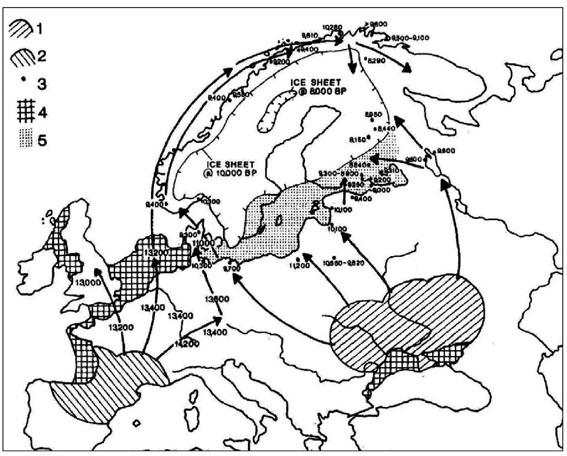
Already about 10 000 BC, there may thus have been pioneers in the neighbourhood of the North Cape, coming from at least three contemporary directions, one by way of Norway, one across Sweden and another in the Finnish northwest. Their descendants were also left on that road.
One of the salient hypotheses of the spread of Indo-European languages relates it to the slow penetration or adoption of agricultural pursuits in Europe during a period of at least 4000 years from Asia Minor to the Baltic, pioneered not by a linguist, but by a prominent archaeologist, Colin Renfrew. Other former language families were entirely superseded, except by the Basque language close to the Pyrenees and the Cantabrian mountain range of Spain, the Etruscan in Italy (extinct) and possible Baltic Sea Finnish (later to become Finnish and Estonian).
The crossing of the elements of the first agricultural pursuits from the Southern Baltic to Scandinavia occurs gradually around 3000 BC (within the Ertebølle culture). It is interesting to note the reluctant adoption of agriculture in these southern parts of Scandinavia. After an initial adaptation to agricultural pursuits there even seems to occur a reversal in certain groups to hunting and fishing, by way of the coastal seal-hunting Pitted Ware culture (Sweden, parts of Norway, and Denmark), in its lifeways comparable to what is known as the Comb-Ceramic groups of Finland and further east.
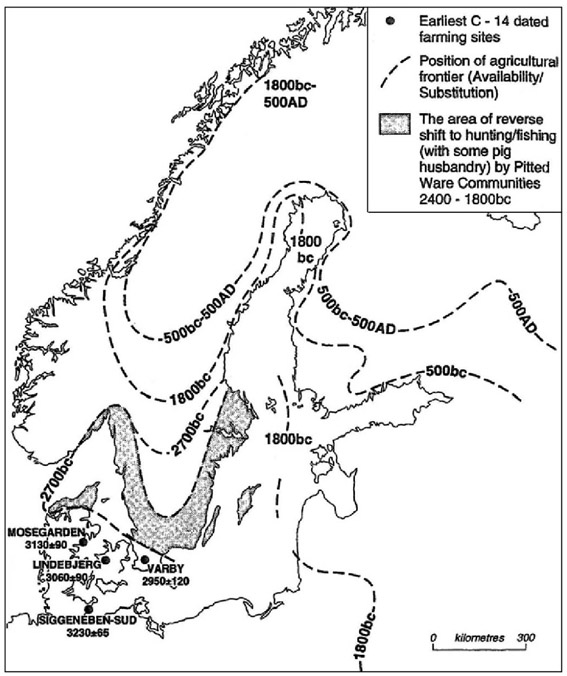
However, agriculture was not adopted in the Eastern approaches to the Baltic (Carelia etc.) until ca AD 500, perhaps indicating an original presence from the Mesolithic of a Proto-Finno-Ugrian stratum in this region. Is what we see perhaps a far-reaching continuity, in life styles as well as in linguistics?
A tendency, which may be of long standing in the Baltic Sea area, is thus the differing approaches – from reluctant acceptance to, in fact, some extent successful resistance – to basic continental impulses, in our time often called “Europeanization”. Two main factors are, as mentioned, the introduction of agriculture, which was treated in the keynote to some extent, and another, the exceedingly slow (and intermittent) introduction and spread of Catholic and Greek-Orthodox Christianity, which was not treated, just mentioned in my keynote.
This presentation exposes briefly some of the manifoldness and the versatility of the area and its human resources. This manifoldness is, I believe, a great advantage both to the interaction of the future, and to the study of history, in “a kind of northern version of the Mediterranean”. However, is the Baltic Sea not a uniquely valuable context in its own right, without reference to a much larger and traditionally more prestigious area?
Names
As we know, the maritime positioning in the Baltic differs slightly. In English, Polish, other Slavonic and Romance languages etc., we have The Baltic, Bałtyk, La (mer) Baltique – very likely the result of outsiders referring to a category of a sea “beyond the Belts” which are Store Belt and Lille Belt, channels between the Danish Islands. It was originally applied in a much more narrow sense than it is today – to a restricted area south of the Danish corridor. The modern use of concepts like Baltic, baltisch, etc., is due to a process going back to Adam of Bremen in the later part of the 11th century, and in the case of the languages of the Balts, a development in the former Russian Empire to designate its provinces south of the Gulf of Finland. This toponymic process was addressed by Josef Svennung in 1953.
To most outsiders, the Baltic Sea ends only with the Kattegat, the water area south of the justly feared point of the Skaw (Skagen) of Jutland, where the Skagerrak, named after the point, starts northward. Such classificatory divisions may have been differently applied in the past. Another dangerous point and border-line seems to have been the sandy point of Skanör south of Malmö, possibly a good reason why the Skanör promontory, former islands, was known by the Roman auctores. This spit carried the ancient Germanic name of Skaþan-auju, a warning name meaning “the island of damage”. It was of such significance that the whole of Scandinavia, originally thus Scadinavia, was named after it. The linguistic remains at the spot are still found in Skanör, Scania/ Skåne.
Other examples of names of the Baltic, some conforming to the international pattern are in Latvian Baltijas jūra, Lithuanian Baltijos jūra, but for once a direction-true Estonian Läänemeri – “the Western Sea”, then Finnish (Varsinainen) Itämeri – “the (true) Eastern Sea” (which must be due to influence from the West, most probably Sweden), Scandinavian of course Östersjön, Østersøen, (former Eystrasalt) – “the Eastern Sea”, as well as German Die Ostsee – “the Eastern Sea”. The Danish lands are still marking the pivot between the great seas up here.
There are various more regional concepts covering parts of the Baltic and the Bothnian Bay (Finnish Pohjanlahti), or parts of it in a proper manner e.g. Perämeri, Merenkurkku & Selkämeri, Ahvenanmeri – “Sea of Åland”, Saaristomeri – “Sea of Archipelagoes”, with corresponding concepts in Swedish, and the Bay of Finland, which of course is Estonian Soome laht, to Soome, Finnish Suomi, Finland (where it is Suomenlahti), and various other related names in different languages.
Each of these regions may certainly be worth a maritime archaeology or history on its own cultural merits. The conference project of maritime history called Bottnisk Contact, started by me in 1982, and mostly dealing with the Bothnian Bay, i.e. the water area north of Stockholm-Åland-Åbo (Turku), is still alive after 17 meetings with two years in-between (in 1994 we met in Tallinn).
To compare maritime positioning: in the important maritime area of the Low Countries the close varieties of seas resulted, as we know also in a Zuiderzee, a Middelzee for that route which is called Binnen de Duinen, “inside the Dunes”, and a (true) Noortzee etc. An Oostzee is of course natural, as well as a Westzee, which is in a strict sense mainly the English Channel (e.g. map of the North Sea in Van de Noort, North Sea Archaeologies, Oxford 2011, p. 5).
Nature
The influence of nature on cultural manifestations is obvious in the Baltic area. However, it is not enough to suggest that only the watersheds for rivers debouching into the Baltic Sea, an excellent hydrographic starting-point, could also be considered the relevant cultural borders of this area, but they are certainly important also in this sense.
The topography of the Baltic Sea area is a product of the last Holocene glaciations also treats paleoseismicity in Sweden, including dramatic events such as postglacial tsunamis, of which some elements may have had archaeological implications, of course very obviously including maritime environments.
In the north we find strong land uplift since the last glaciation, rocky coasts with polished rocks, boulders and pebbles, but less sand. In the south, there is land sinking found south of a border-line from the western Limfjorden area to Rügen in Germany, and mainly sedimentary coasts with sandy beaches and spurs of sandy sediments outside the estuaries of continental river systems. The distribution of a whole bunch of cultural elements conforms strikingly well to this division, hopefully without making us determinists, slaves of nature…
Basically, the Baltic is an inundated plain or valley with some deeper troughs and holes, in particular in the central part and sometimes in the Bothnian Bay. There, the land relief is low, except for a tiny area called the High Coast in Sweden, in the province of Ångermanland. Together with the opposite Low Coast of Österbotten, this coast forms a UNESCO World Heritage (largely because of the history of the discovery of the process of land upheaval and its causes). The world’s highest marine limit (Skuleberget) since the Last Ice Age of 287 m. a. s. l., is found here. Also, one of the deepest holes of the Baltic, Ulvödjupet, of about the corresponding depth, is found here.
The climate is fairly tough during winter, but even in the north the effects of high latitudes are alleviated by the eastward winds from the Gulf Stream outside Norway. An application of the climatic zones to urbanisation shows that medieval towns in the area were only founded south of the boreal and alpine zone. A high percentage of these cities, more than 80 %, were maritime in the most relevant respects.
The most important hydrological factor is the brackish water of the Baltic. It is the greatest boon to shipwreck archaeology and to the preservation of organic material. The reason is the present absence of the Teredo navalis, the ship worm, and of its cousins. However, beyond the Middle Ages we find little – no Iron Age, no Bronze Age. Is this due to influx of more salinity from the Atlantic in earlier periods, or are we looking at the wrong spots (if at all)?
The other factor is the winter ice, of which the cover varies according to the climatic fluctuations. Olaus Magnus records winter travel, even with wooden huts placed on the ice (for fishing, or as inns?), in the Danzig area AD 1539. Even in the north, however, the Baltic offers stable polynya, open channels reappearing in the same area, where not only seal hunters may have found useful passages on water. Although the winter season is difficult for other reasons on the Atlantic, sailing has normally not been consistently impeded by ice during the winter.
Some human aspects
The crossings of the Baltic Sea are mostly of a fairly limited distance. Most important cultural transmission areas are within the scope of the saltus per noctem, the night leap from the coast to coast, by way of larger island, like Bornholm and Gotland or island chains in the Sea of Åland. During the illuminated summer nights of the north, distances may be ignored even in this line of thinking.
The sedentary history along the coasts of the Baltic Sea is highly variable. In the south the landscape was presumably more or less fully cultivated in the Late Neolithic, as an outgrowth of continental conditions. From my own study area at Örnsköldsvik in Northern Ångermanland, Sweden, I could contrast these conditions with a waterfront or shore line zone (within a few kilometers inland), where sedentary agriculture was found only during the Iron Age, a coastal area zone up to 50-70 kilometers inland with medieval farms and hamlets established during the medieval period, and a vast inland zone only colonized by farmers during the 17th and 18th centuries AD. This does not exclude sporadic (but interrupted) farming in a pioneering stage ca 2000 BC, nor the continuous exploitation of coastal resources by semi-nomadic groups, presumably found seasonally also inland. Import of Southern (Danish or Scanian) flint stone is interspersed with the normal implements of local rock resources. Possible maritime implications are not necessarily uninteresting.
Common prehistories?
There are seemingly no common prehistories from the Stone Age to Late Iron Age. However, the Baltic amber, used locally even in the Mesolithic, should be considered as one of the most important trading goods in exchange for bronzes, copper and tin, for which no Baltic resources are known. Of the truly original words of the Baltic, two belong to amber: the Slavo-Baltic jantar and the Danish rav. Although found at the shores, it is doubtful whether amber had particular maritime implications southward (rather riverine ones) in the sense of transportation.
As to the striking abundance of rock art, the distribution of the carvings generally follows the coasts of Scandinavia, mostly in the west. There are rich Mesolithic and partly Neolithic occurrences. The most prolific complex in the south belongs to the Bronze Age with a definite connection to the shores and coasts. Rock paintings are an inland phenomenon, in Northern Scandinavia in Finland, and probably belong to the transition between the Neolithic and the Bronze Age. Of course, the topographic conditions of the south (as mentioned) would exclude rock panels of the Northern kind, but in Denmark there are the same kind of Bronze Age carvings on boulders. Otherwise, this type of art and its motives are almost unknown in the Baltic. Whatever the maritime implications would be for such an obvious connection to the shores as that of rock carvings and together with them the coastal burial cairns, they certainly imply a cognitive world, where both location and motives express a human relationship to the sea, or more specifically, a relationship of perceived contrasts between the sea and land.
Already in the Late Neolithic in Southern part of Baltic area, the outlines of a boat are constructed in graves (e.g. Scania, Sweden). The ship as a symbol must have had a deep funeral significance in the Bronze Age. Some of these graves are visible on the ground and develop into magnificent ship settings with large stones, some of them clearly of an unrealistic size to be based on existing vessels. This ship-setting custom reappears in earnest during the Late Iron Age. The areas in concern are concentrated to the southwest of the Baltic, but occurrences of ship settings are also found concentrated far inland, in contrast to rock carvings and burial cairns of the Bronze Age. Burials in real boats belong to the Iron Age, with a few known exceptions (even down to the Mesolithic times, and its distribution displays the extent of the Scandinavian Viking world). The whole complex of boats in burials and boat-like burial sites with related medieval texts on past Nordic notions of cosmology, was treated as a part of religious history in a less well-known work in Swedish by Åke Ohlmarks.
This obsession with boats seems to be a culture-specific trait of Scandinavia, which has no parallels elsewhere. However, even if one discards the magnificent Indo-Europeanness of the threefold (tripartite) structures in society and pantheon (théologies tripartites) of Georges Dumézil, it is hard not to get fascinated by the Indo-European perspectives offered by the archaeologist Anders Kaliff. There, the cosmology of the primeval giant being cut up into pieces representing the principal components of the world, find striking resemblances (identical in fact) between Scandinavian and Indo-Iranian sources. This giant is in both cases called “Twin” (Ymir, Yima). This myth is applied to archaeological material by Kaliff. However, do we know of e.g. similar burial and re cults on altars, hearths or platform constructions interpreted as such outside the present Hindu and the Scandinavian Bronze Age? We ought to find them at the Southern Baltic as well… However, no particular maritime phase can be found of this ideology.
Seal hunting is still of great interest along the coasts in the Late Bronze Age, not only in the western parts of the Baltic. An interesting case is the occurrence of sites of blubber extraction (some 300) on the island of Kökar in the Åland islands. It was formerly thought that the pottery found there was of Lusatian type, originated in present-day Poland. Today it is rather believed that this pottery type may have spread according to the process of normal cultural transmission, successively from parts of Denmark northward through east Sweden to Finland. Whether its occurrences in Asva type (fort-like) settlements in Estonia are implicated in this direction of the “ ow”, is unclear. They could in fact be due to direct contacts to the core area of the Lusatian culture in Poland, since they do not seem to occur in the area in-between, in Latvia and Lithuania according to Uwe Sperling. Whether this means maritime connections apart from some short passages, cannot be ascertained.
Romantic ideas of a “first Swedish Viking Age” in the Late Bronze Age once compelled the Swedish archaeologist Birger Nerman to such an interpretation for the similarities between the bronze celts (in “local Swedish parlance” mälardalsyxor) of central Sweden and those of inland Russia (northern Volga zone). These parallels have found other interpretative frames today. Moulds have only been found in Russia, and following the import/ export or expansion line of thought of Nerman, it would perhaps be more relevant to apply them the other way around – Russian Late Bronze Age “colonialism” in Sweden?
Interaction and warfare
A few remarkable finds of isolated instances of eastern objects from the Mid-Iron Age have been found on the western shores of the Baltic. One is definitely of Roman Iron Age and Estonian origin and found far from it, at Storkåge in Swedish Västerbotten. They may serve as examples of such finds throughout the past. Their maritime meaning is nebulous, but a sailing ship has in fact been carved (outlined) on the object of the most distant origin, the Finna brooch of Ångermanland, also found in Sweden, obviously of the tradition of the Oka/ Kama river area of north central Russia and presumably made a few centuries later (late Migration or Vendel/ Merovingian period).
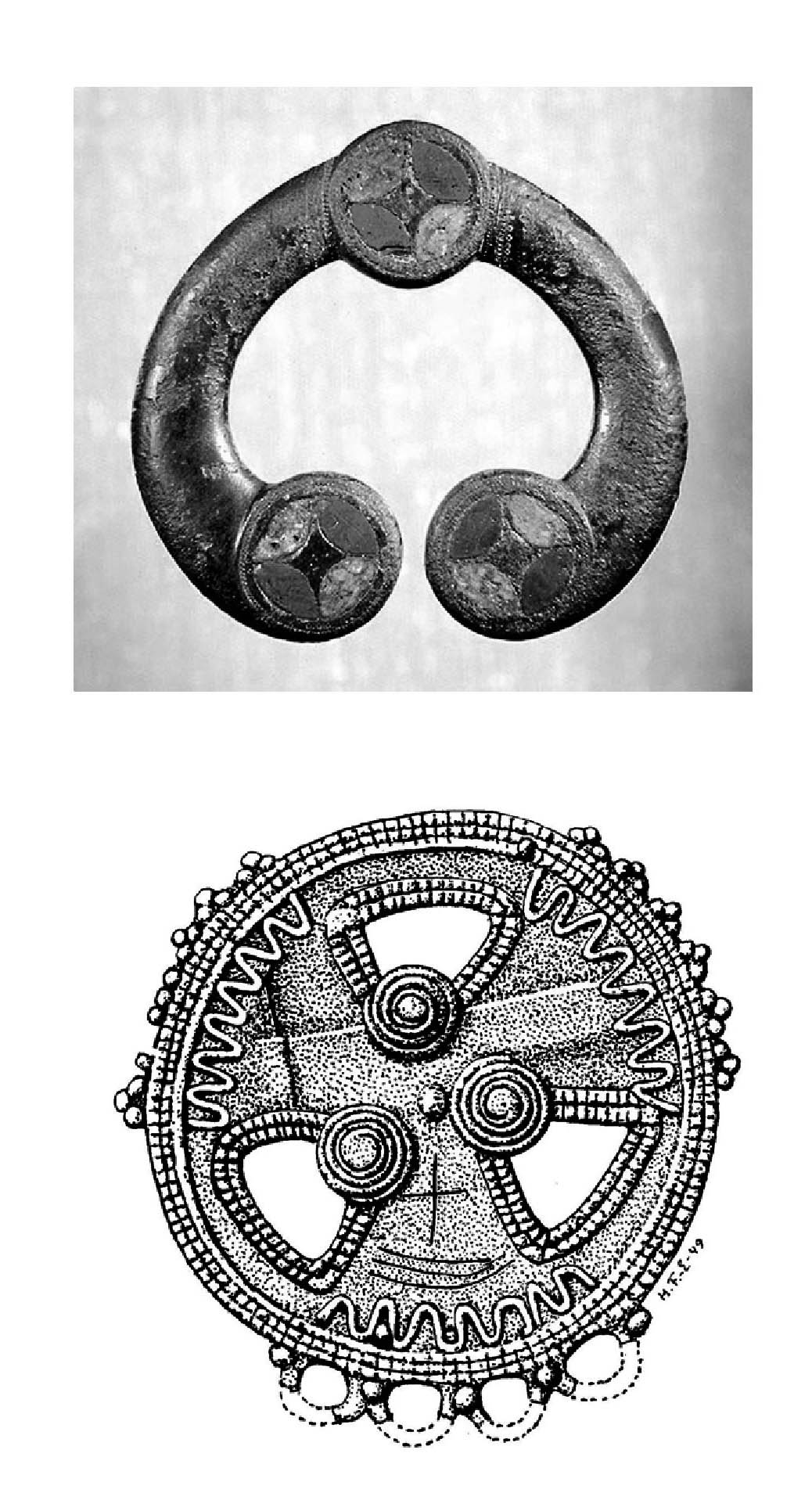
There may have been many examples of ethnic interaction and meeting points for different groups in prehistory, but we have only fragments to refer to, and only in the literate age. At the root of Jutland where during the Viking Age Saxons, Frisians, Danes and Slavonic tribes met according to the present place-name material (e.g. Crumlin-Pedersen 1997, map p. 33). A somewhat similar situation is indicated by various medieval immigration processes in the south, some initiated by the political situation. One case is the occurrence of Slavonic place-names on the Danish island of Falster. We also know of Slavonic immigration on Bornholm. The unique vessel-handling site of Maglebrænde on Falster demonstrates details of different ship types and models with various backgrounds. This many-sided interaction could obviously influence shipbuilding. Whereas, the so-called Nordic shipbuilding techniques are fairly uniform in clinker style with iron nails, vessels built in the West-Slavonic part of the Baltic display various other characteristics (lower and flatter hulk shape, tree-nailed strakes), which may amount to an independent form. At the curious shipbuilding site of Puck in the Bay of Gdansk, we meet a mixture of both traditions.
In the social sphere, we discern traces of earlier endemic warfare, but less obviously influencing settlement. The first great weapon sacrifice from ca 300 BC at Hjortspring on the island Als in southernmost Denmark includes a unique boat, a large warrior canoe of 20 ms, made of lime-tree. The kind of elastic boatbuilding displayed by this vessel was thought to be unique until a related find of a thwart was discovered in 1991 in Hampnäs/ Själevad in Swedish Ångermanland, much further north. It was made of pine, and presumably local. It seems that this kind of boats were spread with the usual rapidity of “military” technology. However, a very basic form of these boats seem to conform well with boats depicted in rock art already in the Early Bronze Age (ca 1800 BC).
From the Late Roman Iron Age (from ca 200-400 AD) and forward, there are already signs that settlements are displaced further inland, which may have to do with the threat from marauders on larger clinker-built vessel of the Nydam type ca 300 AD. It was found together with another large weapon find in Denmark (with sacrifices in several stages at least from 250-500 AD). This idea was put forward by Erik Nylén on the evidence of Gotland, and the process of withdrawal from the coasts has probably been confirmed in certain areas of Denmark. There are certain indications in the Nydam finds and others during the same period of raids of Eastern origin, including Gotland.
The kind of warfare implied is that of chiefdoms, more or less equal in status which fight each other with plunder for redistribution in mind, and maybe also for enforced tributes. The relationship between many Iron Age societies, the outward appearance of which looks somewhat like this, is characterized by the British archaeologist Colin Renfrew as Peer Polity Interaction (PPI).
An example of this would be the background of the unique find of a mass grave in two boats at Salme in Saaremaa, Estonia. It dates to a period, 8th century AD, where semi-historical sources (Ynglingatal about the Uppsala dynasty, etc) refer to Swedish (Mälaren area: chiefdom or kingdom) maritime raids to collect tribute precisely in this area. A more “colonialist” attitude permeates the outdated work of Birger Nerman on contacts during this period, but it is certainly still of some value.
For almost the entire ship history of the medieval period, we possess an unparalleled work in Ellmers in 1972, but of course not exclusively on the Baltic. However, it would be a valuable contribution to the Stand der Forschung to bring that part up to date. A valuable overview of the early Middle Ages in the area is the tiny booklet with a lot of distribution maps by Müller-Wille from 1989.
Common histories?
Are there common histories? A very short survey was made in the keynote by way of maps of later periods, Middle Age to Early Modern Times.
During this time-span, we witness the successive replacement of the Scandinavian dominance in shipping with a raiding kind of type PPE by the forceful conversion and land-taking of the various Crusades and finally the trading near-to-monopoly of the German/ Wendic Hansa. Low German would for centuries have been close to a lingua franca in maritime and urban contexts around the entire Baltic, the only one that we know of so far.
Around 1300, we find the first sequence of points during a journey along the Swedish east coast by way of Finland to Reval/ Tallinn copied into the tax register (Jordebog) of King Valdemar Sejr of Denmark (1202-1241). As indicated by me, its structure may reveal the existence of local pilots. We have a few references on such specialists in the Chronicle of Henry of Livonia.
For the extent and dispersal of maritime trade in heavy goods we have, for instance, the Gotlandic baptismal funts of sandstone from the Klinte area (and to some extent other sculptures), which were exported to a large area mainly in the Baltic and to some extent outside of it, from isolated occurrences at Bruges in Belgium to Umeå in Västerbotten in the Swedish north as the extremes. Dendrology applied on shipwrecks outside the Baltic seem to point out what has already been indicated in few instances of textual evidence in e.g. England, that fairly large quantities of south Baltic oak were exported for such purposes and certainly others as well.
Textual evidence, unfortunately fragmentary, seem to reveal certain interesting facts on sailing in the Baltic. A note on the mappamundi map of Fra Mauro in Venice from AD 1458 tells us that maps and compass are not used in navigation in the Baltic, only the lead. However, during a slightly later period, ca 1500 AD, the sailing directory of Das Seebuch (Dutch/Low German) documents the existence of routes by way of large islands like Gotland in a variable pattern across the Baltic, however, clearly depending on the use of the compass.
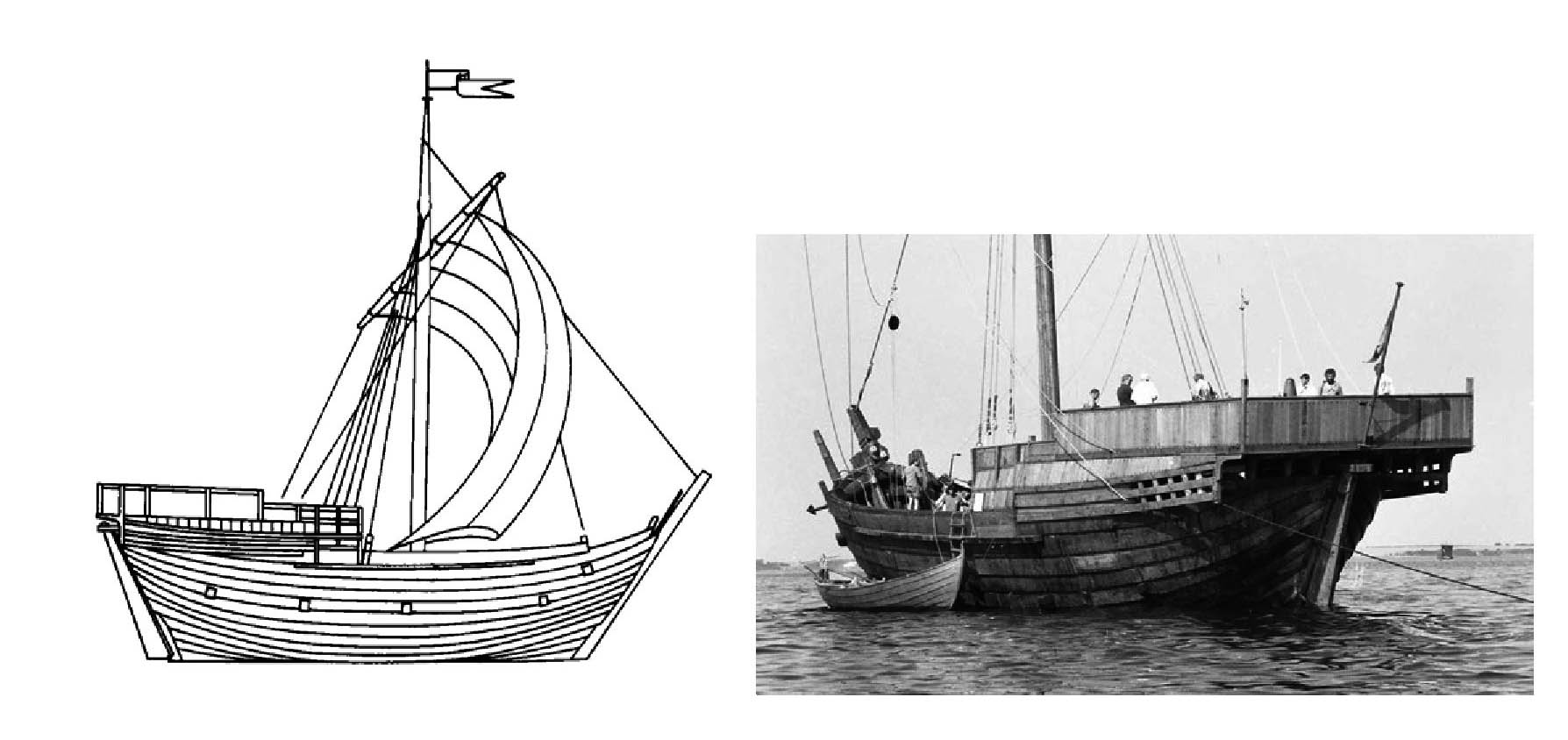
The dominant vessel type would be the cog/ die Kogge as the principal implement of the Hansa, often modelled in archaeological literature on that of the Bremen find (ca 1400 AD). The lure of the cog concept led recently to a particular designation “Baltic (type of) cog,” pinpointing above all two wreck finds in northern Germany: Gellen and Poel. The local pine curves indicated a dating at the end of the 14th century. However, recent research has shown that these ships belong to two quite different contexts. They were finally dated to the late 18th century, when Pomerania was still Swedish, and around 1840 both on South Finnish pine curves. The old-fashioned and partly cog-like features of these wrecks rather express the longue durée traditions of small-scale shipyards and peasant shipping. This fact would also point to a social interpretation of such tenacious technologies.
Parallel to the cog, a large variety of ship types must have plied the Baltic in this kind of small-scale traffic that should interest us in particular to redress the balance of former accounts. A fairly large shipwreck of another type, is that of the mid-16th century “Ringaren” (working name) from the eastern archipelago of Sweden (Tjust), the cargo of which seems to confirm trading contacts above all to the southern Baltic (Danzig area). Nowadays, there are several other finds of the whole period. A large material of shipwrecks has been discovered with invaluable new knowledge on ship building and cargoes. It has, as indicated before, become so large, that we are in need of a synthesis based on contextual variety.
If we want an epitome of the Late Middle Ages in the Baltic area we should turn to the illustrated ethnographic “map” of Olaus Magnus, the Carta marina (actually not his own name of it) of AD 1539. Of course, this is a patriotic expression made in Italy of a nostalgic Swedish exile, but his knowledge of the southern Baltic – he lived for ten years in Danzig (Gdansk) as a member of the Swedish Catholic expatriates - is unusually many-sided. This “map” should always be studied in its original size, which is quite large -to understand the details- not as an example of cartographic accuracy, which it is not.
If we also want an epitome of cultural contacts and eminent monuments of local identity, which illustrates a large bunch of Baltic prehistory and of its Middle Ages, we should of course look at Gotland. This large island in the middle of the main part of the Baltic has a unique mixture of cultural traits, doubly fascinating due to their preservation.
Ancient monuments on the coast
As to an example of coastal monuments of Baltic significance we could choose the coastal stone mazes. Their inception seems to be around 1300, but they were still laid out in the 19th century. Perhaps 600 of them are still extant, but clearly culture-specific in the Baltic, conforming to the medieval spread of Swedish-speaking fishermen-farmers in Sweden, Finland and Estonia. Otherwise, we find small clusters in northernmost Norway, obviously belonging to the Saami culture, and in the White Sea area, esp. in the Solovetsky Islands.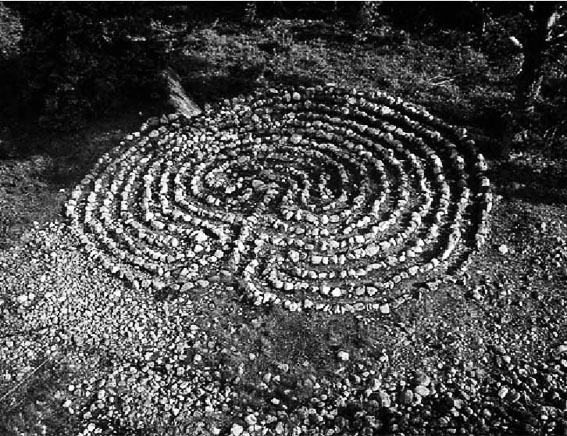
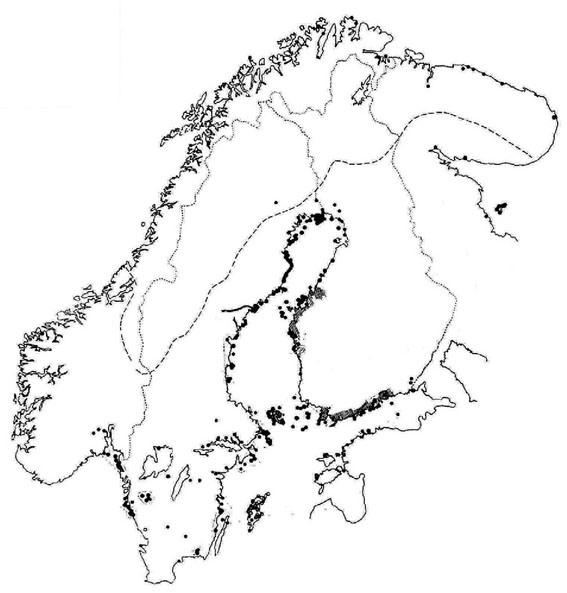 I believe that one of the motives behind stone mazes was already reflected by their other contexts: painted and carved in churches, laid-out on churchyards, and other places where burials were (or were believed) to be found (in the Visby case, close to the late medieval gallows). This motive would accordingly be the warding o of ghosts. Stone mazes are often found on islands, where unknown drowned people were buried permanently for the same reasons: an almost universal notion was up to our own times that ghosts could not pass water. Otherwise, the mazes were also used as instruments of universal fishing magic.
In fact, I have also compared the mazes in their possibly original function to the chapels placed at small harbour churchyards in the skerries, a typical occurrence in the maritime culture of Scandinavia and Finland.
Of course, we should also mention sea marks of which a few might be dated to the Middle Ages. However, most of these could be dated to the latest part, ca AD 1450-1550 and forward. In maritime matters, this era is marked by new economic and political processes, new ship types, and, concomitantly, partly different sailing routes necessitating new marks. According to my deliberations the inspiration (and sometimes the direct initiative) comes from the Low Countries and North Germany (the Hansa league). A number of important innovations in ship construction and sailing at this time and somewhat later: carvel-build, sprit-sail, stay foresail, bowsprit, rounded stem and stern (sometimes with comparatively at bottoms) the transom stern, keel with a rabbet - were also derived from Holland. Strikingly rapidly, these innovations filtered down to vernacular smaller vessels, including oar tholes with pins instead of the traditional hå. However, they were originally restricted to large-scale shipping and certainly not accepted everywhere, especially not in the north. Gradually, however, they became dominant. Social factors should never be neglected in the study of such changes.
The East
The port of Tallinn is situated between the West and the East, as is revealed poetically by the fact that its eponymous ancestors, Linda and Kalev reappear in the dominant place names for it in Scandinavia and Russia, Lindanäs and Kolyvanj. It could as well be a beautiful illustration to the general situation of the Baltic throughout history.
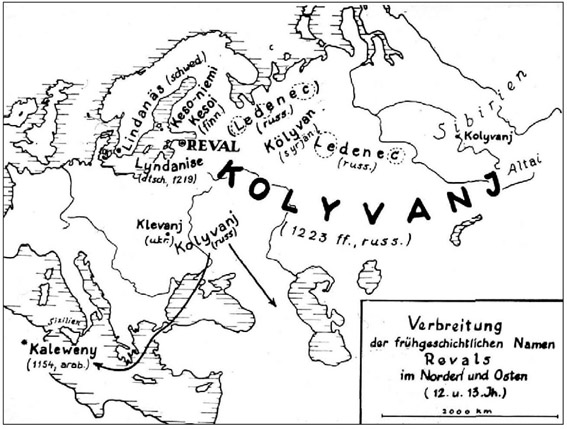
Hitherto, we have been talking mostly of the West. It is important to connect the Baltic perspective to the immense inland area of the east, to the Russian traditions of boat material and its rivers. In the very innermost north of the Baltic, we find traces of Carelian penetration of at least 13th century date along the inland river routes of present-day Finland (e.g. a trading post at Hietaniemi at the Torne river, Norrbotten Sweden). The northern part of the Baltic sea area together with North Russia is the last home of the traditions of the sewn wooden plank boats in Europe, apparently dissolving into Saami, Finnish and Estonian-Karelian-Russian subtraditions.
All through this area we meet the clearest proofs of portages between rivers and along rapids, already documented for the Rus Vikings by the Byzantine emperor Constantinos VII Porphyrogennetos (AD 905-959) between AD 948-952 along the Dnepr in present-day Ukraine. Traditions of expanded log boats and of various other techniques of making vessels in the East remain to be studied. Also the phenomenon of “intermittent travelling” in inland areas (with the vessel carried or dragged on the ground or in the water) is to be taken account of in other Baltic (and North Sea) contexts.
Summary
There is little but the spread of vessel technologies to illuminate actual contacts or interaction of a definitely maritime character, but dispersed glimpses of interaction and/or transmission between differing cultures do appear.
As to the traditional transport zones of the Baltic area I have suggested a generalized picture for the Iron Age and early medieval times.
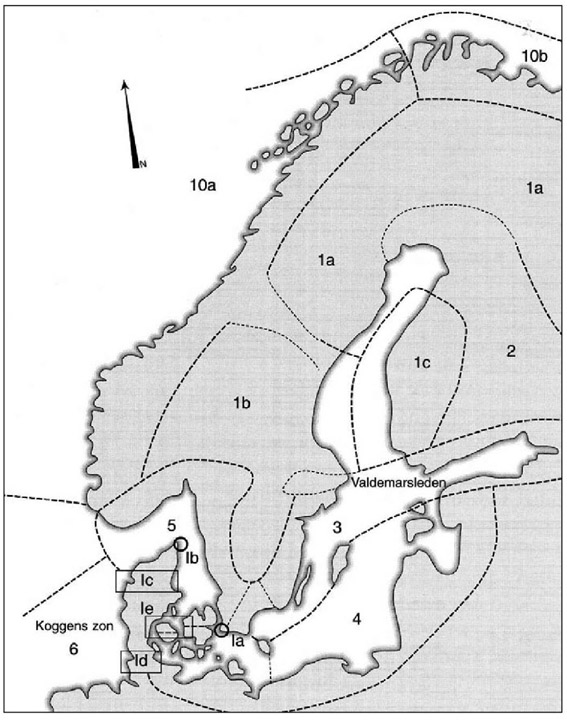
As to the cultural elements that could be deduced for the purpose of an overview of the past, I suggest very much a variety of different, more or less “culture-specific” divisions, but certainly in many cases overlapping:
Those which are common to the south and to the west.
Those which are common to the north.
Those which are common to the east.
That leaves a tiny common heritage, which is common to all of the Baltic, but these are at the same time mostly common to either the Scando-Baltic area, to the North Sea area, or to the whole of Europe.
This is the nature of an “international”, “interregional”, maritime culture, later sometimes creating new identities of its own. It is first apparent during the Viking Age and the Middle Ages c. 750-1500, and fully developed only during the following centuries.
Students of the Baltic need not feel inferior in maritime matters to the Mediterranean. Maritime ethnography was practically born here, its study of small-scale everyday maritime cultures or the diversities of vernacular ship and boat types is, I think, superior to its more prestigious rival. Probably this would go for their respective records of older maritime oral tradition as well. And the unique and enormous potential in the Baltic of the absence of the Teredo (at least for most periods) is beginning to show in earnest. However, so far not beyond the Middle Ages...
The very diversity of the Baltic Sea area through the ages is its greatest asset, posing unique questions of changes, of contact and lack of contact, maritime or not maritime in character.
© Christer Westerdahl, 2021
Lithuanian literature in the 20th century was marked by plateaux and sudden drops. After the country declared its independence in 1918, its literature expanded and came to life again. The possibilities to get better acquainted with European culture and literature, the abundance of literary journals, and the changes in social life were all conducive to its flowering. Alongside poetry, the genre that usually prevails in societies which have no possibilities for free dissemination, the novel, capable of reflecting existential and social processes, thrived. War and occupation, however, interrupted this process.
During the Second World War, about 70 per cent of Lithuanian writers fled to the West. Most of them later settled in the USA. Therefore, the most significant literary discoveries bearing signs of the trauma were made there, on the other side of the Atlantic. The creative work of emigres was banned in Lithuania; however, it nonetheless reached readers through various illegal channels. Today we may say with confidence that emigre poets such as Antanas Mackus, Alfonsas Nyka-Niliūnas and Henrikas Radauskas are writers of a European standard.
However, writers who found themselves abroad felt alien, they did not try, or perhaps were unable, to integrate into the foreign culture. Therefore, today, these authors are almost unknown to foreign readers, although their influence on Lithuanian literature is profound. After the reestablishment of independence, many of these authors were published in Lithuania again, their work received a lot of attention, and it eventually allowed Lithuanian literature to form a more integral whole.
***
Lithuania's return to Europe, which has been going on for over ten years now [2004], reached its final stage this year. The country became a member of the European Union and Nato. For 50 years it was part of the invisible side of Europe, but cherished European values even under the difficult conditions of oppression, behind the Iron Curtain. Thus, the euphoria with which Lithuanians joined the EU is understandable. It was a long-awaited return, after almost all hope had been lost.
But today the time for euphoria is over, and the country is starting a new life which will pose its own questions and present new problems. Next to the hope of creating properly functioning democratic mechanisms and the opportunity to be better off, we will constantly have to tackle the issue of our identity. It has not so far been crossed off the European agenda. In the near future, we will have to formulate it in a slightly different way. Will we remain on the periphery of Europe, from a geographical and a cultural point of view? Will the attempts to cr.eate a "regional Europe", in which the "centre/periphery" division is alien, be successful? Will Lithuania become a fully-fledged region?
This will, to a large part, depend not only on decisions made in Brussels. A nation's identity is not something fixed. It is in a continuous process of creation. Thus, beyond any doubt, we will have what we create under new political and economic conditions, in an atmosphere of openness and creative dialogue.
This year is not only significant because we have joined the European community. To commemorate the centenary of the recovery of our language, the year 2004 was declared The Year of the Language. For four decades the Tsarist authorities banned writing in Lithuanian. Despite the ban, or maybe because of it, Lithuanians preserved the language as an essential element of their identity. Today special attention is being paid to the native language; thus it is not threatened with the same fate that befell Irish.
These two events, accession to the European Union and the centenary of the restoration of the language, combine the future and the past. They are significant to what matters to us today, which also includes literature. Good literature always thrives between the future and the past; therefore, it also plays an important role in creating a nation's identity. Today, Lithuanian literature tries to avoid such trite phrases, but it does not distance itself from the vital issues. Sometimes it approaches those issues with an old-fashioned seriousness; sometimes with irony; sometimes simply with wisdom.
A BRIEF SURVEY WITH A FOCUS ON THE INLAND ENVIRONMENTS, IN PARTICULAR THOSE OF THE FOREST SAMI
What is a Sami boat? Built and used, bought and used by a Sami language-speaking person? Any effort to discern ethnicity or identity in material culture is fraught with serious problems. But do we have a really good reason for giving it up entirely?
 The interest of the Sami peoples for boats and transport by boat in the sea and in inland waters has often been underestimated. But in Lapponia, the famous work of Johannes Schefferus (Jean Scheffer) from 1673 it is emphasized that next to hunting is boatbuilding the most important “art” that is exercised by Sami males. Boats and boat handling has anyway to be studied “holistically” as one of several essential and interacting elements in Sami communities. As to myself I have treated parts of the South Sami area in this perspective. The industries of the Sami appear to be much more varied and manifold than what is normally known, even in ancient times. The specialized and intensive Sami reindeer herding is a stage introduced comparatively late in some Sami groups. There is every reason to demonstrate the potential for boatbuilding offered by the Sami area of Northern Fennoscandia and adjacent regions with similar natural conditions. Solutions to the problems of transport in this largely roadless terrain are of general cultural interest, including not only the construction of the boats themselves but also their extensive use in portages. Such procedures clearly set limits for size. A typical Sami inland boat for river transport was illustrated by a well-known drawing with exceptionally relevant details by Linnæus in 1732 (figs 1-2 ).
 Most sources on Sami boats- historical as well as archaeological- appear when reindeer herding has been accepted as the single most important economy. Ancient Sami reindeer herding culture displays an impressive adaptation to nature and the requirements of work, settlement and transport. It is the most ecologically adapted among the cultures of historical times in Fennoscandia. It has left few traces of its effects on nature and topography, all exceedingly discrete. The constant transhumance movements during an annual cycle meant that definite demands were established on lightness and functional design of everyday objects. This is obvious also in that part of material culture which is treated here. Sami boat culture along the Norrland rivers of Sweden are characterized aptly by Arvid Ehrenmalm in 1743 som “et sätt som liknar them uti theras öfriga lefnadsart”, a way that resembles them in their other ways of life, which is the title of my principal work on this subject.
It is difficult even today simplistically to connect boat building traditions to what we perceive as ethnical groups. However, there are obvious technical traits which makes it easier to assume Sami origin and Sami life behind precisely boat finds.
Sewing technique.
Later historical and largely contemporary sources testify that the boats used by the Sami are sewn together. By this term is understood that the planks are fastened to each other with stitches of wooden fibres in the very overlap in clinker fashion (lapstrake). Normally this would go as well for the keel and the bottom plank. On the other hand, this does not have to mean that other fastening points, such as the connections between the planks and the ribs (frames) are sewn or lashed together. Of course, lashing in this part is standard procedure in Iron Age and early medieval boats in the whole of Fennoscandia. In some early boats that appear to conform to Sami tradition lashing has in fact been replaced by treenails (trunnels) piercing planks and ribs. It may also be questionable whether the hood ends of the planking always were sewn to the stems. This last comment would perhaps only be applicable in larger boats of greater timber scantlings. If the wood in the current section was thin and potentially brittle sewing would be preferred, in fact even in some small iron-nailed boats, such as that found as late as in the 1930's.
In some cases is also retold how the Sami made their boats in this technique and how they used them. Thus so far it is reasonable that Sami boats have been characterized by their sewing techniques. During the 12th century, the year given is the winter of AD 1138, two large boats were built by Samis (“Finns”) for Sigurd Slembadiækn, a Norwegian king, according to the Heimskringla by Snorri Sturluson. Their peculiar technique and their excellent rowing speed were good reasons for poets to compose scaldic verse in their honour.
From the 16th century onward the technical peculiarity of sewing is pointed out as most remarkable in a Nordic context. This technique now appears to have been left behind in boat-building among other groups of maritime people. There are many later testimonies. Statements exist from the last century of survival of this trait. In 1939 Ossian Olofsson, a Swedish expert on inland fishing, reports on a boat that he had found that was sewn in its stem and stern but otherwise iron-nailed, in Jiltjer (Jiltjaur), Sorsele, Västerbottens län, Sweden.
But Samis were not alone in using the type of fastening technique in historical times. What we would today describe as ethnic Finns, Carelians, Russians and Estonians appear to do this as well, and in fact fairly recently. However, it seems that it is possible, at least in Finland, to discern three different sewing techniques and that it may even be possible to connect them to some of these groups (here fig 3). The Sami type of sewing appears to be that of the continuously running seam. For various reasons it may be possible, though, that certain Sami groups may have used boats made in other techniques, perhaps all the time, including those of some majority groups of the South. Thus, it could not be stated with any security that sewn boats is an ethnic element uniting all Samis. Where ethnic Samis have built boats for other groups they may have followed the wishes of their customers, which may not have included sewing between the planks. In North Norway the sewing of at least some Samis in boats ordered by others is still mentioned up to about 1700. The Dutch anthropologist A. J. Prins has pointed out that subarctic sewing techniques in wood is not an unprogressive element. Indeed it seems to be changing even in its later times. They were, according to my wording, a functional, but also adaptive, survivals.
Thus it can be surmised in all probability that finds of sewn boats made within the Sami settlement area in historical times are of Sami origin and that Samis have used them. It is obvious, however, that similar fastening techniques in boats were used by all Scandinavians at least before the middle Iron Age. The first finds in iron-nailed clinker (lapstrake) are dated to the fourth century AD. The large Nydam galley-like ship (23 ms) is dendro-dated to c. AD 310. The youngest boats in sewing technique in South Norway have been dated by radiocarbon to about the same period, the finds of Valderøy to AD 245 (calibrated to a wider span AD 240-420) and Halsnøy to AD 335 (ditto AD 390-535). Moreover, the latter is the first Scandinavian rowing boat although there are earlier finds, possibly from the first centuries AD, of single rowlocks. Before this period all boats appear to have been paddled. Sewing or lashing techniques may with some confidence be regarded as a genetically early element in wooden planked boats in a more or less global perspective of culture.
Consequently it may be more doubtful to apply the geographical criterion for Sami boats earlier than the 16th century in South Scandinavia. Of course, boats are by nature singularly mobile artefacts, and a possibility remains that early coastal Samis, or their customers, could have left their boats to rot even here, especially along the long Norwegian coastlines.
Thus, by sewing is in this context meant planking connected to each other by was of root fibre cords, mostly of spruce or pine produced in a particular spinning craft in the forested countryside, or by twisted reindeer sinews, in the last stage by hemp ropes or cords, possibly cobbler's thread (with pitch). It has been suggested that in order to give a more unambiguous illustration of how the boats were made the technique used would rather be called lashing than sewing. By sewing is normally meant a technique where the hole in the material is made at the same time that the thread is driven through by way of a needle. In lashing you would bore a hole in advance. This is undoubtedly how the Sami (and other) sewn boats were fastened. At the same time it would be possible to avoid an unfortunate thought association. Another type of sewn boats are skin or hide boats, perhaps better known as sewn in popular imagination than the wooden boats. Skin boats are indeed sewn in the normal way. By way of an identical terminology for both boat “types” it might be inferred automatically that sewing in wooden boats quite self-evidently has its origin in the sewing in leather or hides. This is highly doubtful. There is an apparently original and quite specific technique of sewing in wood, of which some varieties can still be studied in small containers in the North. The varieties used have parallels, although some rather distant, in larger artefacts, especially boats. Apart from this, the sewn skin boats are constructed in quite another fashion than wooden planked boats. Skin boats are built with their entire wooden skeleton (laths) first and moreover, they are built upside-down. The original method for making any kind of wooden boat is to build the planking up from the keel right side up. Only after this procedure is finished (at least partly, in the bottom) is inserted into this shell the skeleton, the frames and other athwartships pieces. This would be referred to as respectively the skeleton-first (frame-first) and the shell-first (hull-first) methods.
However, there are other, terminological aspects of great importance. Firstly, the term “sewing” for wooden boats has now been accepted more or less universally. But more significantly in a regional perspective, a number of ancient terms of planks and their contact surfaces in several languages, including the Nordic, such as the Nord. sud, clearly indicate that the verb 'to sew', Nordic syja, has been used for the boats. This includes Latin and Greek terms as well. Thus the primacy goes to the verb “sew” and the noun “sewing.” But in this text it might be possible to use the terms sewing and lashing as synonyms, only due to the need for variation, although the context may be important. But the tree fibre fastenings between planking and ribs will be referred to as “lashings,” and in this case consistently.
Many terms of boats in Sami are of Nordic (North-Germanic) origin. This has often been interpreted as if Sami also had taken over their boat technique and its terminology from the Norse. This conclusion may be doubtful or at least only a partial explanation. Contacts and interaction may have been established in many ways. As we have seen, Samis in North Norway are known to have built boats for the Norse at least since the 12th century and most probably much earlier. This had partly a topographical cause. Most Iron Age fishermen-farmers entering the area from the south settled in the treeless archipelagoes at the outer rim of the lands. The Samis appear to have been already settled in the inner parts of the fiords where the forests were dense. The Sea Samis or their Proto-Sami precursors (whatever we would call them) can be considered the earliest known established expertise of both the area and its distinctive features. Thereby they had acquired both maritime experience and knowledge of boat building adapted to the area. The Nordic terminology in Sami languages and dialects could be dated to this period and also to this area. It may perhaps be explained partly as an adaptation to those kinds of boats which were ordered by the Norse. But this is problematic. A process of acculturation never goes just one way. It consists of several stages. Terminologies on boats, indigenuous Sami and external, were most probably parallel from the beginning. But why where only the imports made permanent? In his review of my book [from 1987] Björn Varenius (1989) gives some possible explanations: the social status of the Sami may have been diminished even in their own eyes concomitant to them becoming a minority in their own lands and their own terminology may therefore have been purged. Moreover, their own boats were too small to acquire status by themselves, and the sewing techniques may have been considered outdated, unsecure and brittle. Some of these arguments are mentioned by Norse and other travellers among the Sami, but only in later times, in marked contrast to the reaction quoted on those elegant galleys allegedly built in AD 1138. But the North Germanic loan words in Sami do indeed occur in many other fields, especially in agrarian matters, where the Southerners certainly were the givers.

In other places and times where sewing of wooden boats seem to be an original technique, like Bronze Age and Iron Age of Western and Southern Europe, the thread was led mostly through one plank at a time, then across a rounded edge and then through the second plank. In the Sami area most of the sewing appears to have been made through both planks at once. This might have occurred as an emulation of nailing, either by wooden pegs or iron nails. In this connection the single Finnish nide (Swed. näst) stitch could be considered the only one which cannot be suspected of being of Norse origin.
Anyway, to some extent these differences could perhaps be explained by a variation between clinker, lapstrake, method or in carvel fashion, edge-to-edge or intermediate stages between them. But this is pure guesswork. The comment above has an unfortunate strain of genetic diffusionism without taking account of difficult questions on e.g. acculturation and interaction. Even if the observation is superficially correct it should arouse scepticism.
Moreover, it is possible to discuss whether treenails as fastenings between planks is a direct descendant of the sewing technique or a separate side-line. Treenails have, even in later times been used in sewn boats to close, lock or seal the stitsches, in particular in a running seam as the typical Sami variety. On the photo of Gustaf Hallströms from Nuotjaur on the Kola peninsula in 1909 the Sami boatbuilder is shown tightening the seam at a stitch by way of a T-formed (hammer-like) implement of wood and at once hammering in a treenail (see figs 4-5).
This is also a doubtful idea. It is only in some rather well-defined times and areas where we can state that treenailing is the dominant trend in the history of boat-building. The only examples of the North is the West Slavonic area during the Viking Age and the High Middle Ages (European style). Otherwise the fully blown treenailing tradition is known from Åland in the Baltic and on both sides of the Skagerrak (including lake Vänern) but only in historical times. Certainly, boats fastened by treenails may have been used up north but they must in this case be so distant in time that no genuine tradition about them would reasonably have survived.
Prehistoric boatbuilding equipment?
Above has been mentioned the T-formed tightening device in Hallström's photo. This tightening device has god counterparts in the sewing of boats, in particular in the Pacific. It is an integral part of sewn boatbuilding in wood. T-formed Neolithic red slate implements (fig 4), of clearly combined functions to a certain extent, are mostly found in coastal seal-hunting settlements in Ångermanland in North Sweden of c. 3000 BC, but spread inland as well, have been compared by me to this recent mallet (or hammer-)-like tightening device of wood for sewn planked boats in the same area (fig 5). This later implement was used in boat building by Sami boatbuilders who are among the latest users of such boats in Europe. This comparison appears problematic, not least owing to the awesome time gap of 4000 years. But a tightening device is, as mentioned, imperative in lashing or sewing in wood. A possible example could have been an implement found at the North Ferriby site with its four boat fragments of c.1400 BC at the Humber estuary in England.
The problem of the time-lag is still apparent in the following. But the T-form of the Neolithic slate implements seductively connects them also with recent shaman drum accessories of antler. Interestingly, the material properties of slate have been deemed almost identical to those of antler (and to some extent bone) by Nordic archaeologists.
There are two drum implements with different functions. The “hammer,” a reindeer antler fork of the drum was used for the séance of the shaman (noaite, Swed. nåjd) and the smaller, slightly different “pointer” served divinatory purposes by its ultimate position on the drum skin. The shaman's drum (Saam. /south/ gievre or /north/ guobde) was metaphorically identified as one of his technical “helpers” or “vehicles.” In fact it was explicitly his boat, during journeys between the world elements -water, air, earth- in his ecstatically engineered soul absence. Among the Evenks of Siberia (the shaman was) “floating down the shamanistic river into the lower world- the khergu. His drum served him in this case as a boat, and his shaman 's drumstick as a paddle” (my italics in the last sentence). And a further argument: “Calling a drum a boat is also more than an expression of figurative language. Mythical images or metaphoric expressions are often understood as a real manifestation of the signified. The drum-boat, for example, can be visualised and sensed as a real object in visions and shaman songs.”
 The time-lag between these items may be cut down considerably, perhaps to 2000 years, but still an overawing distance, due to rich finds, including such implements, in a Proto-Sami settlement in Kjelmøy, in the Varanger area of northernmost Norway from c. 800 BC and onward. It has also been found in a grave a little further south, apparently female, from the first centuries AD. The same Sami term for the drum hammer, translated as “reindeer antler hammer,” is in fact used in recent times for the mallet-like implement for tightening lashings, although it is made of wood. There is for this reason a cognitive connection between the tightening of boats and forms for ecstatic divination. It could have meant a parallel transformation and transmission of all three forms as metaphors and symbols. This also has bearing on the materials used.
The shaman is not a master because he is a boatbuilder but precisely because he is a shaman. But a possible status of a boat-builder as well as a shaman as a metaphorical “bridge-builder” (the term of the Roman priest, Lat. pontifex means “bridge-builder”) across waters (and other elements) could have affected society as a whole. But the boat-builder's status is certainly variable in different societies and contexts. To some extent particular social groups, maritime or not, may have been specialized as boat-builders and their status may so, accordingly, depend entirely on their group status. Samis were indeed boat-builders for the Norse in historical times, but generally speaking, their status among the recent Norse appears to have been low. But there may have been quite another story in the past. This is definitely the case in AD 1138. It does appear so also in the fairly high status boat grave in Norse tradition of an apparently Sami elderly male in Lekanger, North Norway.

Starting in a modern research tradition where ethnicity is a highly situational process this hypothesis on a tiny implement would be less interesting to a discussion on Proto-Sami identity than just to boatbuilding tradition. But personally I would rather want point to la longue durée in shamanistic tradition and mythology all over the Arctic and Subarctic area.
The finds of sewn boats.
Before giving a survey of the finds of sewn boats just a few words on other boats. Other vessels within the Sami area include floats, bårre, pårre, of different types. Kristoffer Sjulsson calls them bloata, which is a loan-word from Nordic languages. Finds of logboats appear to be connected to Nordic and Finnish contexts. From the later parts of the 16th century such finds seem to be highly characteristic of Finnish forest colonizers in south Norway and Central Sweden. They do not belong to the Sami areas in the north. On the other hand they may have been made and used by smaller Sami groups in the south.
Finds of sewn boats in the present Sami area are fairly numerous. However, most of them are fragmentary and some are in fact uncertain, since they have never been documented. By this is meant that the oral records on such finds are many but very few if any at all have been the object of a thorough excavation with scientific ambitions. Not even the best preserved occur in coherent shape. There are in fact only two such cases, from Storholmen at Skellefteälven river in Lappland and Valkijärvi in Vittangi, Norrbotten, both of them in Northern Sweden. None is dated. There is also a fairly complete sewn pulka or ackja (Swed., from Finn. pulkka, ahkio, Sam. kieres, gieretse), a Lapland sleigh, dated to the 13th century, which seems to be basically a boat turned sleigh or anyway with its prototype in a sewn boat, from Soukolojärvi in the river valley of Tornedalen, found in the vicinity of a boat stem (here fig 6.).
It would sometimes appear as if some parts of boats or blanks for such have been submerged intentionally to be used later. This is reasonable since many of the boats have been extraordinarily brittle, to judge by sources in literature. Most have been ordinary, everyday, vessels. Finds of single ribs and bulkheads remind us of the statement by Högström 1746 that the dog took the bulkheads in his mouth at a portage while his Sami master turned the boat upside-down and carried it on his head, steering the vessel through the dense Salix osiers with his oar.
At least about 60 sewn boats and fragments of boats have been found according to statements registered by me. In four cases in Sweden they are preserved and/or documented to some extent, perhaps there are about 10 in Finland, some of them documented, at least 11 in Norway, of which 7-8 are preserved and/ or documented, including one intact little boat from Pasvik at Kirkenes almost at the border to Russia (University Museum of Tromsø). At least a dozen of these are dated by radiocarbon (map mostly of inland finds fig. 7).
A Sami origin for the Viking Age boat find from Bår(d)set in North Norway is problematic. There are a few traits which point in this direction, but the general character of this vessel is Nordic, according to several other authors. But I still believe that this boat was built by a Sami boatbuilder for a Norse customer.
Three oral statements exist on boats made of birch bark, of which two are quite detailed. These finds appear to be unique in Europe. But none of them is documented or dated.
The wooden species, the material for sewing and the caulking (luting) material has probably been variable but very little has been scientifically analyzed.
The finds of boats and parts of boats correspond well with the historical sources. Moreover, both source types give a good overlap in time. Dated boat finds seem to confirm the main forms of Sami boat culture from the 7th and 8th centuries AD up to the 19th century. Other statements in various kinds of literature cover the period from the end of the 1130's up to the beginning of the 20th century. Different environments and economies of the Sami are reflected in several boat types and sizes with somewhat changing details of construction. But there are common traits as well, such as the sewing technique. Others are the form of the ribs. There is a clear tendency at least in the stem and stern for high and fairly thin framing, thereby similar to bulkheads (see fig. 2). These ribs are lashed to the planking, while ribs in other boats, lying closer together than in Nordic vessels, are treenailed quite early. These tendencies can be observed already in the Viking Age. But the material is very scarce.
The reasons for the survival of sewing in the Saami area are apparently many. Partly they may presuppose the use in this context of ethnic signals, a kind of neighbour opposition (a term borrowed from linguistics) which, however, hardly could be isolated from the function and use of the boats in their specific Sami context. In referring to parallels it might be fruitful to remember resistance against innovation from above in comparable situations, e.g. the survival of sewing in larger North Russian vessels among the Pomors until the 19th century in spite of early ukases from Czar Peter the Great in the first part of the 18th century. European standards were encouraged by economic means. But even threats of heavy punishment helped very little.
Other factors are fairly plain. The inland Samis needed light boats which ought to be repaired at the spot with material easily available in nature. It must be pointed out, though, that the production of twisted root fibre cords of high quality requires a lot of preparation. Was there a dearth of iron inland? We know from a few historical sources that some of the Norse in Greenland during the High Middle Ages had to sew and lash their boats together. The lack of wood and tar led to the partial use of train oil, mostly from seals, to impregnate boats. This is also known from the coasts of the North Samis. Another possible advantage with sewing technique is that the fastenings of the boats can relatively easily be dissolved. We also know about the rhos, mainly Norse people, from the account of the Byzantine emperor Constantine VII Porfyrogenetus in his De administrando imperio (Pros ton hyion Romaion) that some stages in boat transport across Russia and along its rapids meant partial dissolution of boats and concomitant portage over land. There are ethnographic parallels among the iban people in travelling by boat across the watersheds of Borneo/ Kalimantan.
So far, sewn boat finds do not occur south of northwest Ångermanland in Sweden. This lack of finds has been interpreted as one of the northerly cultural elements which does not transgress a cultural border zone in this province. The ropes of treeroots for the sewing is another of these elements, like the production of them among the coastal Sami groups in northern Sweden. However the dearth of finds in Jämtland or further south may also be interpreted in other ways. Either did Sami groups not use sewn boats here or they did not settle here until later times. The later possibility is not discussed here, and there is little else to such an explanation, especially since the presence of reindeer hunters and maybe also small-scale reindeer herders seem to be recorded by archaeological finds at least during the Viking Age (AD 800-1050). Still, the lack is striking.
The boat has left significant traces in Saami cognition and representations. It is an important symbol. The supernatural loading found in connection with boats, boat buildings and shamans can only be indicated here (cf above). An obvious sign is the comparative wealth of boat figures on shaman drums. Fairly recently sailing ships together with human figures have also been found as rock carvings, probably Viking period, in Baddjelánnda (Padjelanta), Norrbotten. The connection between the Lapland sleigh and the sewn boats should also be noted. Boat graves are common among the Norse in pagan Scandinavia, and in Sami lands the burial in Lapland sleighs is fairly common. These phenomena are widely separated in time but may express similar metaphors. Boat graves normally represent high or middle status. An interesting boat grave in Salten, Nordland, Norway probably contained a prominent Sami male, and why not a boat-builder? This kind of burial could perhaps deliver arguments in a discussion on shifting identities, religion or ideas on the status of contemporary boat-builders both in Norse and Sami society.
The attitude to sewn boats in the majority societies.
This attitude has certainly varied over time. As far as the tradition of sewing wooden boats was common even in the south (the first four centuries AD) no Sami-built sewn vessels would have been remarkable. Of course other traits could have expressed a local identity but no information exists. The span of attitudes is wide even later. As mentioned already there is a great difference between the praise of the scaldic verse in the Heimskringla ot the two 24-seater galleys built by Samis close to Harstad before the middle of the 12th century and later attitudes to Sami-built boats, although these later are only much smaller vessels. But in 1732 the appreciation -and evidently also surprise- is obvious when Ehrenmalm in 1732 comments on the Sami skills in handling their boats in the rapids of Ångermanälven. On the other hand we also know the scornful words on a Lappish “näverrifva,” a kind of simple birch bark cup, that allegedly were used for Sami-built boats by the dean of Vilhelmina, Olof Ersson Lindahl in the later half of the 19th century. Lindahl was used to be rowed along the extensive lakes up and downstream in those boats to his sermons in the mountain chapel of Fatmomakk. But most of the travellers from the outside were understandably afraid while confronted with techniques possessing unknown qualities, in particular if they were to sustain themselves and their possessions. From this situation a lot of folklore, including migrant tales, can be deduced. Sewn boats in poor repair with their brittle planking were supposed to sink easily. Bask is a curious term for a vessel type in the Varanger/ Tana area in North Norway. It seems to derive from Finn. paski, which means “shit.” Could this attitude among some southerners, provided that the original boats were sewn, be the background?
The use of boats in Sami communities.
Most of the sources recording use mention fishing. This starts already with Olaus Magnus in the beginning of the 16th century. Högström emphasizes at the middle of the 18th the need of boats among those groups which were called fiskarlappar, fishing Lapps. The many finds made of boats in the vicinity of small lakes and tarns substantiate these statements. All Samis depended to a great extent on fishing, at least seasonally. The coastal Samis at the North Atlantic were active not only as efficient fishermen but also as skilful hunters of sea mammals. It is most probable that Sami-built boats have been used as well in fishing and other coastal culture in the northern Baltic. This may be indicated by a few finds in the innermost Bothnian Bay.
During the time when there was no snow on the ground (Swed. barmark) the boat was the most important means of transport everywhere in the inland area. The distances which had to be covered were often staggering. Certain authors, like Ehrenmalm 1743 points out that boats were used by Forest Samis in the movement between different settlement sites in the tax land (skatteland, Norw. bygselland) during the annual cycle. Lundius points to the transport to the churches during important holidays, which often for practical reasons were combined with markets. Probably already Ziegler was alluding to similar markets in the 16th century. The use of boats had also a more official aspect, which was quite common in these days. The only means available for the transport of travellers and government officials from the outside were quite simply the Sami-built boats. The Sami had to be the rowers and ferrymen and were paid for it. Most of our best written sources appeared in connection with such journeys. The authors were very probably the only literate persons moving around in the immense inlands of Lappland. Some important names are Rudbeck the Younger (d.y.), Meldercreutz, Linnæus, Högström, Ehrenmalm, Schnitler (Norman), Tilas.
Of course there were more specialized fields for boats. At several tarns reindeer and other hides were left to soak. Sometimes boats were built only for this purpose, This was explicitly mentioned in the traditions on a boat find at Hangajaure, Sorsele, Lappland. On the other hand the advanced technique of that boat may mean that it had been built for a less mundane function.
The distribution of the finds made in present Sweden shows a remarkable concentration to the Forest Sami culture. In several cases finds could be directly connected to Forest Sami camp sites, and if not, it seems highly probable that they indicate as yet unknown sites. The Forest Sami culture, with its manifold economic niches, has always been more dependent on fishing in the träsk (lakes) than anything else. Their reindeers were kept in small herds close to the camps and were regularly milked. They may have had other domestic animals as well, especially goats. Otherwise hunting took over during the long winter (fur animals, elks, bears).
In this roadless country boats had to be carried to fishing and transport, even if many principal camps and lakes especially important for fishing had been provided with boats built only for this permanent locality. During the transports along the river valleys it would anyway be necessary to carry or haul boats at the rapids and between the watersheds on portages, the mårka (Saam. muorka, Finn. muotka, matka). Graan mentions at the end of the 17th century the carrying of boats for many “mil” (10 kms). The modes of transportation to which the light Sami boats were adapted, this rapids-shooter way, the carrying, dragging and hauling across portages and watersheds is an original characteristic of mobile life in the entire Scandinavian area, in particular in the immense inland areas of Sweden and Finland. Similar modes are as common in the circumpolar subarctic taiga. But the complicated networks have never been systematically mapped. A single unique survey of documented portages has only been made for parts of North Norway, most of them used up to our own times by Samis.
The first mention of this particular mode of transport is found in the classical description of the Northerner Ohthere (Ottar) of the boats of the cwenas (the Anglo-Saxon form; a counterpart to modern Swed. and Norw. kväner, Finn. kainulaiset). Their small, very light, boats were carried between the extensive lakes of the interior and evidently even across the mountains. This account is dated c. AD 890. The Swedish place name specialist Bengt Hesselman has also recorded the prehistoric carrying sites/ portages in South Sweden. A number of similar place name types are known from Finnish and Sami territories. As could be expected, the entire European part of Russia contains place names with similar meaning, esp. volok, portage, watershed. Even though the topographic background is somewhat different than Fennoscandia, by way of extensive plains and majestic rivers this immense transport zone across Northern Europe has been called by me Zavoloshe, Lat. trans iugum, 'on the other side of the (Great) Volok.' This term originally denotes a large tax area of Novgorod during the Middle Ages from the watershed and the sources of rivers running towards the Arctic Ocean down to that sea. Olaus Magnus mentions the same ways of boat handling by Russians (or Carelians) in the inner parts of Finland to be able to arrive at the market in Torneå in AD 1519. Larger, but still light boats, for 20-25 rowers are told by the same author to give strategic advantages in Sweden because they can be carried overland. My own interest for this mode of transport and its implications led to an international symposium and a recent publication called The Signficance of Portages.

The question of the genetic connection between the boat and the Lapland sleigh is fascinating. Both do belong to fundamentally subarctic transport techniques. Was the sleigh developed as a winter version of the portage of the boat? I still maintain that the North retains its particular value to demonstrate by way of functional survivals and interviews of still living people how the transport modes looked like in the roadless prehistory of lands much further south.
Boat types.
The available descriptions of Sami boats and boat finds outline a picture of two main types. These display particular traits and variations within the same type evidently related to their function and area of use.
The small boat
The first was a very small and very light vessel. It was extremely wide-spread throughout the Sami area. I sketched a model for a certain find of Sami making and use in my book (1987) which is identical to this type: “a (small) vessel sewn with a running seam, light and portable, from historical times, the 17th-19th centuries, found in the known area of Sami settlement during this period.” It could be called a håp in some Swedish northern dialects, a term derived from Finn. haapio, a vessel originally made of haapa, the aspen tree, and normally extended. It should be mentioned, however, that even a larger boat is called håp by Olof Rudbeck the Younger (1695). In South Sami it is called vints. It was in fact so small that Lundius (1671) mentions that it could be blown away by the wind if you did not weigh it down with stones. At the same time it was very brittle. Ehrenmalm (1743) and Tilas (1745) affirm that it had to be handled carefully, in particular when you stepped into it lest it might break into pieces. Linnæus (1732, 1811) informs us on edges of planks which were only 0,5 mm thick. This can be substantiated by a few finds. Other parts of the planks were at least of the double thickness. The planks were anyway fairly wide, at least 22-23 cms. There were 3-4 of them on each side of the boat, according to the author of the rimkrönika ('the rhymed chronicle' c. 1700) and to Ehrenmalm, and these were 5-6 ribs (Linnæus). Ehrenmalm mentions a keel length of 1,8-3,6 ms (3-6 alnar appx. ells, of 60 cm each). The lower size would correspond to 2,4 m (4 alnar or ells) as the length overall. The general measurements are given by Linnæus as length 3,6 ms, width 1,5 ms and depth 0,6 m.

There was no bulwark or rail according to Kristoffer Sjulsson, in his memories before 1850, probably substantiated in the find of Välkijärvi, Norrbotten, Sverige. This find is comparatively complete. Traits also described by Sjulsson recur in later working boats of the lappmark, a seat board in the center, the lack of a supporting crosspiece (Swed. knaft) in the stem and stern, but on the other hand triangular lengthwise boards in these sections to sit on. The support for these triangular boards are the bulkhead-like, high but fairly thin, ribs (fig. 9-10). There is also at least one hole piercing the bottom to empty bilge water, mentioned by Kristoffer Sjulsson and Gustav Köniksson (record of interview). As can be seen almost all of the details derive from the 18th and 19th centuries.
This boat type was designed to carry one person and 8-10 nets. Otherwise there was only room either for another person than the rower or luggage of corresponding size to the nets. The type can be substantiated mainly from historical times in South Lappland. But recorded statements also indicate a remarkable continuity. It appears, with some qualified guesswork, to be a survival within the inland Sami areas and may reflect a number of original Sami traits. It is an astoundingly versatile rowing boat, but it seems always to be adapted to its main use in rivers with rapids. It is also used in small lakes. On the other hand it is for understandable reasons never sailed nor used in the large open waters of extensive lakes.
Somewhat contradictory statements exist on the time needed for its construction, its price etc. These may reflect various local conditions and experience with boats in e.g. the North and the South of Sami territory.
If not a boat was at the spot, as expected, along the river or at the shore of a lake, it should be possible rapidly to make a substitute. There is an extreme statement by von Düben who says that the making of these exceedingly thin, portable boats may only require a few hours. Perhaps von Düben was deceived by a humorous informant? (Samis were known to dupe credulous Southerners) A more reasonable (in our ears) estimate is a few days, and in this case the wood had to be there.The longest time recorded by me is a working week. Divergence of opinion on the time required to make a small boat is displayed in particular by Kristoffer Sjulsson. He is certainly a realist, but he mainly represents an inland area between the great lakes and river valleys. Sjulsson states that it was difficult to make a boat and that the work took several weeks. Perhaps he was thinking of a more advanced vessel made to be permanent and not for a temporary crossing? On the other hand the price for a boat given by Graan partly proves the point; 3 lod of silver or a reindeer (an adult).
These statements may be compared to those made by boatbuilders in Norwegian tradition. They were also remarkably efficient. Christensen & Færöyvik mentions that “in most districts, a four-oared boat was considered to represent a week's work!” This is in fact a considerably larger boat than this small Saami boat type. A reasonable conclusion is simply that there was much of varied quality in everyday wooden handicraft in the Sami inland areas and that the semi-professional work along the Atlantic -also by coastal Sami boatbuilders- was more uniform and regular.
As mentioned there are a few statements on finds of birch bark boats. Unfortunately there is so far no documentation of any find but I have no reason to question their authenticity. These statements conform well with the model and size of the small wooden boat, the håp or vints. The existence of vessels made of birch bark could possibly be indicated by the Christmas offer in a birch bark container in the form of a boat as recorded by Rehn. These condescending words on Sami boats comparing them to a simple birch bark cup (“näverrifva”) by the dean Lindahl (above) are more uncertain as evidence (recorded by Kristoffer Sjulsson). From a general point of view the statements of birch bark boats are of course sensational, “electrifying.” They are unique within Europe. But the French count Loménie de Brienne does in fact in 1654 mention sleighs made of birch bark in his account of the Sami.
The larger boat.
The larger boat type of Sami tradition is more difficult to give a name. It is intended for transports in more frequented routes in large rivers. It seems that it was used also in the extensive lake systems in the mountainous area. At least was it mostly found in the northern lappmark during the time of Högström in the middle of the 18th century. It was 7-9 ms (4-5 famnar, fathoms), according to the same informant. An even greater size is recorded from the Torne river by Olof Rudbeck the Younger. It was according to him a long, narrow vessel of 11 ms length (18-19 alnar, “ells”) but only with a width of at most 1,5 ms (2 ½ alnar, “ells”). It was built only of 2-3 planks on each side. As mentioned, even this boat type was called håp by Rudbeck. Basically this large type could have been intended for lakes, and for sailing, but in this case certainly modifications have been made, in particular concerning its length/ width ratio. Sails of bark, most probably birch bark, are mentioned already by Olaus Magnus for the large inland waters.
Unfortunately there are no finds of this boat type. Its general lines seem to indicate influence from the Finnish river boats to the east. It is to be surmised that it got iron nails fairly early, perhaps already during the later part of the 16th century.
The boat(s) of the sea.
Apart from these main inland types we also find a larger sea boat, intended both for rowing and sailing. It left a mention in the Middle Ages by way of Snorri Sturluson for the years 1139-40. This type may be represented even in some Norwegian finds, such as those sewn planks which found a secondary use in medieval Nidaros (Trondheim). Hypothetically it might correspond to smaller fleet types or galleys at the Atlantic, from perhaps 10-12 up to 25 ms. This larger size is computed from Snorri's statement on 12 rowers on each side. The find of Trondheim could represent this range, but this is only a guess. Another interesting early statement is that of Olaus Magnus, that such, larger sewn vessels, called scutha, a traditional term still alive for a sailing cargo ship (skuta, skude, skute) still were sailing the Bothnian Sea. Their connection with the Sami is not clear in any way. There were, as mentioned, several other traditions in sewing techniques in the area, such as the Russian. No finds exist, except a Russian ship in Stockholm, probably from the 18th century.
We have already mentioned that the small Sami boat type seems also to have been used at the sea in the innermost Bothnian area.
Amphibious depots.
This author has discussed similarities in three northern find depot sites for remains of sewn boats. All three seem to be dated to the 13th century or thereabouts. The model find is Keuruu near Jyväskylä in Finland. The find is extensive and consists of numerous parts of several boats, but also a considerable number of skis and sleighs and blanks for making such. This combination seems to recur to some extent at two other find sites, Soukolojärvi in the Torne river valley and Tjautjer or Gråträsk in Piteå landsförsamling (countryside parish), both in Norrbotten, North Sweden (fig. 11). Graträsk is also the place for a possible Sami sacrificial find. But these find sites are much less marked, in fact rather obscure.
Suojoki in Keuruu is a small river debouching in a wetland, followed downstream by more extensive lake and river systems. Upstream there are no longer any coherent water systems. You are up on the forested plateau where no permanent settlements could be found during the Middle Ages. Even south of Keuruu the population was very scarce. The find site is in the wetland below and adjacent to the river.
My hypothesis is that this would be the remains of a site where a transition was made in late autumn or the beginning of winter between boat traffic and further transport on sleighs and skis. Already in the topography there are several indications, particularly the fact that this marks a transition also in the nature of the water systems. I have tried therefore to imagine a situation where traders or hunters from the outside have left their equipment. For some reason it has never been collected. But it is curious that these wooden artefacts have been preserved. Of course in this lush ecology they may have been overgrown by vegetation during the next season and consequently perhaps not refound. They may also have been submerged and thus invisible. However, it appears that some of the wood from the start were deposited in water. A reasonable conclusion would be that this happened intentionally. At least for the blanks, intended as future transport means, a reference could be made to traditional boat-builders use of wetlands to keep their wooden material in water before shaping them. Such find sites, including stems and ribs, are quite common in Scandinavia and e.g. Scotland. But sleighs and skis are uncommon. There are thus indications of a local or rather regional cultural background, diverging in this respect from the remainder of similar wetland finds of Fennoscandia, except possibly those mentioned, in the very north. The closest counterpart to such a site where transition to winter is prepared during movement was found in the Sami höst- och vinterviste (autumn and spring camp) in the mountains. Not only transport means, but also clothes, fishing nets and food were stored here in huts, booths and stone cists for the winter. The Samis left this camp with their reindeer herds for a 300 km transhumance leg on the snow towards the Baltic coastlands. At their return in the spring this store, presumedly still covered partly with snow and below the freezing point, remained at the disposal of the family group in question. This does not mean that I necessarily connect the current sites with Samis. But the transport mode could be similar in both cases. On the other hand the only people living in the vast inlands of Finland at this time would have been Samis. The same goes for the inland of Northern Sweden. The contemporary conditions of wilderness exploitation in trade could also be brought in as an argument. From Western Finland were recruited fur traders and colonizers to the present Swedish north during the Middle Ages. The two sites of Norrbotten were certainly minor in comparison with Keuruu, but their function may have been similar, given the conditions of transport. The Novgorodian traders in the area had a traditional winter journey to collect their goods, especially furs, to return in early spring. Even though the Lapland sleigh may not have been invented by such traders, it must have been necessary to them. Anyway, my hypothesis remains as an alternative explanation, especially after the final publication of the find from Keuruu.
Regional differences.
To judge from the boat sizes and the testimony of Högström (1746) it is possible to assume a difference also in other aspects between the north and the south in the Sami area. The division line would be approximately along the Pite river, Piteälven. This difference could be formulated very simply in our main case, the boats. The Northern groups of Sami were more experienced boatbuilders than those of the south. Besides the former produced not only small boats but also larger varieties.

Apart from this divergent cultural impulses but with variable intensity characterize both parts. The South Sami area seems to be more old-fashioned in vocabulary and boat technology than their northern counterpart. This appears to be a problematic idea, but it is my present point of view. The terminology relating to boats and boat handling of the coastal and river Samis in North Norway is simply impressive and also well-structured.
Besides, differences can be discerned in the transition to the boat traditions of the majority cultures (Swedes, Norwegians, Finns). These transitions apparently occurred in stages. Already in 1695 Rudbeck the Younger records iron nails in the large rapid-shooters boats on the Torne river. At the middle of the 18th century clinker-nailed boats from Norway had been introduced in earnest at the big lake Överuman in the Umeälven river system in Västerbotten further south, according to Norman. At this time the small sewn håpar were still numerous east of the lake Tärnasjön in Sorsele, in small waterways and lakes like in the lower parts downstream Umeälven.
Within the water system of Ångermanälven the sewn boats appear in this period still to reign supreme amongst the Forest Sami. Probably the same conditions would be valid for the Forest Saamis in present Norrbotten and Northern Västerbotten. This conclusion is based upon the comparative wealth of later finds. If preserved (partly) and even visible in the following century they would reasonably belong to this period but not to any earlier (there are certainly exceptions). Along the great mountain lakes of Norrbotten the transition to iron nails and to Norwegian influences in boat culture would have been earlier. These contacts prevailed into our time. Quite a number of the famous nordlandsbåt were driven on toboggan-type runners across the mountains with reindeers as traction.
The differences within the vast Sami area should not be overestimated. There are obvious signs of kinship. Some similarities in boatbuilding from the Kola peninsula to the South Sami rim are striking, at least during the beginnings of last century. However, little of this has been reliably documented. Decisive for fresh research would above all be to connect the lines all-over, and to unfold the eastern perspective.
Cultural interaction and transmission.
Formerly was pointed out a one-sided influence from the Norse (the Nordic side) on the Sami in boat-building. In the light of this short survey it seems more reasonable to surmise that cultural transmission has been more mutual between the Sami and the majority cultures with their origins in the south. They were interdependent in this area. The adaption of the colonizers to the conditions in lappmarken included originally Sami boat types and boat details. Thus, among the later counterparts of the larger Sami håpar are the boats used in timber-floating in several Norrland rivers. This boats have, like the South Sami vints been used in shooting rapids. Their specialized function have made them somewhat different, larger as mentioned, and fairly low in the centre. The same boat type has with variable details been strikingly common in the lakes inland. These boats are related closely to the Sami boats described by Kristoffer Sjulsson from a period in the first half of the 19th century. The type of the timber floater's boats in the south may consequently be described as a functional survival or rather as an adapted such.
It is probable that inland Samis, of the forest variety most likely, already during the Middle Ages built boats for the farmers in the Swedish-speaking coastal zone. The sewn boat used by the rower of Linnæus at the Ume älv is a Saami type, but the rower was a “farmer,” (bonde) according to Linnæus. Sewn boats were used by the farmers of the northernmost settlement, Granön, at this river in the 17th century. It remains a possibility that farmers in northwestern Ångermanland still did the same in the beginning of the 19th century. It should be remembered that quite a number of the agrarian colonizers of lappmarken were themselves of Sami origin, the numbers increasing from south to north up to a third of all settlements in Jokkmokk, Norrbottens län. We know also that the coastal Samis of North Norway built boats in a much larger scale for the Norse at the Atlantic.
It appears that the Samis retained their sewing technique even in larger boats up to about the turn of the century 1700. Their products to order from Norwegian coastal farmers and fishermen must reasonably quite early have included iron-nailed vessels as well. Is it possible that certain works have been made according to the wishes of the customer in a tradition unfamiliar or at least foreign, as Gjessing assumes? This is an interesting question in a general perspective. No definite answer can be given by way of the preserved material. But it is easy to assume that any effort to follow in the steps of another tradition will mean an amalgamation of traits, such as in the Btir(d)set find (above).
We have pointed out that the Sami inland boats have got descendants in “Swedish” working boats. It is always fruitful to compare both sides of Fennoscandia. Apart from general contacts, the Samis have always been border-crossers. There has even been posed a serious question whether the classical Norwegian fishing boat type nordlandsbåten, originally was a creation of Sami boatbuilders. At least it is obvious that some of them built it in later times. Could it be a parallel to how the timber-floater's in Sweden has become what it is? However, as far as I know, there are few details in nordlandsbåtar to suggest any influence from known Sami-built boats. It need not be necessary for this discussion to ascertain that there actually are such traits. But it would be interesting to look at ancient finds, if there are any. There were districts, such as Salten (fjord) where a considerable number of Samis were boatbuilders. They were surprisingly often smiths as well, which is necessary for making iron nails!
The intimacy of the coastal (sea) Samis with Scandinavian boatbuilding may have been part of an explanation for the many loanwords in their language. Thus Gutorm Gjessing expresses this argument, “that they must have adapted their boatbuilding to the wishes and demands of their Norwegian customers.” A whole world is contained within this half-sentence. The contacts and influences were presumedly exceptionally lively in the maritime field c. AD 300-600. In this period the Norse went over entirely to iron-clenched boats. But boats could still be repaired in sewing technique in Scandinavia.
If anything similar has occurred in the later Finnish area is very uncertain, but still possible. The large northerly river boats are interesting as a point of possible convergence. Unfortunately there are no finds of early boats of this kind. The linguistic material across the whole area of the north, of course including Russia, show traces of intermittently dynamic cultural meetings and encounters. Signs of interaction and exchange in boatbuilding may be suspected in the contacts of the Saami with Russia and maybe especially Carelia.
The vast Finnish inland area was undoubtedly once settled- sparsely but anyway- by Sami-speakers. Finnish and Sami are closely related. It seems natural to try to apply a dynamic, variable and situational, concept of ethnicity. A terminological difference between suomi and same, between finne and lapp, can have been imposed from above. The (Swedish) authorities may have applied this difference in order to manage the varied tax forms between the swidden culture farmers in the coastal zone and the hunters and fishermen of the interior. It is a remarkable situation. Why was this distinction accepted by the affected groups? How to distinguish between Sami and non-Sami in this field? How to distinguish between Sami boats and non-Sami boats? Is culture or identity just a question of economy in a certain sense?
At least the complex of linguistic aspects of boats as well as other cultural phenomena should be pursued with a cross-disciplinary aim. I would recommend the kind of study that Olavi Korhonen has carried out. It will in the present paradigm largely be a question of a holistic picture, social structure, ideology, symbols, materials, techniques and finished products. On the way local, cultural and possibly ethnic traditions in boat building will be covered. But to pursue only boat building is probably a dead end.
Anyway, this text gives a range of ideas for future field surveys and studies also in this field. Some examples are neglected areas such as the large Sami-connected river and sea boats, those enigmatic sewn cargo boats that Olaus Magnus mentions from the Bothnian region, and coastal Sami boats from later times.
It is necessary to fill the comparative dearth of materials for the period 1850-1950, where what is imagined as Sami and non-Sami is irrelevant. However it is as important to bind together the entire Sami area from east to west. This complex is still a fragmentarily known chapter. The same goes particularly for Northwest Russia. I believe it can still be done.
In an article revisiting Benedict Anderson’s theory of imagined communities, and in particular the relationship between the modern novel and the nation, Jonathan Culler advances the idea that the novel functions in the contemporary world as a transnational form primarily directed at the international cosmopolitan reader.1 It is therefore possible that the national community of readers closest to the novel’s origin might not be its best audience.2 He provides the example of the critical Peruvian reception accorded Mario Vargas Llosa’s Storyteller, which reproached the author for quietism and evasiveness. Culler argues that Peruvian readers read the novel as a political statement against the backdrop of Vargas Llosa’s political activity and writing. He suggests that a “geographic remove” from the novel’s national context is needed in order to read the novel as a novel.
An interesting test case for Culler’s idea is presented by the reception of Sofi Oksanen’s internationally successful Finnish novel Purge (Puhdistus, 2008) in Estonia, the national setting of the book. Although Culler’s discussion of the cosmopolitan novel refers to postcolonial literature, another transnational phenomenon in contemporary literature that is similar to the postcolonial type discussed by Culler3 is literature on memory. Both address international readership in discussing widespread phenomena such as the postcolonial experience or working through historical traumas, but represent them in the historically specific (national) context. Because it addresses the traumatic legacies of World War II and Soviet rule in Estonia, Purge can be tentatively, albeit somewhat problematically, read as literature on memory and trauma. In my analysis of the Estonian reception of Purge, I examine how a transnational perspective affects the reading of the novel in the national context and vice versa. As one who participated in the debates on Purge in Estonia, I am presenting this article as an attempt at self-reflection.
The novel Purge, based on a play with the same title,4 was translated into Estonian in April 2009. It was received as a quasi-Estonian novel partly because of Oksanen’s Estonian background, and partly because it recounts, through its two protagonists Aliide and Zara, the intertwining stories of Stalinist terror in Estonia and of trafficking in women in post-Soviet Eastern Europe. Zara, a young woman from Vladivostok on the run from sex slavery, arrives in Estonia at the farm of her great-aunt Aliide to learn more about the suffering and acts of crime and complicity in her family during World War II.
The growing success of the novel in Finland and elsewhere was repeatedly reported and celebrated in the Estonian press even before the novel was available in Estonian. After translation, it was powerfully embraced by official publicity, but not reviewed as a literary work.5 The cultural critic Kaarel Tarand suggests that the reasons for the lack of literary reviews, and for Purge’s prominence in the public space in promotional articles and interviews that represented Oksanen as a national hero, are to be found in the international recognition accorded the novel before its arrival in Estonia.6
In the autumn of 2010, more than a year after its publication in Estonia, Purge became the object of unprecedented public debate that centered on the question of presenting Estonian history in fictional form.7 The debate was remarkable in its intensity, and exceeded the public space usually allotted to a literary debate. The discussion was opened by a column in the daily newspaper Eesti Päevaleht by journalist Piret Tali, for whom Purge molded Estonian history “into a modern thriller in short sentences à la Dan Brown and covered with a disgusting trendy sauce of violence against women, anguish, and depression”.8 Her critical approach instantly provoked pain and fury in subsequent defenders of Purge. The critical dissent seems to be, more than a reaction to the novel itself, a response to its acclaim as a document about Estonian history that would enlighten the international reader about the historic suffering of Estonians. The specific points of criticism, all of which revolve around questions of history, can be divided between two broader arguments: one concerns the representational choices made in the novel, and the other deals with problems with the novel’s depiction of history, caused in part by those choices.
The critical approaches to Purge view it as a novel that is part of the culture industry, which aims at accessibility, sensationalism, and entertainment. In telling a horrific story of crimes and suffering inflicted on people, it employs elements of the thriller and melodrama that make it a gripping read, but turn Estonian history into a theme park. The novel exoticizes elements of local color and borrows from Hollywood film in its sensational representation of the violence against women in sex slavery.9
Another aspect of the argument refers to ethnic stereotyping in characterization. On this point Purge is compared to the Stalinist novels of the 1940s—1950s, which “had a certain appeal; they fitted into some of our deep psychological needs, to our needs for fairy tales, for tales of heroes and villains”.10 Whereas in Stalinist literature heroic Soviet citizens were contrasted to sadistic Nazis, the patriotic Estonians in Purge are noble in body and mind, while Soviets are filthy and evil. In other words, Purge’s element of mass culture, its eagerness to entertain the reader, and its popular success seem to make it suspect as a novel about historic suffering because the representational mode distorts history.
If we examine the allegations of distortion more closely, we find that some critics maintain that this schematic mode demonizes and presents an overly negative picture of the Soviet period.11 Attempts to rehabilitate the Soviet period have led to accusations of Soviet nostalgia and insensitivity towards the suffering of co-nationals, as well as an inability to differentiate between the periods of Stalinist terror and the socialism of the 1970s and 1980s.12 Ethnologist Ene Kõresaar, who has analyzed the Purge debate with regard to how memory is discussed in the public arena, argues that the conflicting arguments reflect the typical scenario of post-Soviet memory culture, in which the discourse of totalitarianism and suffering referring to the Stalinist period clashes with milder memories of everyday life under late socialism.13
Another, more serious charge of distortion refers to the sensitive issue of sexual violence against women in the Stalinist period. Tali, who raises the point, argues that in the representational mode used in Purge the theme seems to be borrowed from international experience in Kosovo or Congo rather than Estonian history.14 There is almost no historical research on violence against women in the 1940s in Estonia, and it is not a topos of Estonian memory culture.15 That is not to say that such a phenomenon might not have occurred in the Stalinist period. Tali’s argument indicates some resistance to accepting the possibility of such violence against women in the Estonian context.
Many works of fiction have drawn attention to past crimes that were not being addressed in the present. Nonetheless, it is problematic, I think, to claim something as sensitive as sexual violence against women in a specific historical context, especially if it is presented not as a personal experience of the protagonist, but as a widespread phenomenon. Rein Raud’s summary of the argument about the culture industry — “by linking historical narrative with the clichés familiar enough [...] to the western reader, she [Oksanen] touches precisely those keys and chords that megasuccess presupposes” — is presumably applicable to the issue of sexual violence. Tali’s observation draws attention to the fact that violence against women is a topos in the transnational memory culture to which the international reader can relate.
It is possible, however, that the critics’ problem with the generalization of sexual violence against women is primarily the novel’s perceived relationship to the post-Soviet politics of memory — the last set of questions debated with regard to Purge. Many critics have opined that the novel is celebrated in Estonia because its interpretation of Estonian history is in harmony with the post-Soviet politics of memory. Those whose uneasiness with the representation of history led them to search for errors of historical detail were vulnerable to the objection that they had read Purge as a realist text. It may be argued that, as Purge works with clear-cut dichotomies and stereotypes, it must be read differently. However, as Linda Kaljundi shows in her analysis of the interesting use of olfactory motifs and the theme of purity and filth in Purge, the image of Estonian history that results from such a reading is still susceptible to political and ethical criticism.16
The post-Soviet Estonian politics of memory have centered on the themes of national suffering and heroism, which function as a “dominant narrative and state-supported memory regime”.17 The fixation on victimhood has served as a screen memory18 for avoiding questions about the Holocaust in Estonian territory and the collaboration of Estonians in Soviet rule. At the same time, it has an ethnopolitical dimension in the multi-ethnic Estonian state in that it ignores and excludes the diverse memories of different ethnic groups.19 For Linda Kaljundi, Purge constitutes a powerful reiteration of the regime of memory established in the early 1990s because it represents the interwar Estonian Republic as a pastoral paradise, the farm as a symbol of the nation, and the Soviet occupation as a rupture. Kaljundi demonstrates that the attribution of past and present sexual violence and political terror to Russians equates the two, transfers the victimization of women to the whole nation,20 and assigns the blame to an ethnic group that is a part of post-Soviet Estonia.
My own contribution to the debate drew attention to the melodramatic elements of the text which, in aspiring towards an unequivocal moral interpretation of the world, construct a world of perpetrators and victims. This permits a nationalistic reading of the novel, because the roles are distributed along ethnic lines.21 The melodramatic element is most evident in the redemptive finale of the novel, in which the only morally ambivalent character, the protagonist Aliide, reveals her moral value by saving her niece Zara in the nick of time.22 Her act of (self)sacrificial violence is meant not only to save the girl, but also to purge the social order that is presented in the novel in ethnopolitical terms.23
The reaction to Purge in Estonia brings to mind the reception of Steven Spielberg’s Holocaust film Schindler’s List (1993) in the US, as analyzed by Miriam Bratu Hansen.24 Like Spielberg’s film, Purge addresses collectively relevant historical traumas — the mass deportation of Estonians in 1949 and the annihilation of the Forest Brethren guerilla resistance movement by the Soviet regime in the 1940s and 1950s. In both cases, the reception is characterized by suspicions about the popular success of the works and perceptions of a clash between the representational modes employed and the subject matter. Whereas the polemic against Schindler’s List was based on a comparison with Claude Lanzmann’s film Shoah (1985) as an exemplary attempt to represent the genocide, Purge was negatively compared to the novels of the Estonian writer Ene Mihkelson, which portray Stalinist terror in a highly experimental form and, instead of reworking the historical trauma in the name of national identity, present the conflict between individual remembering and the post-Soviet politics of memory.25
In her illuminating analysis of the reception of Schindler’s List, Miriam Bratu Hansen argues that the film is important for its “diagnostic significance” in relation to the public remembrance of the Holocaust in American culture, but also vis à vis the functioning of public memory in general.26 She shows how the straightforward rejection of the film overshadows its diagnostic value as well as diverts the discussion from the textual workings of the film.
In the light of Hansen’s analysis, Purge can be seen to have a diagnostic value on multiple levels. First, the debate on Purge brought to the fore the differences in the interpretation of World War II and its aftermath in post-Soviet Estonia not only between the ethnic communities in the country, but within the Estonian community itself, in particular with regard to whether or not the memories of ethnic minorities deserve a place in the Estonian collective memory.
The second diagnostic point concerns the nature of collective remembrance and the role of literature as its medium. Michael Rothberg has argued that collective memory is not a “zero-sum struggle for preeminence”, but multidirectional, creating new forms of solidarity through intercultural cross-referencing of different memories.27 Consequently, Purge’s critics’ concerns that the novel may achieve a political impact by establishing a hegemonic image of the past may prove to be exaggerated for two reasons. First, as Rothberg maintains, one memory does not necessarily preclude others. Second, and this brings us back to Culler’s point discussed at the beginning of this article, novels are not read merely as political statements. The critics of Purge fell into the same trap as the novel’s publicists in that they read and discussed the novel as a representation of history. What gets eclipsed is the fact that Purge may not be, or at least does not function transnationally, as a novel about historic national suffering, but rather a masterfully executed, uncanny story about women’s fear.28 Instead of rejecting the novel on ideological grounds that are relevant only in the national context, we ought to analyze its textual workings and its attempt to represent sexual violence and other politically relevant issues in literature more closely.29 As Culler shows, a geographic remove or a transnational perspective may allow readers to find more in a work of art rather than less.
Finally, Purge confirms that literature as a medium of collective remembrance is a phenomenon of reception30 and that popular success is a prerequisite for attracting transnational attention to issues of historic injustice, especially in marginal historical contexts. The national perspective on Purge reinforces the realization that historical specificity may be compromised in the process. How we deal with specificity in remembering historical injustice and suffering in the public arena and in literature is a question still open for discussion.
references
- Research for this article was supported by ESF research grant no. 8530.
- Jonathan Culler, “Anderson and the Novel”, in Diacritics 29, (1999), p. 33.
- Culler discusses the kind of postcolonial literature in which, in Timothy Brennan’s words, “the contradictory topoi of exile and nation are fused in a lament for the necessary and regrettable insistence of nation-forming, in which the writer proclaims his identity with a country whose artificiality and exclusiveness have driven him into a kind of exile — a simultaneous recognition of nationhood and an alienation from it”. See Culler, p. 33; Timothy Brennan, “The National Longing for Form”, in Homi K. Bhabha (ed.), Nation and Narration, London 1990, p. 63.
- Purge premiered in the Finnish National Theatre in 2007.
- Oksanen was named Person of the Year 2009 by the leading Estonian daily newspaper Postimees. The novel topped Estonian Prime Minister Andrus Ansip’s Christmas wish list. See “Ansip tahab jõuluvanalt Oksaneni raamatut” [Ansip wants Oksanen’s book from Santa Claus], in Postimees, 2009-12-22, accessed 2011-11-15, http://www.postimees.ee/204103/ansip-tahab-jouluvanalt-oksaneni-raamatut/. In 2010 Estonian President Toomas Hendrik Ilves awarded Oksanen the Order of the Cross of Terra Mariana for special services to the Estonian Republic. The first review of Purge, by Kaarel Tarand, was published six months after its publication in Estonia. Kaarel Tarand, “Tuumapommiks kujutletud meelelahutus” [Entertainment imagined into a nuclear bomb], in Sirp, 2009-12-18, p. 8.
- Ibid. Purge received the Finlandia Award in 2008, the Runeberg Award in 2009, the Nordic Council Literary Award, and in France, the Prix Femina Étranger and the FNAC prize in 2010.
- The debate was provoked partly by the opening of the play Purge in Estonian theatre Vanemuine in September 2010.
- The first critiques were actually expressed by the renowned Estonian writer Jaan Kaplinski in his blog entry “Sofi Oksanen and the Stalinist Award”, but the negative responses to his post attracted wider attention. See Piret Tali, “Kogu tõde Sofi O-st” [All about Sofi O.], in Eesti Päevaleht, 2010-10-04, p. 3; Jaan Kaplinski, “Sofi Oksanen and the Stalinist Award”, in Ummamuudu, 2010-08-24, accessed 2011-11-15.
- On entertainment and crime, see Tarand, p. 8; on melodrama see Eneken Laanes, “Trauma ja popkultuur: Sofi Oksaneni Puhastus” [Trauma and mass culture: Sofi Oksanen’s Purge], in Vikerkaar, no. 12 (2010), pp. 52—65; on exoticism, see Linda Kaljundi, “‘Puhastus’ ja rahvusliku ajalookirjutuse comeback” [Purge and the revival of national history writing], in Vikerkaar, no. 12 (2010), pp. 36—51; on the representation of sexual violence, see Tali, p. 3, and Laanes, pp. 62—64.
- Kaplinski. For related arguments, see Rein Raud, “Teised meist: stampide keeles ajalugu” [Others about us: history in the language of clichés], in Eesti Päevaleht, 2010-11-05, p. 3; Rein Veidemann, “Oksaneni kuvand eestlastest on vastuoluline” [Oksanen’s image of Estonians is contradictory], in Eesti Päevaleht, 2010-11-01, p. 3.
- Kaplinski; Tali, p. 3.
- Mihhail Lotman, “Sofi Oksanen ja nõukanostalgia” [Sofi Oksanen and nostalgia for the Soviet Union], in Eesti Päevaleht, 2010-10-18, p. 3.
- Ene Kõresaar, “Ajakirjanduse “mälutöö” ja mis on Sofil sellega pistmist” [The role of the press in memory work and what Sofi has to do with it], in Postimees, 2010-11-06, p. 6—7.
- Tali, p. 3.
- The first writer to address the topic, albeit indirectly, was Imbi Paju in her documentary film Memories Denied (2005) and in her book with the same title (2009).
- Kaljundi, p. 46.
- Eva-Clarita Onken, “The Baltic States and Moscow’s 9 May Commemoration: Analysing Memory Politics in Europe”, in Europe-Asia Studies 59, (2007), p. 31.
- For a discussion of the concept of screen memory, see Michael Rothberg, Multidirectional Memory: Remembering the Holocaust in the Age of Decolonization, Palo Alto 2009, pp. 12—16.
- Onken, p. 37.
- Kaljundi, p. 46. For a reading of the way in which “the story of a era, of a state, of a family and of a woman [...] are braided into a rope”, see Mari Klein, “‘Puhastus’ on väga mitmetasandiline lugu” [Purge is a multilayered story], in Eesti Päevaleht, 2009-01-16, p. 12.
- Laanes, pp. 59—62. My understanding of melodrama is indebted to Linda Williams and Peter Brooks. See Linda Williams, “Melodrama Revised”, in Nick Browne (ed.), Refiguring Film Genres: History and Theory, Berkeley 1998, pp. 42—88; Peter Brooks, The Melodramatic Imagination: Balzac, Henry James, Melodrama and the Mode of Excess, New Haven 1995.
- For a different reading of the ending of Purge, see Markku Lehtimäki, “Sofistikoitunut kertomus ja lukemisen etiikka” [Sophisticated writing and the ethics of reading], in Avain, 2010:2, pp. 40—49. For Lehtimäki as well, the finale redeems Aliide, but rather than being melodramatic, it turns Purge into a novel of moral ambivalence. He compares Aliide’s dilemma in saving Zara by killing Russian pimps to Sethe’s dilemma in Toni Morrison’s Beloved in killing her child in order to save her from slavery. I do not find this an apt comparison, because Sethe kills her child in order to save her from slavery, whereas Aliide kills a third party in order to save Zara and redeem her own past deeds, as Lehtimäki suggests.
- Zara comes to Aliide as a Russian girl, but Aliide decides to save her because she has her Estonian grandfather’s Hans’s chin. As she kills herself, Aliide thinks, “If the girl made it home, she would tell Ingel that the land she lost long ago was waiting for her. Ingel and Linda could get Estonian citizenship. [...] Since she was a descendent of Ingel and Linda, she could get an Estonian passport, too. She wouldn’t ever have to go back to Russia” (Sofi Oksanen, Purge, New York, 2010, p. 335; 355—356). The initial social order is restored by expelling the scapegoats — the Russian pimps — and by bringing Zara, who was unjustly removed from her community, back within its periphery. I am indebted to René Girard for my understanding of sacrificial violence: see René Girard, “Violence and Representation in the Mythical Text”, in To Double Business Bound: Essays on Literature, Mimesis, and Anthropology, Baltimore 1978, p. 185.
- Miriam Bratu Hansen, “Schindler’s List Is Not Shoah. Second Commandment, Popular Modernism, and Public Memory”, in Yosefa Loshitzky (ed.), Spielberg’s Holocaust: Critical Perspectives on Schindler’s List, Bloomington 1997, pp. 77—103.
- Ene Mihkelsons’s novels describing Stalinist terror are Ahasveeruse uni [The dream of Ahasuerus] (2001) and Katkuhaud [Plague grave] (2007). For a non-antagonistic comparison of Oksanen and Mihkelson, see Sirje Olesk, “Two Ways to Write About Estonian History”, in Estonian Literary Magazine 2011:1, pp. 4—11.
- Hansen, p. 94.
- Michael Rothberg, pp. 3, 5. It is important to note that Rothberg’s approach addresses the relationship of the different histories of victimization, whereas in the Purge debate a single ethnic group’s different ways of remembering the past compete.
- The last point was made by Tiina Kirss. See Tiina Kirss, “Sofi O. ja tema raamat” [Sofi O. and her book], in Eesti Päevaleht, 2010-10-20, p. 3.
- Hansen analyzes the role of sound in the visual production of Schindler’s List. See Hansen, p. 85—94.
- Astrid Erll, Memory in Culture, Basingstoke 2011, p. 160. In reference to Schindler’s List, Hansen also argues that the predominant media of public memory are media of mass consumption. See Hansen, p. 98

Hogland, Hochland, Suursaari in Finnish, is an island today almost forgotten in the inner part of the Gulf of Finland, 11 km long, 3 km at its widest and 1,5 at its narrowest. The most spectacular is its height, a small boy fishing off the coast of Finland, called it “a whale with three humps”. The humps are all more than 100 m above sea level, one as much as 176 m high. Its landscape differs much from other Baltic islands.
A very early description of Hogland is given by Adam Olearius, secretary of a diplomatic embassy from the Duke of Holstein to the Great Duke of Muscovy in 1635. The embassy embarks at Travemünde on October 27, which is quite late of the year for travelling by ship in the Baltic. Two weeks later, having passed by Bornholm, Öland, Kalmar and Gotland they leave Reval on November 8. But a terrible storm breaks out when they are at high sea. “the weather became so foul, that it seem’d rather an Earth-quake, and should turn the World upside down… one of the Sea-men, having got up into the scuttle of the sprit-sail, told us, he discover’d Hogland.” The ship manages to cast anchor on shallow water close to the island in the evening. The next day the ambassadors go ashore “to observe the situation of the country and refresh themselves”. Having thanked God for their deliverance and prayed, a discussion starts whether to go to Narva or return to Reval. Before anything is decided the ship’s master comes and announces that the wind being East, the ship is in danger to be thrown on the rocks and should as soon as possible take to the sea for Reval.
But as soon as the embassy was on board and the anchor lifted the wind became so strong that it was impossible to take the course intended. There was just time to let down the boat and set the ambassadors ashore, before the ship was struck against the rocks, split and sunk. Fortunately the shipwreck happened so close to the shore that all the men were saved, a good part of the goods and 7 horses, of which 2 died on the second day. Now followed 9 days of forced living in fishermen’s huts on Hogland. The observant Olearius thus became the first to describe the island. “Hogland hath its name from the height of its situation, it being seen a great way into the Sea… You see nothing but Rocks, Firr-trees, and Thorns. We indeed saw some few Hares, which in winter turn white, as they do all over Livonia;” Olearius also call the fishermen “Livonians” and recognizes that they “could speak nothing but the jargon of the Country.” Apparently his experience of people from Estonia/Latvia (“Livland”) accounts for this comment. Much is saved from the shipwreck, although a valuable clock is broken to pieces (apparently a gift to Muscovy) by horses trying to get loose. Of great concern is how they all are to be fed, especially if they have to stay longer. “We had but little Bread left and the Bisket was so soak’d in Salt-water, that we were forc’d to boil it in fresh, with a little Cummin or Fennel, and so made a Pottage of it for our Servants. One day, we took, in a Brook which falls from the Mountains, as many small Fishes as found… two good meales.” Olearius is afraid that they might be “reduc’d to… feeding on the barks of the trees, as some that had been cast away there [on the island] some years before, were contrain’d to do.” On November 17 the weather is better and the Ambassadors with some of the retinue embark themselves (10 people) in two fishing boats. But even now they have to stop overnight on an island not far away (with two ruined huts, as Olearius noted). By now they are at the end of provisions, feeding on a piece of “Milan Cheese”, sitting by the bonfire. With great difficulty they talk the fishermen into rowing them south. Only by promising “a three-pint Flagon of strong-water” do the fishermen agree to such slavery.
The rest of the Embassy joined “with the horses and baggage” on November 24, having found a transport on two other ships forced to Hogland by foul weather. They all went to the village of Kunda, east of Reval, where they stayed for three weeks “to refresh ourselves after so much hardship at Sea”.
What can we conclude about Hogland from Olearius’ description? The island is in no way unknown to skippers, sailors and fishermen. On maps from the Middle Ages the sea around Hogland is even called Mare Hochlandiae. Olearius does not speak about any other people than fishermen, but we know that already in 1547 13 homesteads paid taxes to the parish of Viborg, to which it belonged. Taxes were paid in Baltic herring, the main produce of the island. Hogland was part of the kingdom of Sweden at this time and remained so until 1721 when it was ceded to Russia after several years of warfare between tsar Peter and king Charles XII. However, in 1811 it became part of the Grand Duchy of Finland, when intelligent Finnish diplomats managed to talk tsar Alexander into giving the Viborg province (the Karelian isthmus) back to Finland.
Apparently life on Hogland did not change much during several centuries. Fishing was the main livelihood and the herring was generally shipped south to Estonia, to Toolse (Tolsburg) and Kunda where it was exchanged for cloth, salt, potato, seed. Like on other out-lying islands piracy was practiced sometimes and anything “floating ashore” from shipwrecks was picked up by the villagers who even had the shores divided by themselves. In the 19th century visitors could find pieces of ebony and mahogany in the houses, while the forest of Hogland was mainly pine, spruce and birch. Seal hunting would be practiced by villagers and hunters in late winter on the ice and by time a special seal dog appeared, a shaggy “hoglander”. The breed did not survive the war, when the islanders were hastily evacuated before the Soviet bombing on November 30, 1939.
The island became more populated in the 18th century (there is a general increase in population in the Finnish archipelago), two villages grew up, Suurkylä and Kiiskinkylä, 5 km apart. In 1768 a small church was built, but the island still belonged to the parish of Viborg. However, in 1841 Suursaari and the smaller Tytärsaari got their own parishes, a local police was set up, together with primary schools. The economy of the island was still based on fishing and in years of scarcity men would leave for weeks or months to work in Estonia, as boat-builders and carpenters.
It could have continued so, but something unexpected happened. The island was discovered by artists! The landscape of Hogland was unique in Finland, with the high rocky mountains (Pohjoiskorkia (106 m.a.s.l.), Lounatkorkia (176 m) and Haukkavuori (142 m), small lakes inside the island, narrow steep-sided valleys and interesting formations, created at an early age by ice and water – grottoes and conglomerations of round stones (so called “devil’s fields”, “pirunpelto”). The round stones were even sold as cobblestones to Petersburg and Reval in the 19th century. But in order to enter the world of artists, more was needed than spectacular landscape. First: artists in Europe had moved out of their ateliers and started painting outside (plein air). The importance of natural light was discovered, and on an island surrounded by masses of water, light gets a special reflective quality. Second: Hogland entered into the movement of national romanticism, the nation of Finland was to be built in pictures - attractive landscapes, sturdy peasants at work in the fields or sunburnt fishermen with glittering nets. A woman painter, Victoria Åberg, wrote in a letter from Hogland (21 August 1860): “People here are sturdy, strong and clever, because they have always been fighting with the elements.” Many of the Finnish artists of the time had been studying in Düsseldorf where landscape painting was developed and by coming back to Finland they looked for captivating views. The painter Thorsten Waenerberg came to the island every year from the 1870s on and won the state price for his “Mountains in Hogland” in 1894. Waenerberg soon became the director of Ateneum, art school and museum in Helsinki.
Parallel to the artists’ interest in Hogland something else happened. In 1896 a pioneer for tourism, August Ramsay, came to the island. He had been active in the foundation of the Tourist Society of Finland (1887), Suomen Matkailijayhdistys. Finns should learn to know their own country, travel to beautiful places, and what could be more enticing than spectacular Hogland. Ramsay was soon joined by the island’s school teacher Emil Elenius in propagating the beauty of the island. Elenius was a practical man and started organizing “the living” for the tourists, he talked the villagers into renting rooms and worked to create places to eat. He wrote extensively in Finnish papers. He was soon joined by the lawyer Eino Havas in praise of the island. Havas put out a guide to Hogland in 1920 (a second enlarged edition appeared in 1927).
By then much had happened: Since 1914 there were transports twice a week from Kotka by boat, and from 1918 a post boat was regularly coming not only to Hogland but to other smaller islands as well. By this time 800-900 people were living on Hogland to take care of the increasing number of visitors. Soon the close-by Tytärsaari (with 550 people) was included into the tourist net. Since the villagers still kept to their fishing, the Finnish Tourist Society built a “maja”, ready in 1920, where food was served, concerts were given, evening programs offered. Kiosks and pavilions for coffee, soft drinks and pastries sprang up. In 1923 a very active woman, Eva Lilius, built a dancing restaurant, called “kasino”, on a cape (Kappelniemi) close to the main village. Visiting orchestras played jazz and swing, creating a continental flair to the island.
The most assiduous visitors were still the artists. One could even speak of an artist colony, where the artists did not only paint and draw but also discussed the newest trends in art. A boy from the village, Juhana Mattila, discovered the world of art through the painters, and became eventually an artist himself. Mattila was the one who organized a “memorial” exhibition of Hogland paintings in Helsinki, in 1940, after the island was occupied by Soviet military forces.
By the 1920s plein air painting had changed considerably. Gone was the naturalism of the Düsseldorfers, expressionism and pointillism had taken the floor. A totally new picture of Hogland is given by Magnus Enckell who spent his summers on the island from 1901 till 1912. Now the canvases explode of colours - the worship of the sun, naked bodies, and the glittering water becomes the object. Together with his friend Verner Thomé, Enckell’s paintings convey an atmosphere of joyous life, leisure and free time. For the yearly Paris exhibition in 1912, 14 paintings were sent from Finland and 6 of them had been painted on Hogland. Raging world war, revolution and civil war did not affect the island much. Even in 1916 200 visitors found their way to Hogland, followed by 400 in 1917. The island appeared to have been a sacred haven. But the heyday of the island occurred in the twenties and the thirties when artists and writers would practically make pilgrimages to Hogland. An art historian lists about 100 Finnish artists who painted on the island, including a later celebrity like Eliel Saarinen. The writer Olavi Paavolainen spoke of the island as a “Hyperborean Tahiti”.
In 1919 a law forbidding alcoholic beverages was passed in Finland (it existed until 1932), which to some degree affected the island since it lay halfway across the Gulf from Estonia where no such law existed. Contacts between Estonians and Finns through Hogland had always been part of Baltic communication. A cultural contact was established by the Estonian writer Friedebert Tuglas who came to Hogland in 1911. He had been imprisoned by the tsarist police in 1905 and was constantly persecuted for his writings. On Hogland he made contacts with a Finnish family and could later live in their house in Helsinki for several years. He even travelled incognito in Europe on the passport of a member of the family. One could say that Hogland was an open place, not only for Baltic winds blowing from every direction, bringing about shipwrecks on its rocky shores, it was a cultural meeting point of artists, musicians, writers and general people looking for natural beauty, sundrenched beaches and good company. It all came to a brutal end in 1939, when the island was attacked by Soviet bombers and invaded by Russian military forces. After 1941 the island passed from Russians to Finns and back to Russians again. Since March 1942 the Finns again held the island. With the cease-fire between Soviet and Finland in September 1944 it was demanded by the Soviets that the island should be included in the areas ceded to Russia. And the Finns were commanded to hinder a German invasion of the island, ordered by Berlin. When the German landing started on September 15 1944, it was met by fierce shooting from the coast. Ships were sunk, men were killed on both sides, and finally it all ended with over 1000 Germans being taken prisoner (and eventually sent to Siberia). The Finnish “Lapland war” (German soldiers being driven north into Norway) started in fact on Hogland.
From 1944 Hogland has been Soviet territory (officially 1947), transformed into Russian territory in 1991. It was sealed off from the start, turned into a military area, and the only sign of life to the outside world were the blinking lighthouses. For a short time in the end of the 1990s the island “opened up” to visitors. Most of them were Finns who had Hogland ancestry (including memories like pictures, photographs of the island). To their amazement the harbor of the village Suurkylä had not yet been cleared of all the sunken ships, boats and military equipment from the German landing in September 1944. Of the villages nothing was left, the new casino-restaurant built in brick in 1937 was a ruin. Soviet barracks were also in deplorable shape. The beautiful summer resort of Hogland had been turned into a wasteland.
References
1. The Voyages & Travels of the Ambassadors from the Duke of Holstein, to the Great Duke of Muscovy, and the King of Persia. By Adam Olearius, Secretary of the Embassy. Rendered into English by John Davies, of Kidwelly, London M.DC.LXII
2. Eino Havas: Suursaari ja Kymenlaakso. Matkailijaopas. Helsinki: Otava 1927 (Otava)
3. Paratiisisaari. Menetetty Suursaari taiteilijoiden kuvaamana. Etelä-Karjalan taidemuseo 25.5. – 1.9. 2002. ISBN 951-785-062-X (© South Karelian Art museum and photographers)
4. Kauko Röykä & Juha Metso: Suursaari. Helsinki: Like 2016. ISBN 978-952-01-1389-6