

English
The Baltic Sea is a youngish body of water – paleoceanographer Dr Robert Spielhagen calls it a Geological Toddler – formed only 14,000 to 12,000 years ago, at the end of the Ice Age. First it was a large glacial meltwater lake. Around 6,500 BC it began to drain westwards. Now it is a brackish sea fringed by Denmark, Sweden, Finland, Russia, Estonia, Latvia, Lithuania, Poland, and Germany, and through the Danish Straits and the Kiel Canal it is connected to the North Sea and the Atlantic Ocean.
A young body of water over old rocks. A flat sea floor. The Baltic is very much an above-and-below sort of place. A contiguity – or call it a sympathy – of land and water. Needle trees in the north and east, deciduous in the south. Amber forming 50 million years ago from the resin of conifers that once stood in mixed forest and became submerged. Black to brown to yellow to white nuggets, some with inclusions, still wash onto beaches. In mythologies they symbolise tears and memory. It’s said that as jewellery, amber takes on the soul of its owner.
There are lakes and islands and post-glacial rebound: new islands keep appearing. Last year a headline announced that Estonia had shrunk by 4 square kilometres but gained 95 new islands. Bornholm, belonging to Denmark, is one of the larger and older ones. Unearthings of arrowheads made of flint, axe heads made of elk antler, mean it was already settled around 9,000-8,000 BCE. Because it sits on a major tectonic zone, the Fennoscandian Border, it has spectacular granite cliffs in the north and meadowy flatlands in the south.
The marine biologist and conservationist Rachel Carson called the Baltic ‘a sea of complex and wonderful hydrography’. Geographically and historically, it is a much-studied and debated region. While the definition of the Baltic, and Baltic space, has varied, depending on the power-play of countries trying to control it, what is paramount – at a time when the freedom of some Baltic countries is once again threatened – is its potential for environmental and political collaboration, for unity.
In its oral histories – the Baltic, Finnic, and West Slavic legends and folk-songs that have been passed down – there is evidence that the earliest inhabitants were already recording some of the most ancient and cataclysmic events: the sea apparently rising or falling, fireballs streaking across the night sky, islands emerging, lakes wandering, foreshores shifting, and the mysterious disappearances and reappearances of herring shoals. From their various vantage points, in their different languages, Baltic peoples have always been singing their land and sea. Coastal and underwater archaeology looks at shipwrecks, middens and other debris, to reveal maritime activities, including the twelfth- to thirteenth-century routes of Teutonic crusaders – invaders arriving to subjugate and convert (Germanise, Christianise) the Baltic’s defiantly pagan tribes, of which the Pruzzen – indigenous Balts, also called Old Prussians – from an area that later became East Prussia, were the last stronghold against colonisation. Even after they were vanquished, they kept their language alive for another 500 years, until the early eighteenth century. It is now extinct.
There are many books about the Baltic, but good ones in English are rare. On my shelf I see Paul Scraton’s Ghosts on the Shore: Travels along Germany’s Baltic Coast (2017). It is leisurely and learned. Sebaldian without the hangups. Like all the best travel writers, Scraton is a happy walker. Bad weather doesn’t seem to bother him. He observes nature and built environments – including Soviet-era architecture – as attentively as the people he meets along the way. He often stops for a beer. On the high cliffs near Sellin on the island of Rügen, he pays homage to the beech trees, which ‘tell the story of the German lands before people began to interfere and shape the landscape to their own needs’. Walking in a forest reminds him of the artist Caspar David Friedrich’s soldier who ‘stands alone ... attempting to make out movement or the blinking of an eye in the gloomy shadows’. Soldiers and watchfulness – brought to the point of pathological surveillance in the Soviet era – play an important part in this region’s history. And while Scraton mentions well-known seashore enthusiasts like Heinrich Mann and Thomas Mann, he also focuses on his own partner’s childhood in the GDR. He makes us aware of the lives of ordinary people. And is interested in those who stayed and those who didn’t, like Peter Döbler, a young doctor from Rostock who in 1971 swam forty-eight kilometres for twenty-four hours across the Baltic, between Kühlungsborn in the GDR and the island of Fehmarn in West Germany. Tapping into a wealth of untold Baltic narratives, Scraton notes that ‘if there were ghosts on this shore ... it was because we had brought them with us’. Some of those ghosts we know already, while others – they may even be kinfolk – await discovery. Their histories explain the new complexities we now face.
Complexities like the fact that Russia’s vagabondish shadow fleet – suspected of sabotage and espionage – has been lurking off the coast of the strategically situated Swedish island of Gotland. The Russian President is thought to have his eyes on this place, much as he had his eyes on Ukraine, before invading. He has openly declared his wish to reclaim the Baltic countries that were once part of the Soviet Union. Russians still own properties there, including two buildings on Riga’s famous Alberta Street, cheek by jowl with the extraordinary apartment blocks designed by Mikhail Eisenstein, who is one of the Baltic souls of Brokken’s book. Of course the Russian President’s personal real estate is wrapped in secrecy; to reveal it leads to imprisonment in Siberia, or worse. But like Khrushchev and Brezhnev before him, it’s thought Putin has a fancy residence at Jūrmala in Latvia, on the so-called Baltic Riviera. Nor is Poland far from his sights. Those Baltic countries – now members of the EU and NATO – are on the alert. Already plagued by pro-Russian vandalism and hybrid warfare, by nuclear posturing and other forms of coercion, Baltic countries have increased their defence budgets, expanded their armed forces, fortified their borders, and disconnected from the Russian power grid, in preparation for the possibility (some say probability) of a war between Russia and NATO.
Next to Scraton on the bookshelf is Max Egremont’s magnificent Forgotten Land: Journeys among the Ghosts of East Prussia (2011), rich with history, curiosity, and emotion. At one point he describes a visit by the French writer Michel Tournier, whose prize-winning novel The Erl-King (1972) had been set in wartime East Prussia. Tournier was accompanying his friend, the surgeon and writer Hans von Lehndorff, who once lived and worked there and wrote East Prussian Diary (1963), considered one of the most moving war books of our time. Egremont points out that ‘Tournier had never been to the place he’d written about. Expecting a grim landscape, he found, in what were now Polish lands, a bright place of lakes and forests, full of young people on holiday’. But Lehndorff’s experience was very different; it was his first return ‘home’ since the war, and Tournier ‘watched with immense sympathy his friend’s confusion among the ruined houses and unrecognizable gardens of his childhood, the vanished trees and paths and the overgrown graves’.
Egremont’s more recent book The Glass Wall: Lives on the Baltic Frontier (2021) sits alongside Peter Unwin’s Baltic Approaches (1996), and (some in translation, some not) the work of Johannes Bobrowski, Theodor Fontane, Uwe Johnson, Andreas Kossert, Siegfried Lenz, Klaus-Jürgen Liedtke, Arno Surminski. There’s Hansjörg Küster’s Die Ostsee: Eine Natur- und Kulturgeschichte (2002). And a gorgeous art book titled Baltic Light. And John Noble’s Baltic States and Kaliningrad (1994), a Lonely Planet Guide that has already taken on the charm of an old Baedeker. There’s a print-out about the world’s first bird observatory at Rossitten (now Rybachy). Another of Mary Wollstonecraft’s Letters Written During a Short Residence in Sweden, Norway, and Denmark (1796), with passages I’ve highlighted to foreground her interest in nature. Wollstonecraft wrote, ‘I was unwilling to leave Gothenburg without visiting Trolhættan. I wished not only to see the cascade, but to observe the progress of the stupendous attempt to form a canal through the rocks’. There are maps. Picture books. There’s a cookbook with dishes my grandmother used to make: herring with sour cream, summer cherry soup with sago, and Beetenbartsch, borscht. Books about wars, deportations, evacuations, deaths, atrocities, and their aftermaths. Lately my reading has been guided by The Baltic Sea Library, an online and multi-lingual treasure trove of texts. I’m not an expert in the field, nor sentimental, just very curious about a region my ancestors inhabited from east to west.
Also on the shelf are small pieces of flint I’ve collected on the Baltic coast. They are fossilised parts of cephalopods. Known as Hühnergötter – adder stones, hag stones, witch stones – people used them as tools and amulets and to make fire. Age 358-70 million years.
It is usually said the Baltic sea has no colour of its own. It mirrors its environment: a glassy green, a spectrum of grey, and rarely, memorably, on sunny days in summer the sea turns blue.
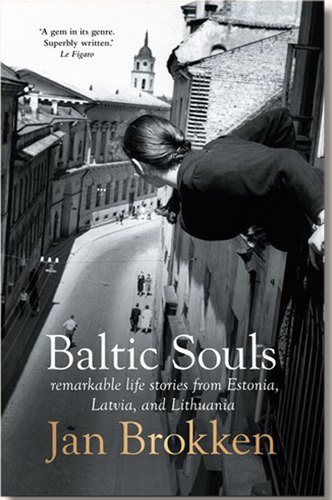 Cover of Jan Brokken, Baltic Souls: Remarkable Life Stories from Estonia, Latvia, and Lithuania, (2024).
On my friend’s advice, I buy Baltic Souls, with its stunning cover image by the Lithuanian photographer Antanas Sutkus. It shows a woman leaning precariously from a balcony, her body at ninety degrees, her head turned away from us. She stretches as far as she can, to catch a glimpse of something at the far end of a winding street. Titled ‘Marathon in University Street’ it is a visual expression of something invisible: the present moment, perhaps, as it passes into time. An endorsement describes the book as a gem in its genre. What genre is that? A skilful blend, I’m guessing, of travel, memoir, history, biogeography, and collective biography, not easy to classify.
I’m a little troubled by the word souls in the title. It is an old-fashioned term, hardly used these days. In this book, what is it supposed to mean, mortal or immortal souls, companionable (Kantian), phenomenological (Hegelian) or argumentative (Nietzschean) souls? Or am I unnecessarily distracted by this wafty word, is it simply interchangeable with ghosts, as in Scraton’s and Egremont’s titles, or with shadows, as in Bobrowski’s Shadow Lands? I ask my friend what he thinks. You’ll see when you read it, he replies.
Three epigraphs signpost the way. The first is about sons judging their fathers, the second about the importance of personalising impersonal histories, and the third is the well-known proverb, that it is a curse to live in interesting times, which Hannah Arendt, caught up in her own tumultuous era, liked to quote. Now, applied to a time closer to ours, the proverb illuminates that extraordinary moment in the early 1990s when the Berlin Wall had come down, history had cracked open the scabrous shell of Soviet dominance, and Lithuania, Latvia and Estonia emerged to reinherit their independence.
The proverb’s wryness is also a good example of Arendt’s own intelligent sense of humour. She liked to laugh. Humour was one of her favourite strategies for critical thinking. She would demonstrate – to friends, to students – ways in which laughter questions, unsettles, lightens, liberates, how it is the opposite of repression.
Baltic Souls is made up of fifteen stories of repression and liberation, each following a life or set of lives begun, or played out, in these south-eastern countries of the Baltic Sea: Estonia, Latvia, and Lithuania, and one non-country, their bedraggled orphan-cousin, unhappily called Kaliningrad Oblast. Unhappily, because Russian had never been its language nor its culture, and now it finds itself named for Mikhail Kalinin, one of Joseph Stalin’s most obsequious puppets.
It was once Königsberg, the capital of East Prussia, the German province partitioned at the Potsdam Conference in 1945, its southern half apportioned to Poland, its northern half to the Soviet Union. Later, during the USSR’s period of de-Stalinization – when slates were wiped clean, and names were changed, Stalingrad (for example) becoming Volgograd – at that moment Kaliningrad could also have been given a new name, but it was overlooked. And when the Soviet Union ceased to exist, and the three Baltic states became independent, Kaliningrad Oblast was again left behind. Positioned on the Baltic Sea, often described as wedged, sandwiched, nestled, or perched between Lithuania and Poland, it is now a Russian exclave hundreds of miles west of the so-called motherland. Moves for it to become independent have been quashed. The occupation continues, because this smidgen of a place (larger than Montenegro, smaller than Kuwait) provides Russia with a westernmost territory, therefore a convenient outpost and (at Baltiysk, formerly Pillau) its only ice-free harbour. Headquarters for the Russian Navy’s Baltic Fleet, it is also an arsenal for a large number of nuclear warheads and other weaponry. The Lonely Planet Guide from the 90s, when Kaliningrad was cautiously opening up to the lure of tourism, describes it as ‘a far from lovely city’ where ‘the traffic fumes are thick, and the Pregolya River flowing through the city’s heart is black as pitch and really stinks’.
Kaliningrad was flushing more wastewater and all kinds of industrial effluent into the sea, than any other Baltic community. Now – like St Petersburg, another major polluter – the Oblast at least has a new sewerage system and wastewater treatment plant. And a pulp and paper mill, once responsible for toxic chemical contamination, has stopped operation. In 2019 those former pollution sites were taken off the list of hot spots by HELCOM (the Helsinki Convention first held in 1974, also known as the Baltic Marine Environmental Protection Commission). Beyond Kaliningrad and the touristy coast, the Oblast is a shrouded place of military bases, small towns, long-abandoned villages and fallow farms. On the bright side, a region once described as a fearsome wilderness by conquering Teutonic knights is now rewilding. In increasing numbers, wolves, bears, boar, deer, elk, lynx, even bison roam the large and ancient Romincka forest and heath, which stretches between Poland, Kaliningrad and Lithuania. However, the forest is close to the Suwalki Corridor – dubbed ‘the tiny bit of Europe with big implications’ (World Economic Forum), and ‘NATO’s worst nightmare’ (Daily Express) – where Russia wants to build a land bridge to connect its ally Belarus with Kaliningrad, for easy access.
The Oblast’s abundant water bodies – groundwater, marshlands, streams, lagoons, lakes, ponds (especially ponds, used as dumps) – and seashores continue to be at risk of fouling, including (as elsewhere in the world) from agricultural and industrial waste, oil, dodgy landfill practices, plastics, microplastics, and radioactive waste. And in the Baltic Sea itself, there are still tens of thousands of unswept mines.
Globally, colonisation, conflict and migrations have given rise to a new interest in borders – natural and unnatural – their connotations, their shape-shiftings, crossings, dangers and alternatives. Thinking beyond borders, some communities are concentrating on the ecoregions they have in common – such as rivers and overlapping catchment areas – and under the auspices of HELCOM and similar organisations, are joining forces to protect their combined natural and cultural resources.
But if until recently the Baltic was becoming a key place for regional environmental cooperation, this was turned around by Russia’s occupation of Crimea in 2014 and its invasion of Ukraine in 2022. The Russian war against Ukraine has been causing such severe environmental destruction that it amounts to ecocide: widespread transborder damage to nature which will be difficult or impossible to reverse. The Baltic Sea is one of the world’s busiest waters, with more than 2,000 vessels crossing it in all directions every day. Lately it has been plagued by acts of hybrid warfare. Russia’s rusty, uninsured, sanctions-evading shadow-fleet is an environmental hazard, threatening the sea with oil spills and wreckage, as well as being engaged in outright violations, including GPS jamming and AIS spoofing. This grey-zone aggression endangers both maritime and aviation safety in the area, it slows EU and global trade, and it jeopardises Baltic tourism. As I write – early 2025 – Baltic countries and NATO are investigating the serious damage to an undersea fibre optic cable between Latvia and Sweden. Previously, a Russian oil tanker was suspected of dragging its anchor along the seabed and severing telecom cables and a power line that connects Finland and Estonia. A ship sailing under a Panamanian flag from Russia to Egypt experienced engine failure and for a long time blocked shipping lanes. A Chinese bulk carrier cut communications cables between Sweden and Lithuania, Finland and Germany. Caught in the act, the pirates play dumb, ‘oh ... the anchor must have dropped’, an unlikely scenario.
As our immediate attention is drawn to the war in Ukraine, the Kaliningrad Question seems less pressing. Despite its menace, the Oblast retains a degree of vagueness: it is often unidentified on maps, and not included in geopolitical discussions. It is the elephant in the Baltic room. And it would indeed be alarming if – Russian guns blazing – Kaliningrad suddenly appeared in the limelight.
It wasn’t always unlovely. Now we can only base our impressions on texts, photos and hearsay. Its avenues were lined with trees, its gardens full of flowers. A traveller viewing it from a tower saw a spectacle of colour reflected in its waterways. Of her childhood in Königsberg, the artist Käthe Kollwitz (1867-1945) wrote that she was very grateful to her parents for trusting her and her sister to explore the town on their own, its parks, winding streets with gabled houses, busy riversides and docklands. The family spent summers in Rauschen (now Svetlogorsk), when it was still a small fishing village on the Samland Peninsula north of Königsberg. In 1929 Thomas Mann was in Rauschen (the word suggests a lightly sweeping or whispering movement, of wind or sea, sand or forest) and he wondered if there could ever be a more seductively named destination for a summer vacation. He fell in love with this coastline and promptly had a house built about 70 kilometres north-east, just across the border in Lithuania, at Nidden (Nida) on the narrow Curonian Spit, with its gleaming beaches and pine and birch woods. 1929 was also the year he was awarded the Nobel Prize. The Mann family spent three blissful summers in Nidden, before their escape into exile in 1933. For Kollwitz, Königsberg and Rauschen were the places of her first artistic inspirations, where she watched people: mothers and children, old women and men, carters, dockhands, fishermen. Her biographer writes: ‘Their hard-worked bodies, their plain, ageless clothes, but most of all, their lined faces held a mysterious beauty for her. They possessed a grandness of presence, manner and movement that she had seen in no others and that she wanted to see again and again. They at once stimulated and satisfied her young aesthetic eye’.
Philosopher Immanuel Kant (1724-1804) also made Königsberg and surrounding places his own by walking: to the university where he taught, and on the paths around the Schlossteich, and to the port to admire ships from around the globe, to watch the unloading of their cargo, salute their merchants, and now and then invite one of them to his lunchtime gatherings. He thought while he walked. Sometimes he went further afield, to Juditten, or further still, to a small cottage he loved at Moditten. There he wrote Observations on the Feeling of the Beautiful and Sublime (1764) and according to local lore, after a good day’s work, he enjoyed a wine made of red and black currants, Kopskiekelwein, its name indicating that your face will hit the floor if you have too much of it. Given all its links with the world, Kant saw Königsberg as ‘a suitable place for broadening one’s knowledge ... In such a city, this knowledge can be acquired even without travelling’. Though the Baltic was close, it’s unlikely that Kant ever dipped his toes in its shallows.
Kant’s philosophical offspring, Hannah Arendt (1906-1975,) also spent her early years in Königsberg and on the Baltic, where both sets of grandparents had holiday homes; she stayed mostly at Neukuhren, just east of Rauschen. I imagine that one day she jumped off the end of the pier, and started to swim. Because throughout her life, in many places, she swam whenever the opportunity arose, telling the psychiatrist-philosopher Karl Jaspers that swimming always reminded her of home. The philosopher and cultural critic Walter Benjamin, in recommending Arendt’s biography of the German-Jewish writer Rahel Varnhagen to Gershom Sholem, said her book ‘swims with powerful strokes against the current of edifying and apologetic Judaic studies.’
Jaspers and Benjamin were her friends. Jaspers she admired as someone for whom truth and communication were one and the same thing, and that he believed more in beginnings than endings. Benjamin she admired for his poetic vision, his sense of wonder, and that for him ‘the smaller the object, the more likely it seemed that it could contain in the most concentrated form everything else’. Before his tragic death Benjamin entrusted Arendt with manuscripts she would later edit, for the collection titled Illuminations. Friendship was a significant part of her philosophy and self-understanding. In her PhD thesis on Love and St Augustine (with Jaspers as her supervisor), she identified friendship as the highest form of love, because (manifesting as compassion, solidarity, loyalty, neighbourliness, and doing unto others as you would have them do unto you), friendship encompassed and surpassed all other forms of love, from the personal to the spiritual. And in this regard, Arendt thought of Rahel Varnhagen as her best friend, irrespective of the fact that they lived in different times, with Varnhagen born in 1771 and Arendt in 1906. In many ways her biography of Varnhagen was also an autobiography.
Some years ago at Neukuhren (now Pionersky) Putin began building a maritime complex, with passenger terminals for the lucrative Baltic cruise industry. The website for Norwegian Cruise Lines still invites us to ‘enjoy strolling along Pionersky’s extensive waterfront for sweeping views of the sea [and] shopping for amber jewellery’. I asked them if this destination is available. They replied, ‘Unfortunately we do not have any sailings visiting Pionersky, Russia at this time. The location is still available on our website as this used to be a port of call we would offer for certain sailings, and we hope to be able to include it again in future’.
------------------------------------------------------------------------
With all of that in mind – my miscellaneous knowledge of the Baltic, and my specific interest in the Kaliningrad region, where some of my forebears lived – I began to read Baltic Souls. Jan Brokken is a very good storyteller. He has an eye for detail, and his adventures and probings hold the reader’s attention. The son of a Dutch theologian, he was born in 1947 in Leiden and grew up in the village of Rhoon, near Rotterdam. His novels, literary non-fiction and travel writing have been translated into many languages. They include The Reprisal (set during WW2 in Rhoon), The Cossack Garden (about the friendship between Alexander von Wrangel and Fyodor Dostoevsky), and The Just (about a Dutch diplomat in Lithuania who saved thousands of Jews by providing them with visas for the Dutch island of Curaçao). He has written about West Africa, China and Russia. And about Indonesia, where his parents and brothers lived and were incarcerated for over three years during the Japanese occupation. In an interview he explained that they never recovered from those experiences, that his father’s heart remained in Indonesia, and that he (the author, born later) was ‘marked by a war in which I had not participated’. Nor had Jan Brokken participated in Dutch colonialism, which precipitated Indonesia’s fight for independence. In Baltic Souls we find many echoes of Brokken’s predicament – of familial grief, and history revealing itself generationally – in his heartfelt biographies of others.
Between 1999 and 2010 Brokken travelled in the Baltic region, a ‘corner of Europe [that is] thick with shadows’. He coaxes some of those shadows into the light and introduces us to a motley crew: a family of booksellers, a famous architect father and his even more famous film-maker son, the violinist Gidon Kremer, the composer Arvo Pärt, the sculptor Jacques Lipchitz, the artist Mark Rothko, a novelist, a spy, some sailors, and a handful of aristocrats, among others. His style is more documentary than writerly; there are few literary affectations. There’s a sense that these are stories Brokken is compelled to tell. It brings to mind Benjamin’s observation: ‘More and more often there is embarrassment all around when we wish to hear a story expressed. It is as if something that seemed inalienable to us, the securest among our possessions, were taken from us: the ability to exchange experiences’. Within the context of recent Baltic history, Brokken builds each subject’s circumstances to points of great intensity, which (as I’d been warned) did indeed become harrowing. The book is best read one story at a time.
His chapter on ‘The Bookseller of Riga’ gives us Jānis Roze, born in 1878 when Latvia was part of the Russian Empire. He learned the publishing and book selling trade as an apprentice in a provincial town. When his employer was killed during the 1905 uprising against the czar and the czarist reprisals, Roze (arrested, awaiting execution, and released) moved to Riga and started his own publishing house. In the winter of 2007, over coffee and cake, Brokken meets Roze’s grandson, who shares his family stories: of Lenin granting independence to the Baltic countries, Latvia becoming a Republic in 1918, the joy of Latvians’ claiming their national identity, an economic and cultural revival, even inspiring Roze to start a literary magazine. The euphoria was short-lived. In 1939 Stalin and Hitler agreed that Baltic countries would be returned to the Soviet Union. Soviet forces invaded Latvia in 1940, rounded up opponents, and deported 100,000 Latvians. Another bookseller, Jānis Rapa, tore a map of Latvia from a map of Europe, and killed himself, clutching the scrap in his hand. In 1941 Roze, his wife and daughter were arrested as class enemies. His sons and other family members managed to escape. At the station where Roze was separated from his wife and daughter, an old carriage now stands as a memorial. The Nazis arrived and Latvian men were conscripted to fight against the Red Army. Most of Riga’s Jewish population was murdered. And a year later Roze died in a forced labour camp at Solikamsk in Siberia, from starvation and exhaustion. For six years his wife and daughter were in a different penal colony, in the Arctic Circle. The daughter was released in 1947, she was ill and her mother escaped to take care of her. They struggled for four weeks to reach Riga, where the mother had to go into hiding from authorities until 1958, when Khrushchev denounced Stalinist repression. Brokken also tells the story of Ināra Belinkaja, who was eighteen when she began work at Bookshop Number Three (formerly Roze’s) in 1962. She found boxes of old papers and photos, and lobbied for the shop to be named after its founder. One day she was visited by Jānis’ daughter, who introduced her to other members of the family; in November 1988 they were present at the emotional unveiling of a bronze bust of Jānis Roze. Nine months later on 23 August 1989 Estonians, Latvians and Lithuanians formed a human chain stretching 650 kilometres from Talinn to Vilnius. Lavia, Lithuania and Estonia officially regained their independence in 1991. Today Jānis Roze and Sons is one of Latvia’s leading bookshops, with 35 stores across the country. Ināra Belinkaja and Jānis’ grandson Ainars Roze are still at the helm. The story ends precariously, with Ainars’ son (Jānis III) anxious about introducing his father to his Russian girlfriend, and Ainars summoning the grace to put the family’s memory of traumas aside, for the sake of his son’s future happiness.
In ‘The Architect’s Shoes: Eisenstein vs Eisenstein’, Brokken begins with Mikhail Eisenstein, the architect of several eccentric apartment complexes built between 1901 and 1906 in Riga. Born Moisey Eisenstein in 1867 in Bila Tserkva, a Ukrainian town with a large Jewish population, he studied engineering in St Petersburg, converted to Russian Orthodoxy and married a wealthy woman. The couple moved to Riga and established a cultured household of books, music, and hospitality. He was a jovial fellow, bombastic, admired Napoleon, played tennis, enjoyed horse riding. Summers were spent in a grand house on the coast. He owned 40 pairs of patent-leather shoes and kept a register for their different occasions.
Mikhail Eisenstein is sometimes called the Gaudi of Latvia. His yellow, pink, blue, and turquoise buildings were influenced by Art Nouveau and the Secession designs of Otto Wagner. Their most striking feature is an excess of ornamentation: nymphs, mermaids, sphinxes, dragons, peacocks, eagles, lions and giant heads, all vying for the passer-by’s attention. But on the cusp of widespread social upheaval, it was a style that could not last. And perhaps its demise was accelerated by Adolf Loos’s essay ‘Ornament and Crime’ in 1908, which accuses anyone fond of unnecessary ornamentation of being unmodern – that was the crime. Modernisms were advancing; there was no turning back. Regrettably, the plans of Eisenstein’s buildings were all the same: stairs and kitchens for domestic staff at the back, showy living rooms at the front. Brokken comments that ‘this layout alone gave Eisenstein Jr enough reason to despise his father’ for his snobbery.
Mikhail’s son Sergei was born in 1898. An only child, precocious, he had no trouble learning English, German, French and Russian. He was desperately unhappy about his father, who (in his view) was much too busy designing awful buildings. Although Mikhail sometimes took his son to the circus, opera, or theatre, he was domineering, and in public Sergei was embarrassed by his father’s pomposity. From his window in Riga, when he was seven, Sergei witnessed the uproar and violence of the workers’ revolt. It excited him. When his parents’ marriage ended, he was devastated. Like his father, he later studied engineering in St Petersburg, and also showed talent as a designer, which he applied to stage design and montage. When Sergei Eisenstein found himself in the middle of the Revolution, because of his own rebellion against his father he felt he had a special affinity with this great moment in history.
In 1920 Mikhail died in exile in Berlin. Sergei, who believed the Revolution had made him an artist, became one of the twentieth century’s most important film-makers. Despite their opposition, father and son were very much alike. Both had a strong visual style. Both were embellishers. The pathos of Eisenstein’s Battleship Potemkin (1925) is not unlike the melodrama presented across the surfaces of his father’s buildings. Biographers and film critics have found rich strata of autobiography in Sergei Eisenstein’s work, including a preserved state of childishness. In the end he lived in Moscow with his mother and his Latvian nanny. But Stalin, the father figure he had to impress, mistrusted him and censored his work. After Eisenstein’s death in 1948, Stalin (not aesthetically gifted) derided him as an avant-gardist, a bourgeois, a Jew, and a traitor.
At the start of the twentieth century, half the population of Baltic cities was Jewish. Arendt said that like all Jewish children she experienced anti-Semitism, but she was not poisoned by it, because her mother ‘insisted that I not humble myself’. If teachers made anti-Semitic remarks, her mother told her ‘to stand up immediately, leave the class, go home’ and let the school deal with the situation. ‘I had a day off from school, and that was, of course, very nice’. If the slur came from another child, she had to face up to it, then and there. She grew up politically astute, but her heightened awareness of history – her premonition of what was to come, foreshadowed by the murders of Rosa Luxemburg and Karl Liebknecht – took its toll on her health. There was a time when she was fearful and never wanted to leave Königsberg.
In ‘Hannah Arendt’s City’, Brokken laments all that was destroyed in Königsberg during the RAF bombings of August 1944 and the Soviet shellings and German defence of April 1945: entire districts were erased, including the historic centre, the fourteenth-century cathedral, most churches, the university founded in the sixteenth century, the warehouses which gave Königsberg its Hanseatic atmosphere – such as the warehouse where Arendt’s grandfather Jacob Cohn stored the tea he imported from Russia – and the house on Tiergartenstrasse where Arendt’s family lived. The city was emptied of much more than its beloved buildings. It was entirely emptied of its people. If they could, the Lithuanians returned to Lithuania, Poles to Poland. Due to increasing anti-Semitism and violence, a large part of the Jewish community had left Königsberg in the 1920s and 30s. In 1938, during Kristallnacht, the city’s Jewish sites, its synagogues, cemeteries, schools, orphanages, homes and businesses, were vandalised or burned and as soon as possible, people fled, including Arendt’s mother. Of the Jews who stayed, few survived what followed: deprivation, forced labour, murder. Nor did others survive the ravages of war and dangers of evacuation. In early 1945, the sinking of MV Wilhelm Gustloff killed 9,400 evacuees in the deadliest marine disaster of all time. Anyone who remained was expelled by the Soviets.
After the war, the Oblast was resettled with groups from Central Russia, Belarus, and Ukraine, and later Lithuanians, and ethnic Germans from Kazakhstan and Uzbekistan. Brokken writes, ‘The merchant city was transformed into a hermetically sealed Soviet garrison town, and by the century’s end it had become a mob town, as lawless as Al Capone’s Chicago’. Not only crime, but also poverty and disease were rife. The best-known landmark of the post-war years was a monumental ruin called House of Soviets, or The Monster. It had been built near the old site of the thirteenth-century castle, and – on unstable foundations – it was left unfinished for decades. Considered one of the ugliest buildings in the world, it has recently been demolished.
Arendt had left Königsberg to pursue her studies. She had an affair with the philosopher Martin Heidegger, and lived in Berlin, Marburg, Freiburg, and Heidelberg, where her doctorate was conferred in 1929; that year she married the philosopher and journalist Günther (Stern) Anders. She became a political activist, and went into exile, first to France, then to America, where she arrived in 1941 with her second husband, the historian and philosopher Heinrich Blücher, and her mother. She taught at Berkeley, Princeton, Chicago and other universities, and was Professor of Political Philosophy at The New School for Social Research in New York City. Her works include The Origins of Totalitarianism (1951), Rahel Varnhagen – The Life of a Jewess (1957), The Human Condition (1958), and most controversially (coining the phrase ‘banality of evil’) Eichmann in Jerusalem (1963). In an interview in 1964 she said, ‘In the way I think and form judgements, I’m still from Königsberg’. She died in New York in 1975. The Life of the Mind was her last work, incomplete at the time of her death and published posthumously in 1978.
When Brokken visited Kaliningrad in 2009, he noticed signs of change – the restoration of Kant’s tomb, and of the Cathedral – and he left ‘with the impression that this was a city in waiting, impatient for a new purpose, a new future, and a new name ... the door appeared to be opening, if only a chink’.
For a few years it did begin to open up to tourism and trade, and even to Kaliningraders doing their weekly shopping in Poland. Now the Oblast is again difficult to enter. Online there are chats on how to get in – by air, train, bus, car, water, bike – advising that you need an invitation which is hard to obtain, as well as a visa. There are reports of odd bureaucratic twists: like not being allowed to exit in the same way you entered. This seems apt, for a city famous in its former life for the eighteenth-century mathematician Leonhard Euler’s Seven Bridges puzzle. Once seven bridges over the Pregel river connected islands and the mainland and Euler wondered – in theory, not in situ; he was never in Königsberg – if it was possible to complete a circuit by crossing each bridge only once. He concluded that ‘after we have determined that a route actually exists, we are left with the question how to find it’.
Perhaps the problem has been solved by the fact that now there are only five bridges and two of them are new. Given the current risk of military activity, terrorism, and arbitrary detention, many governments warn against traveling to any part of Russia, including Kaliningrad. Occasionally a lone cyclist reports a pleasant and problem-free holiday. Online someone (perhaps a stooge) writes a review, saying he’d been there and it’s a place everyone should visit it has a lot of history and probably gets overlooked though it shouldnt. Marzipan along with centuries old bridge.
Poland now makes a point of calling the city Królewiec (its old Polish name), Lithuania calls it Karaliaučius, and Latvia and Estonia favour Königsberg. The Kremlin sees these as hostile acts. Repeated calls for the withdrawal of Russian troops from the Oblast, and for Kaliningrad/Königsberg to be placed under EU jurisdiction have gone unheeded and its attempts to achieve sovereignty have failed. In limbo, it now stands as an example of what must not be allowed to happen to Ukraine.
------------------------------------------------------------------------
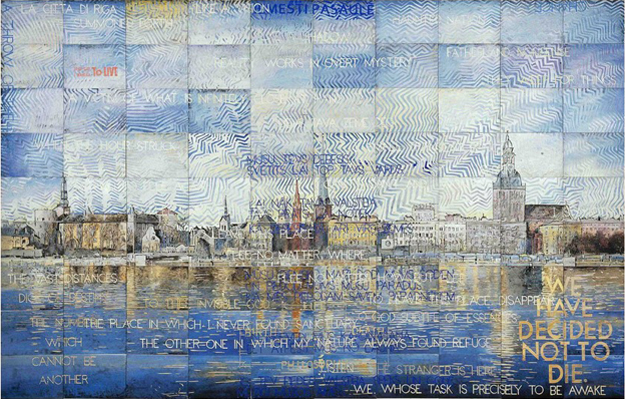 Journey to Nowhere, 2017, Imants Tillers. Courtesy of the artist. © Imants Tillers
The friend who urged me to read Baltic Souls is the Latvian-Australian artist Imants Tillers. In his essay collection Credo, he recounts his parents’ post-war arrival in Australia as displaced persons – ‘penniless but grateful after the tribulations of wartime to start a new and better life’. Initially, to repay their passage, his father was a labourer for the Water Board, his mother a live-in domestic. His father then studied, while working as a draughtsman, and became a mechanical engineer, hoping his Australian-born children would choose similarly reliable professions. Tillers writes, ‘Although Latvian was my first language and English my second, being of Latvian descent in Australia was of such little consequence that I did not register I was bilingual until I was in my twenties’. When he made his own first trip to Latvia in 1976, it was ‘a country I thought I was already familiar with even though I had never been there before’, and it needs to be qualified, ‘that at the time Latvia as such did not exist. It was part of the Soviet Union and therefore did not appear differentiated in any way on world maps’. Tillers’ artworks speak of connections and displacements and global turbulence. Journeys to Nowhere. Poles of inaccessibility. Failed localities. Places like Liepāja (Liebau) where his mother was born. And because it was the nearest city to Karosta, a naval base for the Soviet submarine fleet, it was strictly forbidden to go there.
The phrase strictly forbidden has me remembering my own visit to Russia in 1970, when it was still the Soviet Union – flying Aeroflot from London to Moscow, a surprisingly short trip; thankful for the shiny red apple given to each passenger as a snack; an hour or so into the flight (over Kaliningrad), being ordered to lower the blinds and put away our cameras.
Tillers notes that Liepāja was also the port from which young Markus Rothkowitz left this homeland for America in 1913. He became Mark Rothko, one of the twentieth century’s foremost artists, but as Brokken says in ‘The Story of an Unknown Adventure’, Rothko always ‘felt like an outcast in America ... never able to forgive having been relocated (“transplantation” was the word he used) to a country where he never felt at home’. It has been suggested that Rothko’s luminous colour-field abstractions are inspired by the diffused Baltic light he remembered from his Latvian childhood – in the words of his biographer, ‘a light longed for but beyond reach’. At the end of his life, what Rothko most wished for was a one-man show in his hometown Dvinsk (now Daugavpils).
Baltic light is a phenomenon peculiar to the region, it gives the impression, mostly in summer, that daylight has been powdered and a delicately-warm blue has found its way into all other colours, into everything.
When I ask Tillers what, in Baltic Souls, affected him so deeply, he says, ‘well ... everything’ – the crushing weight of history, the individual stories, and especially the one called ‘The Will of the Father – Kremer vs Kremer’, featuring the Latvian (also Jewish, German and Swedish) violinist Gidon Kremer, about a tormented father tormenting his son. Gidon’s father was the violinist Markus Kremer, who was hidden under the floorboards of a shed by the mistress of a Nazi officer, and survived the Holocaust, to find that thirty-five members of his family, including his first wife and young daughter, had been killed. He married again and spent the rest of his life compulsively reading and talking about the Holocaust – he needed to know it all – and transferring his overwhelming pain and guilt to his son. Gidon Kremer tried to explain the burden of that legacy in his 1993 book Kindheitssplitter. The title is translated as Fragments of a Childhood, though Splitter also suggests splinter, the kind that is embedded and impossible to remove.
Brokken points out that Kremer and his friend, the dancer Mikhail Baryshnikov, had similar childhoods, or according to Baryshnikov, no childhood. And Brokken himself admits that ‘the war weighed just as heavily on my own father’s shoulders, cast just as much gloom over my childhood’. This in turn resonates with Tillers’ experience. His father, also called Imants Tillers (Eisenstein vs Eisenstein, Kremer vs Kremer, Tillers vs Tillers), had a deeply unhappy youth followed by the horrors of war, so that later he could never express his emotions, which puzzled and upset his son. Sometimes father and son played chess together, in silence, or went fishing. Where, I asked. ‘On Botany Bay in a tinny, very early before sunrise. I don’t remember catching any fish.’ His father wanted him to succeed in life – to excel (the migrant’s mantra) without drawing too much attention to himself – and was horrified by his son’s wish for the challenges of a rockier path.
The inability to express oneself – no longer knowing how to turn experiences into stories – Walter Benjamin notes, began with World War I. He paints a picture of war changing the world, changing all but the clouds, ‘and beneath these clouds, in a forcefield of destructive torrents and explosions, was the tiny, fragile human body’.
Tillers’ paintings are made up of modestly sized canvas boards. On each board, he puts down layers, and also cuts them back, achieving a dynamic, quakelike surface. ‘The first layer is the blue text around the perimeter of each work. Next is the white text, whatever that might be. Last comes the imagery. This usually inolves an under layer, then metallic paint, and lastly a wash of black gouache’. When the finished boards are placed together there is a play (or battle), of text, image, texture and colour. One of the persistent phrases that appear in his work is Nature Speaks.
Tillers is perpetually in dialogue, with himself, with the artworld, with the past. Another phrase, Reversible Destiny (borrowed from the artists Madeline Gins and Arakawa), appears in a number of his paintings, because ‘being incorporated into the Soviet Union for 50 years, Latvians always hoped for a miracle. For Reversible Destiny’.
------------------------------------------------------------------------
Still unsure about the term ‘souls’, I contact Jan Brokken. He explains that in choosing his title he was thinking of Gogol’s Dead Souls and wanted to bring some of the dead souls of the Baltic back to life, but he also sees the term ‘more broadly, as a common destiny experienced by Baltic peoples over centuries of sorrow and oppression’.
Nikolai Vasilyevich Gogol’s picaresque novel Dead Souls is a shaggy dog story: a circular debate about the meaning of souls, which was a term used synonymously with serfs, who could be bought and sold, dead or alive, in tsarist Russia. Though Gogol is often considered quintessentially Russian, it should be remembered that he was Ukrainian and played an important part in the revival of Ukraine’s national identity. His novel is a satirical hammering of Russian bureaucracy and corruption, greed and heartlessness.
The destructive forces of heartlessness were on Kant’s mind when he argued against ‘soulless despotism’ and stressed the urgent need for peace in his radical essay on ‘Perpetual Peace’. He warned that peace treaties are invalid if they are made in preparation for another war. That ‘no independent states, large or small, shall come under the dominion of another state’ in any way whatsoever. That existing armies ‘shall in time be totally abolished’. In 1795 he was writing as if he were writing now.
But perhaps the Swedish Nobel Prize laureate Tomas Tranströmer should have the last word, with these lines from his narrative poem ‘Baltics’:
... The waves come in from no-man’s-water
and break against the stones.
I walk along the shore. Walking along the shore is not what it was.
You have to stretch your mouth too wide, keep too many conversations going at once;
your
walls are thin.
and even in the utter darkness you hear it dragging after you.
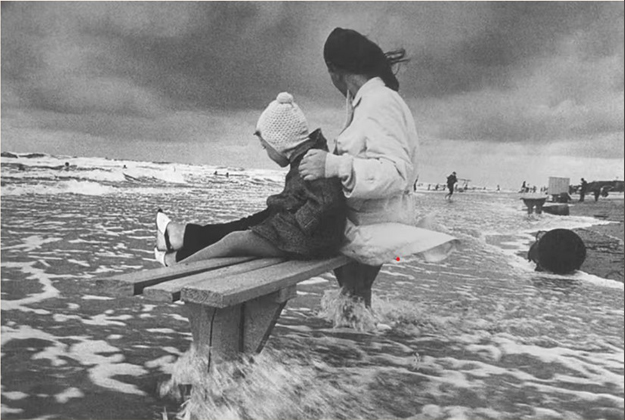 At the Baltic Sea, Giruliai, 1972, Antanas Sutkus. Courtesy of Galerie Albrecht Berlin. © Antanas Sutkus
© Evelyn Juers / Sydney Review of Books, 1 April, 2025
Extracts from Part One: Now That It’s Broken, House of Exile – The Life and Times of Heinrich Mann and Nelly Kroeger-Mann (Giramondo, 2009)
The brothers were tied by bonds of love and jealousy. There were fallings-out, short and long periods of not speaking to each other, followed by peace. Tidal forces of affection. During one of the family’s summer holidays in Travemünde, a seaside resort 15 kilometres from Lübeck, to cut the ice, Heinrich raced Tommy to the shore and deliberately fell over in the sand to let his brother win. Then they both dipped their toes into the blue-green water – measured in degrees of coldness, even on the hottest day – and daring one another, they both plunged into the waves.
Two hundred fifty rivers drain into the glacial basin of the Baltic Sea; as the largest volume of brackish – in some parts almost fresh – water on the planet, it contains only about a quarter of the salt of oceans. It was once a lake and has been a sea for a scant 7,000 years; now it is related to the North Sea, and distantly, to the North Atlantic, via narrow straits. Sudden wind changes and violent storms have always made it hazardous for ships; on its bed there are more rotting, rusting wrecks than in any other sea on Earth. Heinrich told his younger brother, as they dived into the viridescent waves, about a marine landscape of ships’ hulls, broken masts, treasure chests and cannon balls, crusted with shells, flagged with fluorescent algae. He said that the Baltic was a cemetery. That swimming further out, they must be careful not to touch the bottom with their feet, for fear of kicking up old bones. That the water of the Baltic tastes like blood.
In Los Angeles, in the not yet broken darkness before dawn, Heinrich cast pencil markings across a new page of his sketchbook: 1886, he calculated, May or June, when their mother began to read Anna Karenina to them, for soon afterwards they were on holiday, and the book, unfinished, had been left at home.
Travemünde in July and August was a place of milk-washed skies, sand like silk against the skin, shells picked up and left randomly on windowsills and gateposts. Everyone rose early and retired late; with a Nordic thirst for light and warmth, accumulated over too many months of winter, they lavished themselves with sun. At the water’s edge was the familiar line-up of bathing machines which one entered clothed and exited by a short ladder, temporarily amphibian, for health from sea water and sea air. From the promenade, and from a pathmaze of manicured gardens, with the crunch of pebbles underfoot, came bursts of laughter and sounds of calling to acquaintances, in a great variety of dialects and languages. Holidaymakers wearing mostly white, men with straw hats, women twirling parasols, strolled, or gathered with contagious leisure, against the backdrop of the hardly incongruous row of picturesque Swiss chalets, or the Musiktempel, or the Kurhaus where one sipped salt water. On the beach children chased raucous seagulls, and with Lilliputian spades built forts and castles; with their bare hands they dug wet sand, urgently, to make channels and as the water rushed in and out, and the walls threatened to collapse, they hurried to secure them; if someone wilfully destroyed these masterworks, there were slaps, kicks, howls, tears.
A youth carrying a book might slink towards the dunes to read or daydream, unsure of his status in society, while others of his age rehearsed the arts of courtship in every little way. Two or three young people walked in the direction of the lighthouse and the Brodtener Steilufer, a cliff from which great chunks, trees even, sometimes fell into the sea; at its base was a narrow strip of sand, a renowned treasure trail for fossil hunters, leading between Travemünde and the fishing-village of Niendorf.
Along slowly darkening paths some who stayed out late followed the rituals of glow worms – wingless female beetles, Lampyris noctiluca – that lit up their bodies to attract the unilluminated flying males.
Like many others, the Manns probably hired an open carriage for excursions to villages further along the coast, Niendorf, Timmendorf, Scharbeutz, where they would eat freshly smoked fish for lunch, herring, sprats, or eel. They stopped to buy berries from a farmer’s stall, and the old coachman took a nap while they picked great bunches of blue lupins that grew beside the road, and strawflowers from a whitegold carpet covering the dunes. As they headed back to Travemünde for dinner, fields on one side, sea on the other, Lula coughed from the dust kicked up by the horses, and Heinrich noticed that Carla was almost asleep against his chest, that Tommy was sunburnt.
Light and shade flickered hypnotically as the carriage rolled through a forest of beech trees. The coachman told stories. Not only amber washed up on these shores, he said, but people too, the living and the dead. He recounted the terrible storms he’d experienced in his lifetime. The worst by far were the winds that caused the great flood of November 1872, when it seemed as if in the wild black of night, the sea would altogether claim the land. Trees bent like straw, buildings were destroyed, others filled with sand, people and animals drowned, those who had managed to climb onto rooftops felt walls collapse below and were set adrift. As the water subsided, survivors were found in treetops and boats were stranded on meadows far from the shore.
Going further back in time, the coachman thought it was the summer of 1837, he was a young man then, courting the innkeeper’s daughter, and he remembered that travellers on their way by ship to other Baltic ports had to wait for the wild weather to abate before continuing their journeys. The wind was so powerful that a beehive was tossed high into the air, and with its swarm intact it was carried to an island. For days the inn was full of restless people, pacing, smoking, drinking; not a rowdy bunch at first, but they grew irritable as the weather worsened. The storyteller remembered one man going to Riga, who was increasingly impatient with the delay, intolerant of the crowded space, red with anger; how the volume of his voice rose from his chest, producing rapid streams of curses; how he slammed the wooden benches with his fist. To calm him, the innkeeper showed him a book which absorbed the man so completely, he was seen musing, making notes, tapping rythms on the table, and when the storm passed and it was time to continue their journey, his wife had trouble rousing him from his concentration. The fellow’s name, the coachman revealed as he pulled up at the hotel entrance, was Wagner.
And the book the innkeeper had brought him was Till Eulenspiegel, which he’d immediately thought would be a perfect subject for a quintessentially German comic opera. Richard and Minna Wagner were going to Riga, where he was to take up the position of musical director at the German Theatre. The Wagners’ return journey in 1839, with their Newfoundland dog, was even more eventful. Minna was pregnant, and having lived beyond their means in Riga, they were travelling in a great hurry across borders, without visas, to escape their creditors. At one point their coach overturned, and as if the trickster Eulenspiegel himself was at work, Wagner landed in a pile of dung. Man, woman, and dog crawled through high grass to reach the dinghy that would take them to their ship. Minna later found she had miscarried. They expected to be in London in a week, but the trip took almost a month. Tempestuous weather blew the small merchant vessel far off course; it was driven onto rocks that tore off its figurehead, and the sailors, familiar with the legend of the fleeing Dutchman, suspected that the Wagners might be the harbingers of great misfortune. The opera based on this experience premiered in 1843. It was a great success.
In early September 1886 the Manns arrived back in Lübeck, bright-eyed and tanned...
.... 1889 or 1890, only a few steps from the Holstentor – via the Puppenbrücke, the bridge of dolls – Lübeck’s Lindenplatz became a site of yearning for Thomas Mann. This neighbourhood was the home of his schoolfriend, Armin Martens, the son of a timber merchant. In the novella Tonio Kröger (1903), portraying Martens as Hans Hansen, Tonio (who was Thomas) named what he loved best: the fountain, the old walnut tree, his violin and the sea in the distance, the dreamlike summer sounds of the Baltic Sea. He loved his dark, fiery mother, who played the piano and the violin so enchantingly. And he loved Hans Hansen, and had already suffered a great deal on his account. For it seemed that whoever loves the most is at a disadvantage and must suffer...
... Thomas Mann later claimed that he and his brother were strongly influenced by the shadowy atmosphere of Lübeck, where twisting Gothic alleys and hidden corners seemed to be haunted by something very old and pale, emotionally deformed, spiritually diseased, a remnant of the hysteria of medieval times. He said Lübeck was the city of The Dance of Death. Hans Christian Andersen, who visited St. Marien in 1831, thought he detected ironic smiles on the skeletons’ faces, and was moved to write a story about a boy called Christian who asked for paper reproductions of figures from The Dance of Death to play with. Most likely, for the Mann children, those images in all their tricky ambiguity would have provided rich material for theatrical productions and night terrors. The church fresco was destroyed in the bombing of 1942 ...
© Evelyn Juers, 2009
https://www.theguardian.com/books/2011/jun/24/house-of-exile-evelyn-juers-review
In an interview from 1977, author Thomas Brasch, who had recently moved from the GDR to West Germany, said that people in East Germany experienced the same problems as in any other contemporary industrial society. There were struggles with bureaucracy everywhere, and a declining faith in economic and technological progress. East Germany was no different from Finland or Japan. The Berlin Wall, he added, was really the only “GDR-specific problem”.1 But the Wall was hardly a minor issue. Later in the same interview, he laconically characterized his formative conditions as a writer in a way that suggested the dominating presence of the Mauer: “I started writing when the GDR was a functioning state, which was surrounded by a wall.”2
It is no surprise, then, that the Wall figures in Brasch’s first collection of stories, Vor den Vätern sterben die Söhne, from the same year, 1977. Brasch had written the stories in the GDR but taken the manuscript with him to West Berlin and published it with Rotbuch, a left-wing publisher there. The longest story of the collection tracks the travels of a group of young people, two men and one woman. In this story, the Wall appears several times: the text alludes to it tacitly, then refers to it explicitly, and finally the characters visit it. Towards the end of the story, the three friends are in Berlin for a blues concert and make their way to the Wall, an episode Brasch renders with absolute terseness: “After the concert we went to the Wall. I thought it was higher than that, Sophie said.”3 Unlike Brasch, the characters never cross over to the West.
Thomas Brasch was obviously neither the first nor the best-known author to write about the Wall.4 One of the most famous novels on the division of Germany is Christa Wolf’s 1963 bestseller Der geteilte Himmel. Between Wolf’s novel and Brasch’s story, however, the heavens have darkened and hardened. For Brasch, the sky is no longer partitioned, but has become a part of the enclosure; it is a lid, a cover. The title of the story mentioned above reads, “Und über uns schließt sich ein Himmel aus Stahl”. About fifteen years after the division of the sky referred to in Wolf’s novel, the area to the East has turned into a vault; it is a border above people’s heads, a boundary that contains and confines them.
But is there a way in which the Wall is not simply mentioned in the title of Brasch’s story or gestured to in a brief scene, but somehow inscribed into the text, into its very literary form? I think there is. Let me summarize the story.
Three young East Germans meet, spend some time together, maybe a couple of weeks, and then disperse again. The male narrator meets Robert, a student, at a rare screening of a controversial, prohibited film. After getting into a fight with what are probably undercover secret police agents sent to intimidate the audience, the two escape and leave the city on a motorbike. They travel to the East German coast and stay on the beach for a while. While there, Robert persuades Sophie, a young female nursing student working in a pub, to join them. The three of them share intimate stories, bicker, go bathing, have sex, mockingly participate in a cheesy seaside resort singing competition, go on trips with the motor bike, and attend the American Folk Blues Festival in the capital. After a few days, the group breaks up. Sophie must return to her child and start her hospital work. The narrator works in a factory and cannot extend his sick leave. And Robert tries illegally to cross the German-German border and dies. In their final heated discussion about what to do next — get back to work routines or somehow continue their marginal existence — Robert accidentally smashes the motorbike: there will be no more traveling.
Summarized in this way, the story pattern may seem vaguely familiar. The plot has an unstructured feel to it. It jumps from encounter to encounter, moves through a seemingly random series of events in a journey without a clear destination. It is about a few young people who want to live more freely and wildly, to disregard duties and conventions, until their obligations close in on them again and the resulting tensions strain their relationships. The group seeks a “mobile refuge from social circumstances felt to be lacking or oppressive”.5 They hop on a bike and embrace, however briefly, “the road as a way of life”.6 In other words, Brasch’s story belongs to the genre of the road movie, the emblematic countercultural narrative form in which the improvised nomadism of non-conformists with motorized vehicles represents a challenge to the normative-administrative order of the hegemonic majority. The story of their trip more or less begins with Robert sitting behind the narrator on the motorbike and shouting out: “Let’s get out of the city, just go wherever, someplace where we can get more air.”7 And then they travel to the shoreline, where they can feel the damp sea breeze on their faces.
It may seem odd to invoke a very American genre to discuss a text about the GDR, but Brasch’s story is already well-stocked with similar references to popular culture from the West. The narrator and his friend sing the songs of the Rolling Stones, Bob Dylan, and Simon and Garfunkel as they work themselves up into excitement about the folk concert in Berlin. “Every day I have the blues”, Robert exclaims on the beach, and the prison legends of American blues artists seem to resonate with their own helplessness.8 They see their own boxed-in lives reflected in the songs of men on death row in the Louisiana State Penitentiary. The story couldn’t possibly contain more interregional encounters, moments of cultural cross-pollination, and transmogrified German-English (or “denglisch”) phrases, given the boundaries that were imposed to filter or completely arrest the flow of people, ideas, and goods between East and West. The blues artists who perform have been invited to the GDR, and so are presumably considered non-threatening by the regime, but the three protagonists listening to them associate the music with their own entrapment. It is not an exaggeration to say that the characters in this East German story are animated by cultural energies coming from the Cold War enemy.
Yet the story embodies the pattern of the road movie genre only imperfectly. It is here that we must return to the Wall. Perhaps we can say that the Berlin Wall is not simply mentioned or indicated as a cruel physical barrier in the text, but also shows up in the text as a limit imposed on full participation in a genre, a closing that shows up too early in the unfolding of the generic pattern. “And Over Us a Sky of Steel Is Closing” is an abbreviated, even truncated road movie. The protagonists set out on an impromptu journey away from everything that burdens them: the tedium of factory work, the narrowness of dogmatic Marxist university teaching, the unspoken norms on how to conduct one’s social and sexual life, and, most immediately, the censorship and thuggish political oppression. And they have barely started out when they run up against the limit. It takes them little time to travel to the coast, a day’s ride interrupted only by a fuel stop, and geographically, that is as far as they ever get. There is no path across the water. Instead, they soon return from the seaside, and even claim that the sea gets irritating after a while, only to find themselves standing finally at the Wall. They travel, but not further and further away from a starting point. Instead, they get to the sea and back again, closer and closer to the impenetrable barrier that seals off their life trajectories. Any road movie might portray claustrophobia and people eager to escape enclosure, but in Brasch’s case, the period of relief is really very short. If the text activates the road movie pattern as a possible frame of interpretation, this association serves only to highlight how its heroes can do nothing but move in circles within an enclosed space.
Judging by Brasch’s text, there is not enough room for a road movie in the GDR. It is not the fact that the story ends in such a melancholy, desperate way that prevents full membership in the genre, but the fact that it must end so quickly. The road epic has shrunk to a road novella. Yet paradoxically, this curtailed variant may be the ultimate road movie, because it actualizes the idea that traveling is inherently subversive. The heroes are either outlaws escaping from the forces of control, or non-conformists breaking out of their designated place in society.9 In a party state that oversees and molds every aspect of citizens’ behavior, one could argue, the unplanned and aimless road trip can once again become genuinely subversive. While people who crisscross the country, crash local talent shows, steal alcohol, explore their sexuality, and listen to blues music may not be engaging in unequivocal political protest, they are clearly not helping to build the socialist state.
But here we must avoid a tired and facetious account of how intolerant societies keep the idea of rebellion interesting, or how demarcations and discipline help restore the liberating impulse of the road movie. If a repressive party state narrows down the space of permissible behavior, more and more seemingly trivial actions will be classified as implicit protest.10 And if that same state installs a system of nearly total surveillance and nearly perfect border control, these forms of protest will become completely neutralized, contained, and ineffectual.11 The result, in Brasch’s story, is that the characters go mad out of total helplessness. They are not outlaws on the run from the law because everything they do, no matter how trivial, is potentially suspicious; nor are they wild and free individuals who defy the borders of their world because there really is no road, just a day-long trip to a dead end. The protagonists are stuck in the static condition of inescapable and ineffective rebellion.
In Brasch’s story, East Germany is a functioning state surrounded by a wall, a circumscribed, homogeneous space with no exit or threshold, a single cell.12 The GDR citizen is confined to one area, but, according to Brasch, also trapped in a single phase of life, or kept in an extended childhood. The non-journey corresponds to personal non-development. In another interview from 1977, Brasch explained that there was no way for East German citizens to keep out of politics, since all actions were judged by their ideological potential, but that there was also no way of formulating political alternatives in cooperation with others. As a result, people were reduced to a state of “childish obstinacy”.13 These observations bring home the harrowing meaning of the collection’s title, “The Sons Die Before the Fathers”. The “sons”, the heirs of socialism, never leave adolescence, or never cross the threshold from one space or one age to another. The road trip and the life journey are both contained and sealed off by barriers.
To read Brasch’s texts is to witness people scurrying about and never growing up under a sky of steel. This can be a discomforting experience. Vor den Vätern sterben die Söhne was published in West Germany but not in the East, for obvious reasons. The truncated road movie was bound to one of the two German states, the GDR, and never describes a place outside it, although the author and the first generation of readers were located outside. Today, the reader, critic, or scholar inherits this position outside East Germany, and slips into the role of someone watching as people suffocate inside the “Riesenknast”, or gigantic prison, next door.14
Brasch himself said that he paid no attention to the geopolitical map when writing, and he clearly wanted to avoid ranking the two Germanys or celebrating either of them. When interviewers in the West invited him to facilitate self-congratulatory West German attitudes by speaking of his first-hand experience of GDR horrors, he declined. But because the 1977 collection of stories could only be published in the West, there was never a time when it could avoid placing the reader in the position of an external witness to stunted development under conditions of confinement. In the text written in and about the East, but made available in the West, the border lies between the reader and the events represented. Brasch’s Vor den Vätern sterben die Söhne is a case of “dislocated literature”15: the collection crossed the demarcation line of the Cold War, and was immediately approached as a document of life behind the Wall.
Modern literature often guides its readers behind the scenes. In a complex world, authors can take us into spaces and minds that would otherwise be inaccessible and unknown to us. Brasch does so, but so do countless other authors; this is nothing remarkable. In the case of Brasch’s story about a leaden sky, however, the author and the initial and primary book market were just on the other side of the Berlin Wall, and the story does not make its readers invisible spectators of scenes in distant, inaccessible places. Rather, I would suggest, it pulls the reader quite close to the neighboring, country-wide prison, and even shows the reader models of privileged spectatorship. For instance, one West German in the truncated road movie is a tourist chatting to the desperate Robert at a train station. It is clear that this traveler represents the opportunity to move freely and even visit inside the prison, a role shared by West German readers. “I’m sorry”, the young visitor from the West says glibly, “every time I’m here I forget that you people can’t get out”.16
Brasch lets us peek over the Wall. And what we then see is how this wall destroys the people on the other side of it. Given the collection’s publication history, the topic of Brasch’s novella could not be simply life in East Germany, but rather life in East Germany as observed from somewhere else, or as seen by witnesses who are more mobile. Today, the text should perhaps not be read as a document of East German conditions, but rather as a document of East German conditions that was inevitably offered up for the voyeuristic consumption of a West German audience.
“The socialist experiment” is a common phrase that is obviously attractive to socialism’s critics: to call socialism an experiment is to imply that a particular hypothesis — the proposition that socialism constitutes a viable and desirable political and economic system — was conclusively refuted when put to an empirical test, namely the attempt to construct a socialist society in the Eastern part of Germany and other places. No laws of history brought socialism about; it was a man-made endeavor that failed. But Brasch’s cut-off road movie highlights another meaning of the “socialist experiment”. When reading his story, we approach the text as a window onto a clearly delimited space in which a dreary human action is being played out. The protagonists are cast in the role of lab rats to be studied. What happens to human relationships under conditions of internment? How does detention affect well-being? These are questions that force themselves upon us when we are reading across the border. Brasch’s novella does two things: it presents lives smothered by incarceration, and it also places the reader on the other side of the barrier, as a witness to the road movie that crashes into the Wall. ≈
references
- “Das wahrscheinlich einzig DDR-spezifische Problem.” Thomas Brasch, “Ich merke mich nur im Chaos”: Interviews 1976—2001, ed. Martina Hanf, Frankfurt am Main 2009, p. 18.
- “Ich begann zu schreiben, als die DDR ein funktionierender Staat war, um den eine Mauer stand.” Thomas Brasch, “Ich merke mich nur im Chaos”, p. 25.
- “Nach dem Konzert gingen wir an die Mauer. Ich habe sie mir höher vorgestellt, sagte Sophie.” Thomas Brasch, Vor den Vätern sterben die Söhne, Frankfurt am Main 2002, p. 56.
- See Michael Opitz, “Mauer in der Literatur der DDR”, in Metzler Lexikon DDR-Literatur: Autoren, Institutionen, Debatten, ed. Michael Opitz and Michael Hofmann, Stuttgart 2009, pp. 213—218.
- David Laderman, Driving Visions: Exploring the Road Movie, Austin 2002, p. 2.
- Daniel Lopez, Films by genre, Jefferson, NC 1993, pp. 256–57.
- “Weiter [...] raus aus der Stadt, irgendwohin, wo man mehr Luft kriegt.” Thomas Brasch, Vor den Vätern sterben die Söhne, p. 35.
- “Every day I have the blues.” Thomas Brasch, Vor den Vätern sterben die Söhne, p. 54.
- See Steven Cohan and Ina Rae Hark, “Introduction”, in The Road Movie Book, ed. Cohan and Hark, New York 1997, pp. 1—14.
- See Detlef Pollack and Dieter Rink, “Einleitung”, in Zwischen Verweigerung und Opposition: Politischer Protest in der DDR 1970—1989, Frankfurt am Main 1997, pp. 7—29.
- On Stasi surveillance in the GDR, see Jens Gieseke, Mielke-Konzern: Die Geschichte der Stasi 1945—1990, Stuttgart 2001.
- On the space of the cell, see Sven Rücker, “Das Gesetz der Überschreitung: Eine philosophische Geschichte der Grenzen”, Diss., FU Berlin, 2010, p. 324.
- Thomas Hoernigk, Eberhard Knödler-Bunte, and Lienhard Wawrzyn, “Interview with Thomas Brasch”, trans. Eric Rentschler and Edward Weintraut, in New German Critique 12 (1977), pp. 141—168.
- Thomas Brasch, Vor den Vätern sterben die Söhne, p. 129.
- I borrow this phrase from Markus Huss, Kaisa Kaakinen, and Jenny Willner, the organizers of the Baltic “Dislocating Literature” network.
- “Entschuldigen Sie [...] jedesmal, wenn ich hier bin, vergesse ich, daß Sie ja nicht rauskommen.” Thomas Brasch, Vor den Vätern sterben die Söhne, p. 61.
Elena Genrikhovna Guro was a painter and a poet who lived between 1877-1913. Her family was of French ancestry. Guro's poetical landscape was St. Petersburg and around the Baltic Sea, especially the Karelian Isthmus. Her time was the Russian Silver Age 1890-1914, which was a period of crucial change politically, scientifically, and - culturally. The freedom of censorship before World War I resulted in a spiritual renaissance. The Russian Avantgarde could begin. Guro was one of the driving forces among the Russian so called cubo-futurists, yet she is not widely known. Only in the good last decade she has received increasing attention, and then foremost as a writer. [1]
Members of Elena Guro's circle were the violinist, painter and later colour theorist Mikhail Matiushin; the inventor of the painting the Black Square (1915) Kazimir Malevich; the poet and painter Vladimir Maiakovsky; "The President of the Universe" Velimir Khlebnikov, who calculated historical processes mathematically and who constructed his own language, from the sounds of birds and laughter; and Nikolai Kulbin who introduced Wassily Kandinsky's "On the Spiritual in Art" in St. Petersburg, before it had even been published in Munich. These innovators all had two things in common: the belief in the artist as a mediator of the secrets of nature to the humans, and the influence from Elena Guro. [2]
Mostly it is Guro as a writer that has been considered. She wrote a number of volumes of prose impression, poems and plays. Here, I will also discuss her as a painter. As I see it, these two sides of her creativity are mutually enriching each other.
Cultural and geographical landscape
Before World War I the Russian and Scandinavian art worlds had a lot of contact. Everything happened everywhere almost at the same time. The atmosphere and the visual culture around the Baltic Sea was cosmopolitan. It was characterized by the meeting of the Finnish and the Swedish, the Estonian, Latvian, Lithuanian, the German and the Russian. A quick look at the map shows that the Baltic countries are on the route from Helsinki and St. Petersburg to the Continent. The borders between the countries were open. Although a visa was required to the isolationist czarist Russia, it was still possible for anyone who wanted to walk across the borders. It was common to know more than one language and many practiced more than one art form. A contemporary to Guro, the poetess Edith Södergran, who in one poem is "drinking power from the smallest and tenderest grasses", even started to write in German before deciding for her mothertongue Swedish, although she lived in Russia.
Many went to the big cities to study, foremost in Germany and in Russia. The spheres of culture were open and communicative. Many Scandinavian, Baltic and Russian artists studied and exhibited in Berlin. The Ukrainian-born sculptor Arkhipenko had a school there, and Herwarth Walden, after his divorce from the German poet Else Lasker-Schüler, remarried a Swedish woman. Walden organized the gallery and journal Sturm which was an important forum for making contacts in the world of art and literature in the 1920s. Finnish artists went to Petersburg to study at the Academy of Art because there was none in Helsinki. The Finnish Helene Schjerfbeck studied paintings at the Hermitage, Beda Schernschantz spent a summer in Vormsi/Wormsö in Estonia and Ellen Thesleff exhibited more than once in Russia. The contacts between the different countries were lively.
In the summertime many people relaxed on the seaside. They read the Norwegian writer Knut Hamsun's popular book Pan where the hero flees the life in the city to live nearer to nature. This wisdom was followed by many. In the summertime, the feet were to be let loose like if they were on pasture, the Nobel Prize winner Harry Martinsson wrote. In his science fiction poem Aniara the Karelian Isthmus was the closest to Paradise on earth one could possibly get.
In the fashionable resort Terijoki (today Zelenogorsk) on the Karelian Isthmus, you could choose spending your time watching a Strindberg-play, dine in one of the restaurants or gamble at the casino, maybe in the company of the poets Alexander Blok and Osip Mandelstam or the painter Ilia Repin who lived not far away all year around.
The intensive steam-ship traffic made it easy to go ashore along all the coast from Tammisaari/Ekenäs and Naantali/Nådendal in the Finnish archipelago meeting with the Stockholm archipelago on the other side with its more than twenty thousand islands, over the artist colonies in Kuokkala on the Karelian Isthmus and Jurmala outside of Riga down to Rügen in the south. In 1870 the railway was finished between St. Petersburg and Helsinki so now it became even cheaper and quicker to exchange the stuffy and dusty atmosphere from the stinking city-industries to the freshness of sand dunes and sea. When Rainer Maria Rilke felt the 'frozen' sand between his toes during a visit in Borgeby near the Sound in Southern Sweden he wrote in a letter to the Swedish writer and cultural critic Ellen Key: "Ich glaube, wir ... brauchen (trotzdem Italien sein Wohltun hat) doch bald wieder Norden, Weite, Wind".
This cultural landscape Elena Guro inhabitated with other intellectuals who discussed democratic rights, womens' right to vote, social welfare and educational reforms. They lived in irregular wooden houses often built for more than one family. Playful in styles, their architectural mixture of English cottages, Italian and Swiss villas, were colourfully painted.
International Exhibitions
Around the turn of the century the popular Art Nouveau and National Romantic styles emphasized the unique features of the nature of the North. For ornaments and decorations now local flowers and herbs were chosen instead of the earlier acantus and palmtree patterns from the Mediterranean. In this soil more daring experiments turned up.
Sergei Diaghilev, organizer of World of Art (Mir Iskusstva) an association of artists publishing a journal with the same name, was active in the promotion of Scandinavian and Finnish art in Russia. (Later he became the impresario for the world-touring Ballets Russes which had its base in Paris and Monte Carlo.) A three weeks stay in Scandinavia included a visit at the big international exhibition of art and industry in Stockholm 1897. Here Diaghilev became acquainted with Swedish, Danish and Norwegian artists. In October the same year he opened a huge show in the great hall of the Imperial Society for Encouragement of the Arts in St. Petersburg. Near to three hundred works were exhibited by, amongst others, the animal-painter Bruno Liljefors, the celebrated Anders Zorn, Eugène Jansson and Carl Larsson from Sweden. Norwegian participants were Edvard Munch, Kitty Kielland and Erik Werenskiøld, who at this time was busy illustrating the Viking Saga Snorre's Edda. Vilhelm Hammershøi and P.S. Krøyer came from Denmark. A year later Dhiaghilev made a big exhibition with Finnish artists.
These exhibitions gave a rich material to the artists on the other side of the sea. The often occuring moonlit evening and winter landscapes of the Nordic artists did not lose their effect even in black-and-white print and were therefore well suited for illustrations. Between 1898-1904 the lavish World of Art journal was filled with Scandinavian artists. This impact on Russian art around the turn of the last century, is therefore not to be underestimated. The young Elena Guro was one of these artists. As a teenager she saw these shows, and read this journal.
"Northern Romantic Tradition"
The worship of light, the long "white" summer nights, the severe landscape and snowy winters belong to the common exotism of the North. To the art historian Robert Rosenblum, the painters representing the "northern romantic tradition" were Caspar David Friedrich, William Turner and the early Mondrian. With sceneries devoid of people, nature was left to itself to be contemplated. By its emptiness, except for lonely trees and naked rocks, it was interpreted as loaded with deeper meaning which opens up for religious and sublime experiences. The one who is left alone in such a place is "confronted by the overwhelming, incomprehensible immensity of the universe", Rosenblum says. [3] Although beyond his scope, Scandinavia and Russia would also well fit into this tradition of vistas that by their void of people are seen as transcended with spirituality. Communicating the language of the gigantic forests and expands of sea, sky and open fields, Guro and her husband, the musician and painter Mikhail Matiushin (1861-1934), would make important proponents with their supernatural experiences.
Between 1909 -14 the so-called cubo-futurism developed in Russia merging images and words. Synthesis in art was the catchword of these days. The artists' association Union of Youth (Soiuz molodëzhi) in St. Petersburg was one spokesman. Driving forces were, in addition to Guro and Matiushin, the Latvian critic Voldemars Matvejs (1877-1914), who wrote under the pseudonym Vladimir Markov. The Union of Youth arranged five exhibitions in Petersburg and one in Riga.
In Paris, Picasso had to go to Africa and Gauguin to Tahiti to come closer to genuine and "primitive" art. In Moscow, the artists' group Jack of Diamonds (Bubnovyi valet) stressed their affinity with the folk art from the Southern parts of Russia, whereas the participants in Union of Youth did not have to go anywhere but exploited their domestic pagandom with norse gods and Vikings as their treasure box for new images mixed with their contemporary mass-produced cheap prints.
The painting style of Guro was of a searching kind in the vicinities of the French Nabi, impressionism, post-impressionism, futurism and cubism. But when it came to her worldview, many aspects of it coincided with that of the Russian symbolists. Here it was more the pantheistic outlook of the second generation symbolists painters of the Blue Rose group (Golubaia roza) with Pavel Kuznetsov, an adept of Viktor Borisov-Musatov's, and the younger generation of poets such as Andrei Bely and Viacheslav Ivanov who attracted her, than the decadent part of symbolism. With its roots in folk art and its pantheistic outlook, Scandinavian painting, was far more important for the symbolist writers and painters in Russia than the literary approach of, for example, the Munich-secessionists.
The Russian avantgarde is usually associated with futurism and constructivism linked with modernity and industrialism. But for Guro with her interest in nature she rather belongs to a organic-oriented trend emanating from German romanticism. In Russia, both symbolists and futurists were much more interested in nature than, say their counterparts among the Italian machine-glorifying futurists.
Pantheism
Guro read many writers interested in 'God in everything'. She was drawn to the pantheism of Whitman, Verhaeren, Ruskin, Bergson and Lev Tolstoy. The American writer Walt Whitman's Leaves of Grass (1855) is imbued with a community of everything living. In his book Modern Painters (5 vols. 1843-60) the English art critic and essayist John Ruskin ascribed human feelings to non-human subjects, especially to trees. The artist was believed to be an inspired teacher and prophet who mirrored the visual creation of God in his art. Ruskin was against the effects of the industrial revolution, and supported old craftmanship which was important for the Arts and Crafts movement and served as a source box for the avantgarde. The Belgian critic Émile Verhaeren (1855-1916) is less known, but also an proponent of the green wave Guro belonged to. Verhaeren was also against the uncritical acceptance of the factories that turned man into a passive instrument without a will of his own. Verhaeren who wrote about James Ensor's painterly explorations of fantasy and hallucination in his landscapes of wind and waves, comparing the artist to a "seer".
To give you an idea of how these texts could sound, let us listen to the painter James Whistler's "The Ten O'Clock Lecture" first delivered in 1885, which was translated into many languages: "Nature contains the elements, in color and form, of all pictures, as the key-board contains the notes of all music. But the artist is to pick, and choose, and group with science, these elements, that the result may be beautiful - as the musician gathers his notes, and forms his chords, until he brings forth from chaos glorious harmony... Nature, who, for once, has sung in tune, sings her exquisite song to the artist alone..." [4]
Guro was inspired by the German idealists Schlegel and Schopenhauer who saw nature as animated and spiritualized. She was interested in Buddhism, Hinduism, mystery religions and Gnosticism with additions from natural sciences, archaeology, medicine, evolutionism and Campanella's City of the Sun. She read the French philosopher Henry Bergson on how to catch a partial glimpse of the universe, and the German physican and psychologist Gustav Fechner, according to whom "one human being dies, when one eye of the universe closes". [5]
She also took interest in Solovyov and in Swedenborg. In the Russian philosopher Vladimir Solovyov's (1853-1900) Sophiology the concept of all-unity is prominent. "Sophia" (wisdom), the female principle of earth, unites earth with the male principle of heaven ("theos"-God). The Swedish mystic and scientist Emanuel Swedenborg (1688-1772) was widely read in St. Petersburg before 1917. Swedenborg focused the relationship between spirit and matter in connection with anatomy, physiology, and psychology. He defined a doctrine of direct "correspondences" between earthly phenomena and those of "the other world" in a neo-Platonic way.
In art, the correspondences of colours and musical sounds of Baudelaire and Rimbaud set the tone.
Guro's Painting
The very heart of Guro's style is impressions from careful observation. She spent endless hours following the changes of colours in nature in different seasons, different times of the day and in various weather. The resulting knowledge from these enormous efforts, she then used in her painting. She combined the browns and greys of Picasso's and Braque's Cubism, with colour combinations that had emanated from her observations. The long dawns and dusks stretched into long periods excellent for colour-viewing. And truly so, it is not the strongest illumination which lures the brightest colours to come forth, but rather a soft, damped down light of the Northern hemisphere.
In Novum Organum ('New Organ') from 1620, the British renaissance philosopher Francis Bacon pointed out the importance to leave the books with their interpretations, and instead to turn directly to nature: "Those however who aspire not to guess and divine, but to discover and know; who propose not to devise mimic and fabulous worlds of their own, but to examine and dissect the nature of this very world itself; must go to the facts themselves for everything." [6] Goethe also compared nature to a book which should be read attentively. And also for him it was colours that were revealed. Both Aristotle and Goethe realized that colour is born between darkness and light.
"There is only one teacher - nature" Matiushin echoes Guro over and over again, in his memoirs. "Nature can teach us to create" he said, because "observations in nature is a first step in order to attain a higher dimension", a "new spatial understanding". [7]
From Guro's diaries, correspondence and Matiushin's reminiscences, we are given a picture of a Guro who spent the best part of her time in the country-side. To her, the city was a "stone pocket" which prevented her from coming in contact with the sources of organic life, the basis for her creative force. [8] To her, the city seemed inorganic and dead. Early in the mornings, Guro left the house for the forest and the sea.
"Guro devoted herself to nature. She said: 'for the seeker there are countries not yet seen to live in'." But the artist who already has ready recipies "nature does not like, and for them it is a closed book [...] Guro gave nature everything she had, physically and mentally and in return, nature revealed for her "like for nobody else" its 'secrets' of growing and dynamics." [9]
Guro did not only simply look at her surrounding, she also practiced different observational techniques through meditation and yoga. These techniques helped her to concentrate on the rich flow from her open senses - and to let scents, sounds, lights, shades and colours into her wide-open and non-prejudiced 'pure mind'. This deliberate training from the "unconscious" via the "subconscious" would result in a complete "consciousness". [10] Thanks to this heightened attentiveness, comparable to an "animated embracement", visual impressions of colours and forms would apperar different in this condition than to the normal eye. As a result from this training, the field of observation would be "freed, wide and indifferent to deluding fragments of colour and form." [11]
The knowledge resulting from this new way of looking Guro used in her painting. In a letter from the countryside Guro the painter writes to Matiushin the musician: "I have to play on so many tones at the same time, and to such an extent master the interrelations, but the result will lead to such a knowledge of how to use colours, that I will endure. I am convinced it will be worth it..." [12]
Language of Nature
Guro wanted to create a new visual and poetic language. It was the invisible relations between the phenomena that she looked-out for. Searching pristine forms in prose and painting, she made close-ups of findings from her morning walks - pine-trees, trunk, bark, pine-cones, stones, mushrooms, and found freshness in local folklore. The everyday is streaming through the senses and she created unheard words. In her poem "Finljandia" - "Finland", Guro strove to transmit the onomatopoetical sounds from Finnish lullabies, intertwined with the mimicking of the wind sighing in the pine forests: "Shuiat, - shuiiat ... lulla, lolla, lalla-lu ... ti-i-i, ti-i-u-u .... shuiat, shuiat, ... tere-dere-dere.... Khu! .... Tio-i...vii- i .... u". [13]
Guro was believed by her contemporaries to be a natural synaesthete, in the sense that 'real' sensations from one sense faculty triggers the perception of another; i.e., you hear something which makes you see something or the other way around.
She took notes of sounds during her walks, that inspired her adept Boris Ender (1893-1960) to write zaum-poetry (za-beyond, um- mind, intellect, senses), a poetry which in this era of Esperanto was to become a new universal language.
"U - ShVI - GL. V
Kh, EV. VIU. V. UV
GVE - AV -S.V
GLIAGL. G. U
Fir trees and ice. Above zero. Evening January the First. " [14]
It was the correspondences between the colours that made her react; the contact where sound floats into image and sensations from different modalitites met.
'Higher' realities
In Russia, Guro was one of the first artists they who took interest in what was called the fourth dimension.
Guro's pantheistic formulation of man's identity as a creature including a merging with cosmos, was a combination of German idealism with ideas on the fourth dimension as "hyperspace" (and not as time), a notion popular from around the turn of the centrury 1900. [15] Many artists believed in the existence of another reality beyond the one we normally see, and that it was the task of the artist to show the way into this higher reality by making it visible for philosophers and scientists.
Guro believed in a higher reality physically embodied as a living "organism". She made analogical connections between the anatomy of the human body and the 'body' of the earth. For her, the sky is the forehead and the sea are the eyes. Here the individual has become a metonymic part, a "microcosmic monad" mirroring the "macrocosmic monad", or the world. This belief was shared by many philosophers and mystics. The theosophist Pyotr Uspensky (1878-1947- adept of G.I. Gurdjieff) said in his book Tertium Organum. Keys to the Enigmas of the World inspired by William James' "pluralist universe" and Henry Bergson's "snapshots of reality", Uspensky said: "Within ourselves the visual consciousness is united with the eyes, and the tactility with the skin. But neither skin nor eyes knows anything about the sensations of the other. They are unified and related only in a 'wider consciousness' which is the unity of all humans, animals and plants." [16] It is thus not isolated parts that form this meta-creature, but their interrelations. And those who realised this had reached "cosmic consciousness" which was the same as to have become a "superman" (sverkhchelovek). [17]
Life is motion and therefore life is evidence of an existing higher existence, Guro thought. The intermediate forms between higher and lower dimensions exist in the borderland between the organic and the inorganic world. It is obviously visible that plants and flowers from the organic world embrace motion, but even stones and crystals of the inorganic world were seen as a "presumable seat of activity", the mystic mathematician Charles Howard Hinton said in his book The Fourth Dimension from 1904. [18]
In a text Guro wrote together with Matiushin, in 1912/13, they say: "Growing ever slender as they recede into the sky, the branches of the trees are like bronchial tubes - the basic element of respiration [...] The sacred earth breathes through them, the earth breathes through the sky. The result is a complete circle of earthly and celestial metabolism. They are the signs of an ulterior life." [19] The observations in nature were also an important source "to disclose the great power of motion set free". To achieve an understanding of organic dynamics and formations of life, growing material such as roots, boughs, cankers and excrescenses on trees, etc are studied. [20] So this 'organic' or 'pantheist' kind of vision and attentiveness, would lead to the ability to see this, a higher "living organism". [21]
For Guro nature served as an entrance to these higher realities. Guro often expressed herself in terms of seasonal cyclical growing, by metaphores like "seed" and "sprout" to mark a beginning, that developes "grows" into a mature fruit. But this growing was "hidden" and "unrecognizable" for most people. Nature was to reveal her secrets but only for those who were "attentive" enough. [22] Guro's method to approach these spiritual realities was by observations of the organic world. She believed that if she would follow the motion of growing, this would possibly give hints to the riddle of life hidden in other realitites.
Reception
In descriptions of Guro as a person, we are given insecurity and shyness, complexes and difficulties in socializing. But when reading her books, and looking at her pictures, the impression one gets is very different. Here we meet a self-confident and independent artist.
Her brush is bold with its secure strokes and assured lines. Not to talk about her choice of colours. As a colourist she is extremely rich. In some of her oil-paintings, she has filled her brimming brush with not only one, but with numerous colours. Her paintings show a deep knowledge of the workings of colour phenomena. Her drawings have a quality of three-dimensionality.
In her choice of subjects, her writing and her painting largely correspond. In one series, she makes close-ups of a tree (a recurring subject): first the whole tree, then the trunk, then the bark, a knot hole. Or mushrooms becoming "part of cosmos" as their little white heads start showing above the moss. As a poet her images are surprising: In her book Baby Camels in the Sky (posthumously published in 1914), she describes clouds as "goodhearted, lanky baby camels, covered with an aureole of fluff". [23]
Her poetical language is that of intimacy, that gives fresh images painted onto the retina in the eyes before the light goes out before sleep, rather than to be declamed in megaphones. Her art needs time to contemplate. It is not the art of action, but rather of states of mind. Her play Autumnal Dream she dedicated "to those who are not in a hurry". [24] This strategy of taking time, is essential also in making contrasting colours come forth.
As we have seen her, the intellectual level of Guro's method was very advanced. Yet in the reception of her art, she met with the same destiny as many of her contemporaries: In the reception of her art, her personality and her artistic work merged. To Guro, the "primitive" or the "naive" was a deliberate approach, but as many of her female colleagues (Paula Modersohn Becker, Georgia O'Keeffe only to mention two), the reception of her underestimated the intentional approach of her artistic work. Her "female nature" diminished her to "identify" with nature, and thus implicitly not with "culture". Because she in her art was interested in nature, she has been received as having no method, but only a "natural connection" with nature. As if she were speaking the language of nature simply because it is part of nature.
She produced a great number of drawings, water-colours, canvasses, and outlines for poems and prose. Still, deceased at the age of thirtysix, she did not live long enough to fully realize herself as an artist. As a painter Guro did not create a homogeneous style. A lot of what she has left is still in a stage of sketches. Neverthelsess, these works have qualities of fresh spontaneity and directness. After her early death, Matiushin kept Guro's diaries, sketches and paintings as a source of inspiration.
To sum up: Although Elena Guro was both a painter and a writer, her visual side has hardly been considered. Why? I think there are at least two reasons for this. One is that her estate was spread to so many different hands after her death, which has made it practically difficult to study her, and following the large part is still not sufficiently studied. The second reason is that photographs do not do justice to her pictures. Her visual language is to a large extent built around an extraordinary big amount of colours that are hardly possible to convey in other media.
Guro's ability to cross the borders between sound and vision was an important incitement for the movement of Organic Culture, that was elaborated in Leningrad in the 1920s by Matiushin and Guro's adept Boris Ender and his sisters Ksenia and Maria Ender. The issue here was not to produce and to analyse images in the sense of symbols or metaphores, but rather about impressions, as parallels of different senses. Under the motto of Scientific Organization of Labour in the Arts (Nauchnaia Organizatsiia Truda v iskusstve) laboratory research was made where colour figured prominently. Colours that influence space, forms, contours, perspective, words, sounds, noise and vice versa. Guro took interest in barely noticeable differences and other visual phenomena that were scrutinized in Matiushin's colour laboratory during the 1920s in Leningrad, the result of which was a colour theory published in 1932 as the last manifesto of the avantgarde. But that is another story.
Lecture given at the Visby conference on "Landscapes of the Baltic in Literature and Art" in November 2002
© Margareta Tillberg, 2002
[1] In order to prepare this presentation I have used original written and visual material by Elena Guro and her husband Mikhail Matiushin (1861-1934). Guro produced a number of illustrated books in small editions, with prose, poetry and plays such as Hurdy Gurdy (Sharmanka) 1909, Autumnal Dream (Osennii son) 1912, Baby Camels in the Sky (Nebesnye verbliuzhata) 1914, aswell as in group miscellanies (Troe and Sadok sudei). Other material consists of diaries, correspondence, outlines to essays and articles; sketches, paintings and drawings. It is currently stored in archives and museum funds, as well as in private hands, mostly in Russia. When I began to work in the archives in 1992, most of the Guro estate had not been published. Since then Guro has gained in popularity in Russia and fragments of her works, at least her writing, has now partly been published and/or republished. Her painting oeuvre however, is even less known. All the translations from Russian to English in this text, have been done by the author, MT.
[2] Guro's influence on others has been stressed in writings by Evgeny Kovtun, Zoia Ender, Milica Banjanin and Tanya Nikolskaya.
[3] Robert Rosenblum Modern Painting and the Northern Romantic Tradition: Friedrich to Rothko. Thames and Hudson 1988 p. 14.
[4] Reprinted in Henri Dorra ed. Symbolist Art Theories. A Critical Anthology. University of California Press 1994 pp. 67-70.
[5] As quoted in Pyotr Uspensky (in the west also Ouspensky) Tertium Organum. Kliuch k zagadkam mira (first ed. 1911) Reprint. Andreev i synov'ia. SPb 1992 p. 148.
[6] From The Works of Francis Bacon, 14 Vols. eds. Spedding, Ellis & Heath, London 1857-64, Vol 4 p. 28, as quoted in Svetlana Alpers The Art of Describing. University of Chicago Press 1983 p. 100. Here Alpers also includes an interesting discussion on Bacon's optical influences on Dutch art of the seventeenth century.
[7] Matiushin "Tvorchesky put'..."
[8] Her diaries and correspondence are in RGALI in Moscow and the Pushkin House, SPb.
Matiushin "Russkie kubo-futuristy. Vospominaniia Mikhaila Matiushina" ['Russian Cubo-Futurists. Mikhail Matiushin's Autobiography'] K istorii russkogo avangarda [On the History of the Russian Avant-Garde'] ed. Nikolai Khardzhiev, Stockholm 1976 p. 136.
[9] Matiushin "Tvorchesky put' khudozhnika" ['The Artist's Creative Path']. 1933-34. Private archive SPb.
[10] Matiushin "Opyt khudozhnika novoi mery" ['The Artist's Experience of a New Dimension'9] in Khardzhiev 1976 p. 183.
[11] Matiushin "Opyt khudozhnika.." 1976 p. 183.
[12] Quoted from a letter from Guro to Matiushin, August 1907. Russian State Archive for Literature and Art Moscow: RGALI fund 134, inventory 1, unit of deposit 44, page 204 with reverse side.
[13] Troe. Sankt Peterburg 1913, p. 73.
[14] Zoia Ender "Eksperimenty Borisa Endera v oblasti zaumnogo stikhoslozheniia", Zaumnyi futurizm i dadaizm v russkoi kul'tury. Bern 1991 p. 279.
[15] The fourth dimension as a "hyperspace reality" has been described by Linda Darlyle Henderson in The Fourth Dimension and Non-Euclidian Geometry in Modern Art. Princeton University Press 1983 as well as in her "The Merging of Time and Space: 'The Fourth Dimension in Russia from Ouspensky to Malevich", The Structurist, Saskatoon No. 15/16 1975/76, pp. 97-108.
[16] Ibid. pp. 144-145.
[17] Ibid. p. 233.
[18] Charles Howard Hinton, (Russian transliteration is 'Khinton') Chetvertoe izmerenie i era novoi mysli. Petrograd 1915.
[19] Guro and Matiushin 1912-1913 "Chuvstvo chetvertogo izmereniia" ['The sense of a fourth dimension'] Manuscript Department of the Russian Literature Institute, Pushkin House. RO IRLI SPb, fund 656, published in Organika. Novaia mera vospriiatiia prirody khudozhnikami russkogo avangarda 20 veka. Ed. A. Povelikhina SPb 2001, p. 33.
[20] Central Archive of Literature and Art TsGALI SPb, fund 244, inventory 1, unit of deposit 21, sheet 45.
[21] Matiushin "Opyt khudozhnika..." p. 173.
[22] Matiushin "Russkie kubofuturisty" p. 139.
[23] Elena Guro. Nebesnye verbliuzhata. SPb 1914, p. 1.
[24] Elena Guro. Osennii son. Petrograd 1912. On the page behind the title page, unpaged.
I
The reason I’m here [in Ventspils, October 2008], I think, is because six years ago I took an eight-month journey around the Baltic Sea, and three years ago I published a book about this journey entitled “Towards: A Literary Journey”.
But how did it happen that a young man from Norway, who spent his formative years above the Arctic Circle, on the edge of the great seas to the west, how did it happen that he, that’s me, turned his back to this, started to look east, and spent several years of his life travelling in and reading and writing about the Baltic region?
The answer is very simple: literature.
On the opening pages of my book there is a scene set in Oslo in 1999, some days before my first trip to Riga. I’m standing in a bookshop and looking at maps in travel-guides. Suddenly I see the countries around the Baltic Sea as a whole, as an interconnected north European region. It was not an original idea, not at all; lots of people have seen after the Baltic region in this way. But the interesting thing is that I hadn’t been reading books about the Baltic; the reading came afterwards. At the time I just saw it, out of the blue.
Why did I suddenly see this map, one that I had seen hundreds of times before, in a new way? Why did I see the Baltic world as something united, and not as nine strictly separated nations?
The answer, again, is literature.
I suddenly realised that some of the authors and novels most precious to me are situated round the Baltic Sea. I saw Lübeck on the German coast, and I thought of Thomas Mann. I saw Gdansk, and I thought of The Tin Drum, both the novel and the movie. And then, of course, I saw St. Petersburg, with its great literary tradition. I had just finished my degree in philosophy, and I saw Kaliningrad, Kant, Königsberg. And then I saw, and to some extent knew, and wanted to explore, how the literature on the southern shore of the Baltic was connected with the literature on its northern shore. I was lost in what I had found. These thoughts were going to occupy several years of my life.
We are perhaps used to thinking, or at least I was used to thinking, that seas and rivers divide, that they are above all borders. But of course historically seas and rivers have had a unifying role because they provided the easiest routes for transport; seas and rivers connected people, the Baltic Sea connected people. In fact it may be that mountains divide us more, and that in this sense it is Norway and Sweden that have been lying with their backs to each other.
Norway, where I come from, is a very western oriented country, but if you go west from Norway, there is just water. But if you go east, there is land, and this land comprises many different countries. I wanted to map my world, the part of the world that I had been born into. I wanted to make a grand tour, not by going to Italy or Greece, but by visiting my neighbouring countries, the countries round the Baltic Sea.
I wanted to cross borders. The Nordic countries are longitudinal countries, north-to-south countries. However, when it comes to similarities in landscape and climate it is perhaps the latitudinal connection, the east-west line, which is more significant. I grew up in northern Norway. In my experience the landscapes on the same latitude in Sweden, Finland and Russia are more similar to the landscape I grew up in than several types of landscape found in southern Norway, or for that matter, in the most northern part of my country. Moreover, it is somehow exciting to realize that Oslo, Stockholm, Helsinki and St. Petersburg are situated on almost exactly the same latitude. If you stick to the same longitude in Norway, Sweden and Finland, you will for most of the time find yourself within the same nation. If you look for connections along the latitudes, you will very soon find yourself traversing national borders.
II
Before I wrote my book about my Baltic journey, I had written two novels, and a university thesis about the novel as a literary form; I was not, and had never been, interested in travelogues or travel books. The few I read I often found to be boring, loose, badly structured diaries. But at the same time I wanted to escape the novel, I wanted to get closer to reality, I wanted to write more directly in a non-fictional form -- while at the same time retaining my literary aspirations. Whether I write a novel or a travelogue, my ambition is always to create a piece of art, or at least to try.
A lot has been written about narrative literature in the Baltic world, for example in each nation's national history of literature. The Norwegians love to write and rewrite their national histories of literature, as do the Danes. Less has been written about travelogues from the Baltic region, as far as I know almost nothing. So: who were my predecessors, and who has come after me?
What I have found out is both strange and, at least from my point of view, interesting. It is as if the Baltic Sea Region has been fashionable among travel writers at two points in our history, with almost exactly 200 years in between. First, as you may already know, Johann Gottfried Seume published a travelogue from the Balticin Leipzig in 1806 entitled Mein Sommer 1805. Around the same time two Englishmen, John Carr and Nathaniel Wraxall, published extensive travel books about the Baltic, which were even bigger in scope than Seume's. Then 200 years passed, during which, as far as I have found, no travelogues were published that aspired to cover the whole Baltic area, until I published my own book in 2005. And then, last year, a young Swedish historian published a travel book about the Baltic called Östersjovägar, or Baltic Sea Paths.
Let me begin with the three older works by Seume, Carr and Wraxall. They all begin their journeys in the spring, as I did. For my own part I wanted to travel not only through the countries, but also through the seasons: spring, summer, autumn, winter. John Carr starts his journey on the 14th of May 1804, and completes it on November the third, after travelling five and a half months. Seume starts walking in April 1804 (the poem that opens his book is written in Breslau on the 18th of April), and is back in Leipzig on the first of October, after a journey that has taken almost the exact same amount of time as John Carr's, five and a half months. Nathaniell Wraxall commences his journey on the 19th of April 1774, and writes his last letter in Bremen on the 25th of September, after travelling for five months.
Carr starts his journey in Husum in Schleswig-Holstein, where he arrives by boat from England. Wraxall starts in Copenhagen, where he arrives by boat, also from England. Johann Gottfried Seume starts walking from Leipzig.
Carr publishes his book in 1805, Seume in 1806, Wraxall his expanded edition in 1807. Three in a row.
Nathaniell Wraxall and John Carr embark on their journey in the same direction, from east to west along the northern shore of the Baltic sea, which is also the route I followed myself. The two Englishmen use almost exactly the same route and visit the same cities; Copenhagen, Roskilde, Helsingör, Helsingborg, Jönköping, Linköping, Norrköping, Stockholm, Uppsala, Åbo, Borgå, Viborg, St. Petersburg, Narva, Dorpat, Reval, Riga, Mittau, Polangen (which I suppose is Palanga), Memel, Königsberg, Elbing, Marienburg, Dantzig, Berlin, Lübeck.
Carr completes his journey where he started, in Husum, while Wraxall goes to Bremen. The two gentlemen travel almost exclusively by horse carriage, and by boat. These are the means of travel Seume also uses, although he also walks some stretches of his journey.
Seume is the only one who travels the circle in the opposite direction; he starts on the southern shore and goes east. Per Högselius, as we shall see, does not travel in a circle at all. Seume and Högselius are the only ones who also take an excursion to Moscow. Seume travels more inland than all the others, and does not visit cities like Danzig and Königsberg.
III
It struck me that most of the literary works that I and Per Högselius tried to "track" and situate in the landscape around the Baltic Sea were written after Carr, Wraxall and Seume made their journeys, and thus didn’t exist as literary place in their time. Lübeck was not associated with Buddenbrooks, Danzig had nothing to do with The Tin Drum, Stockholm had yet to encounter Strindberg, St. Petersburg had no idea that Dostoyevski was going to use the city as the setting for Crime and Punishment.
When he begins his journey, John Carr has already read some of the Norwegian-Danish writer Ludvig Holberg, but when he needs literature on his journey, he quotes Shakespeare, or he writes a verse himself. When they visit Elsinore and the Castle Kronborg north of Copenhagen, neither Carr nor Wraxall mentions Hamlet, though they know their Shakespeare. What occupies Carr and Wraxall are kings and queens, their life at court, and the wars they fought. In Denmark they both write at length about the enlightened but tragic reign of Struensee. The shocking details and gossip sound more like fantasy, and remind one of Per Olov Enquist's novel about these incidents, The Royal Physicians Visit.
St. Petersburg is by far the city on the shores of the Baltic that interests Carr, Wraxall and Johann Gottfried Seume most. Carr uses over 200 pages on this marvellous city (his own words), almost half of his book. Petersburg impresses him: “The vast space of its streets and areas will ever give it superiority over every other European capital; but its principal beauty arises from its being the result of one mighty design”. Wraxall is less impressed. But Wraxall visits the city 30 years earlier than Carr. It’s 1774, and the city is still in the making. He writes: “This city is as yet, only an immense outline, which will require future empresses, and almost future ages, to complete.”
The beauty of the city aside, Carr does not find Russia a civilised country. But he is even more shocked when he enters Prussia: “I was shocked at the inhuman blows which, upon every petty occasion, assailed the backs of the soldiers.” For almost the first time on the journey he is furious: “My blood boiled in my veins, to see a little deformed bantam officer, inflicting these disgraceful strokes.”
Johann Gottfried Seume is not much occupied with literature either, but he is by far the most political writer of the pack. The shocked John Carr's observation of the beating of the soldiers could very well have been written by Seume. It doesn’t bother Seume that people will regard him as a political writer. Quite the opposite. He states that a non-political book is not just superfluous, but simply a bad book. Seume is also the most well-informed writer of the three. He has travelled in parts of this area before, and when he arrives at places he has already visited, he investigates to see if ways of life have improved since his last visit. His aim is to improve peoples lives. This is his attitude during the journey: How can people’s life be bettered, how can we use enlightened reason to improve peoples conditions? He harshly criticises the privileges of the nobility, the keeping of slaves, the lack of universal education.
To put it simply one could say that whereas the two Englishmen are preoccupied with what the rulers and kings have accomplished in the wars they have fought, Seume is preoccupied with what they have destroyed in these same wars. Whether he visits small huts or big castles, it is the people living there that really interest him, not the buildings, not the landscape. He talks of the beauty of humanism, the common good, he champions liberal values. To me he sounds like an early social democrat. In his view, Sweden is the friendliest and most humanistic country, and the city of Stockholm is the paradise of the north. John Carr is also impressed by Sweden: “The higher orders of the Swedes are highly cultivated, well informed, and accomplished ... almost every peasant can read, and many of the sons of the peasants are sent from these schools to the colleges of Uppsala”.
What people find beautiful and interesting changes during history. When Carr leaves Russia and enters Prussia – from one eagle to another, as he puts it – and arrives in Memel, the next stop on the journey would be the Curonian Spit, now a world heritage site and a popular tourist destination. But Carr is not interested in this fascinating stretch of moving sand. Not at all. He merely reflects on how he can bypass it most easily, on land or by boat; the territory is an unwelcome annoyance. Nathaniel Wraxall does travel down the spit, in a terrible storm, seeing some of the poorest fishermen he has ever seen, feeding on boiled pumpkins. In general, Nathaniel Wraxall makes harsher judgements than John Carr. Riga, for example, “is a most disagreeable city.” About Åbo he simply states: “There is very little in Åbo”. And Königsberg ”is a great collection of houses and streets without elegance, beauty, or order.”
These are some of the impressions recorded by travellers in the Baltic 200 years ago. Has anything happened during the 200 years that passed before I and Per Högselius made our journeys? A lot, of course. And it is not only that the cities, the landscape, the means of travel, the political systems, customs and beliefs have changed. The way of writing travel books has also changed. My own book and that of Per Högselius exhibit astonishing similarities. We both incorporate personal and even private reflections into our investigations of the cultural history around the Baltic Sea in ways that are unthinkable for Seume, Carr and Wraxall. We explore our own personal pasts and backgrounds in the same manner that we explore the historical backgrounds of the nations we travel through. How did it all start, why did it turn out as it did? It is as if travelling through history, which is what travelling to a large extent is, inevitably turns into searches into the personal history of the traveller himself. Going to foreign places reminds you of your own places, makes you compare.
My own book and that of Per Högselius are extremely occupied with tracing and situating literature in the landscape around the sea. We also both have travelling companions that serve as opposites of ourselves. I am visited by a friend who accompanies me during parts of my journey. He differs from me in that he sees different things from what I see: he sees the surfaces, the visible world, and this is what I try to learn to see during my journey, almost as if I were in school. My aim during the journey is to try to look outward, into the world, not inward, into myself.
Högselius has a new girlfriend, Kasia from Poland, who studies literature, and serves as his opposite because she does not believe in his vision of the Baltic as an interconnected region. She is much more pessimistic than he is. She sees borders, differences, separate national cultures, misunderstandings and disagreements. When he tries to build a Baltic brotherhood in his mind, she tears it apart. And this, of course, is the big similarity between my own and Högselius's book: We are both obsessed with establishing connections in the Baltic world, hunting for signs that bind the countries together, dreaming of a future where the countries are united. Högselius tries to structure his book around a theme that is important for him both professionally and privately. Will he, as an historian, be able to unite the neighbouring nations around the Baltic Sea, unite them for a common future building on a common past, just as he privately tries to unite his liberal, secular Scandinavian values with his girlfriend's Catholic beliefs and much stronger traditional values?
But at the end of the book this engagement with Kasia evaporates; she doesn’t even turn up as expected, on Gotland, where he is waiting for her, where she was supposed to arrive by boat from Liepaja. The ending is quite depressing. No Kasia, and Per starts thinking of the Estonia, the ship that sank. He drinks a beer and muses on the cosmopolitan Baltic world on board this ship, a cosmopolitan world that the sea itself swallowed. The ending is open, but his last thoughts are about the ship, a Baltic future sunken in the sea that was supposed to unite this future.
There is one important difference between my own book and that by Högselius . Högselius is the only one of the five I have been talking about today that doesn’t make a round trip, doesn’t close a circle. He uses Sweden as a base camp, and over one summer he makes three longer journeys through the Baltic, covering all the countries. When I was planning my journey, I considered this way of travelling, but it became clear to me that this was not a way of travelling I wanted to undertake. I wanted to make a circle, I wanted to travel through the differences, leaving one country and entering a new one, not travel back to Norway in between for a rest.
The big difference between the Högselius's book and my won, and the two written by the Englishmen two hundred years ago, is that the older travellers are simply visiting foreign countries. They are not on a quest, searching for the Holy Grail, that lost shimmering idea of a united Baltic world. Seume has an intellectual project, a political one; he wants to improve life in the countries he visits.
I would like to end these reflections on travels round the Baltic Sea with a story about a travel book from that other sea, the North Sea. The year after I published my book, in 2006, I travelled for a couple of months through the islands in the North Sea. On one of many rainy days during this journey I sought shelter in the public library of Lerwick on Shetland. And what do I find on the shelves in the local collection? I find a travel book written by a well-known Norwegian, a politician and former Member of Parliament, Jon Leirfall, a book I have never heard about, a book that is even translated into English with the title West Over Sea.
Jon Leirfall starts to travel to the islands in the North Sea in the seventies, especially Shetland and the Orkney islands. He is reminded of the Norse traditions, and the strong connections historically between the Norwegian west coast and the islands in the North Sea. He keeps coming back to the islands; it irritates him that the contacts between the Norwegian west coast and the islands have come to an end, and it makes him furious that he cannot travel directly to Kirkwall, but has to go via Oslo and Edinburgh. So close, and yet so far away. His quest is exactly the same as the quest Per Högselius and I embarked on in the Baltic.
Norway, Shetland, the Orkney islands, Scotland. Once we were neighbours, we are no more. The sea that once united now separates.
Last week I gave a lecture at a literary festival in Norway.The theme of the festival was “Neighbours”. On Friday I’m going to another Norwegian festival, where the theme is “Crossing borders”. And earlier this autumn there were a festival in Stavanger, where the theme was “Walls”. “Neighbours”, “Crossing borders”. I don’t know what all this is about - perhaps it is a sign of the times. But it connects.
But what if water does not stand for oblivion but is the very elixir of life, the way seas are. Writing in water, like writing on any washable surface, is the art of trying ever different takes on things. Think of that infinitely renewable surface of black- or whiteboard in the classroom. You wipe it clean with a sponge and it is ever ready to teach you new things — a clean slate, a tabula rasa. Klaus-Jürgen Liedtke, writer and translator, has put together a heavyweight anthology of texts from the last two thousand years related to the Baltic Sea. Die Ostsee [The Baltic Sea] provides legions of versions of life by this sea, and with a quote from Herder — who figures prominently in the book — it’s good to set out on this sea as something generic, above politics, an unnamed element:
“wie unsre Schiffahrt geht, ists nur überall Meer”.
[The way our ships sail, it’s the same sea all around]
Water, of course, is also something we use for baptism and rebaptizing. Places and things have been constantly named and renamed on and around the Baltic Sea, by residents, visitors, and intruders. Many political powers around this sea have enjoyed a period of greatness at some time in their history. As Max Fürst, a son of Königsberg, writes here of the sometime realm of Lithuania:
“Es scheint, dass Gott gerecht ist und jedem Volk einmal seine Geschichtsstunde gewährt hat, worauf dann ewige Ansprüche angemeldet werden.”
[It would seem that God is just and has granted each nation its hour of fame, for which claims are then made in perpetuity].
Most realms get a mere fifteen minutes of fame, yet some go on suffering from phantom pains.
Sweden was one of these powers, and a specifically Baltic one. From the peace of Westphalia up to the demise of Charles XII, and even beyond, Sweden liked to view the Baltic as its mare nostrum, a Swedish lake — der Ostsee? — and a Mediterranean of the north. And of course it smarts to give up a mare nostrum; it was painful for Rome once. Sweden, we know, didn’t renounce its claims to the city of Wismar until the early 20th century. Downsizing takes time.
Worldly powers wield their might over names too, and cities along the coast have changed their names as rulers have changed. Reading Die Ostsee there seems to be something particularly unstable about seas. They are such stuff as tall tales and sailor’s yarns are made of, everchanging, stormy or sedate, enthralling, unpredictable, capricious. All of this comes across in the book in stories about shipwrecks, near-shipwrecks, piloting ordeals, risky fishing expeditions, post-war extraditions, etc.
The Baltic Sea in Liedtke’s portrayal has a thousand faces; it is a wonder of relativity. It is even relative to the way you face it. In Germanic languages the Baltic is called the East Sea, as opposed presumably to the North Sea, which lies west of the East Sea, and lies to the south of, for instance, Norway. Norway thus faces south towards a north sea — but then again its name was the Anglo-Saxon way of referring to the way leading to the north. When Danes look west from Jutland they refer, with Danish gusto, to the North Sea as the West Sea. Estonians also talk about the West Sea (Läänemeri), but what they mean is the Baltic, the Baltic being their west sea. And there is no telling where their west sea meets with the Germanic east sea. The borders of the Baltic are writ in water; no limen is visible.
This recountal reminds us that names entail a perspective. In seafarers’ language, names are moored in historical change, as when Königsberg becomes Kaliningrad, or Stettin Szczecin, or Arensburg Kuressaare. Linguists have a category for this, they talk about deixis, or deictic words. A deictic is a digit, Greek for finger. Not only does it, like a finger, point in a certain direction, it also has a pointer, someone to whom this finger belongs. A deictic is always situated: its meaning is relative to the speaker’s time and space. Like today, tomorrow; here, there; you, they, these are fleeting, fickle words.
As I see it, shifting perspectives, the relativity of perspectives, is a propelling idea behind this book. That is how this shallow patch of water becomes such a deep source of texts about discovery and surprise, about seeing things anew. The median depth of the Baltic is fifty-five meters, slightly less than half the height of Rostock’s Petrikirche. It is neither deep nor vast, but is what oceanographers call a marginal sea. It gets its vastness from the multitude of experiences it has been subjected to. That is the very point about the title of Tomas Tranströmer’s long poem Östersjöar (Baltics), which features prominently in the book. This poem has long been found in all the languages of the Baltics — and then some — in the digital Baltic Sea Library (www.balticsealibrary.info). The same point is made in Liedtke’s preface to the book, which is headed “Ostseewelten”[Baltic Sea Worlds], a very audible plural.
Tranströmer’s Baltics poem veers between the Stockholm archipelago and Liepāja/Libau, and thus highlights a distance that is crucial to, indeed constitutive of, this sea’s history. The SSR of Latvia was virtually a world apart from Sweden; the Baltic Sea was split down the middle. It was, to a rare extent as far as small seas go, a politically divided entity, much like Berlin or Nikosia/Lefkoşa.
Being a contested area, it has always been an object of curiosity about the other borderers, plunderers, explorers, merchants, townbuilders, and statebuilders — curiosity about the Other, in short. And Die Ostsee is organized along this curiosity, this inquisitiveness. It feeds on it. Its sections come in the following sequence: Arrival and departure, Real and invented voyages, Histories and battles, Close by the water, Cities by the sea, Provinces, Islands and peripheries. This organization in itself guides the reader into looking at the contents in a certain way. National anthologies usually take the easy way out, proceeding historically, serially, ticking off currents and tendencies, whereas supra-national anthologies tend to construct their narration thematically, as in, e.g., Hans Magnus Enzensberger’s thesaurus Museum der modernen Poesie, which subdivides its contents into Moments, Localities, Seas, Graves, Nuptials, Laments, etc.
If your guiding lights are neither national nor supranational, nor even poetic, but spatial, and that is the case here, you’re at liberty to try any amount of narrative reframing. Time — cumulative, linear time — has dominated historical discourse in all its aspects, and in any national framework there is always an implicit priority to boost the national idea. If you skip this focus, you can raise space from being just a setting into being a theme, and you can gain new nodal points for your story in the process.
Arrivals and departures — travel — make up a theme that runs through not just the first sections of the book, but through all of it. When your customary setting changes, you’re thrown off balance. Everything becomes new and strange. This has been an age-old principle not only for travel literature, but also for any writing that wants to ‘make it new’, to deautomatize, to freshen up perspectives, to unsettle. And much of the strangeness cuts both ways. A traveller sees things that are new and strange, but he also gets to know himself better in new surroundings. “It is not necessarily at home that we best encounter our true selves. The furniture insists we cannot change because it does not”, Alain de Botton remarks in his The Art of Travel. You have to expose yourself to strangeness in order to unsettle yourself.
The book is full of matter for comparison, which is another way of looking anew at things. Carl Michael Bellman, Sweden’s great eighteenth-century songwriter and composer, is portrayed in one way by Ernst Moritz Arndt and in quite another by Johannes Bobrowski. Königsberg looks different to Nikolai Karamsin, Russian traveller of great renown, arriving from the east and much impressed, than it looks to Hans Graf von Lehndorff a century and a half later, in the chaos which ensues after the Russian army’s arrival from the east. And readers who think Günter Grass’s The Tin Drum, with eels eating a horse’s carcass, provides a rather drastic image of fishing in the Baltic will find in this book that Werner Bergengruen outshines Grass. The Balto-German Bergengruen’s eels feed on a fisherman’s wife.
Foreigners or aliens can surprise you at home, too: we read about a Finnish lady during one of those many wars with Russia. All of a sudden a Kalmuck enters her room and she is literally dumbfounded. The mere sight of him deprives her of her hearing, forever. Encounters with novelty abound. Aptly, the sections of Die Ostsee are interfoliated with the Swedish cartographer Olaus Magnus’s Carta marina of Scandinavia from 1539. The map delights in the beasts and dragons that cartographers knew inhabit untravelled territories.
The book starts out by pulling a trick of sorts: its first text and first arrival is not so much at some spot in the Baltic but in the Baltic per se, as a sea. In its opening text the Finnish-Swedish writer Arvid Mörne arrives at the coast, and finally in Riga in 1929. Mörne sets out from Lake Wolfgang on a meandering journey, starting on the continent and narrowing in on the deep north. His essay is little known even in Finland, but it is an inventive way of sensitizing the reader to the northern shallows of the Baltic by descending and zooming in on them from mid-European alpine heights. The core interest of the book is the water catchment area of the Baltic basin. The people who inhabit the Baltic rim area (die Anrainer) are about as numerous as the population of Germany.
I have stressed the importance of space partly because time is always the walk-over winner in anything that smells of history, whereas in Die Ostsee it is not. But obviously it too smells of history. At the farthest end of the spectrum we find Tacitus, the man who put Germans and even more faraway peoples on the map. I cannot refrain from telling you something about myself, as a Finn, in the words of Tacitus:
“Die Finnen sind sonderbar wild, grässlich arm: sie haben nicht Waffen, nicht Pferd, nicht Heim; […] Den Menschen gegenüber ohne Fürsorge, sorglos gegenüber Göttern, haben sie sich des Allerschwersten versichert: niemals von einem Wunsche belästigt zu werden.”
[In wonderful savageness live the nation of the Fenni, and in beastly poverty, destitute of arms, of horses, and of homes; […] Secure against the designs of men, secure against the malignity of the Gods, they have accomplished a thing of infinite difficulty; that to them nothing remains even to be wished].
This is history; today even Finns have desires.
This book, then, is born out of the happy confluence of time and space: in a sense it is the child of the reemergence after 1989 of the Baltic as a common area, not a split space. It has been a slow and tentative reemergence; such things take their time. I am reminded of an anecdote told by the Estonian novelist Jaan Kross at a Lahti International Writers’ reunion which I chaired in the very early nineties. On one of his first trips outside the Soviet Union Kross, who is well represented in the present book, was strolling about in a bazaar in Cairo. A carpet seller asked him where he came from. “From Estonia”, he proudly answered. “There’s no such place”, said the carpet man. “Oh yes there is”, Kross insisted, and walked in triumph to a wall map he had observed in the sales stall, in order to point out Estonia’s particular place in the universe. But as he got up close, he realised that this particular place was covered in toto by the Michelin Man, the fat cartyre man logo, which easily took the place of all three Baltic republics. Ocular proof was not to be had, and the carpet seller never suspended his disbelief in the existence of Estonia.
From this we learn that not even Michelin guidance can be trusted. We can get better bearings if we access texts which are imbued by or soaked in the history of space, and map them along the two-thousand-year time span available to us, as in Die Ostsee.
Review of Die Ostsee [Berlin: Galiani 2018]
Published in Baltic Worlds February 2019
When Sophia Smith Galer’s How to Kill a Language was reviewed under the provocative title “Sometimes It’s OK to Let a Language Die,” the discussion produced an unexpected response. Even people with little previous engagement with linguistics or language preservation found themselves defending the right of linguistic communities to maintain and use their languages. What initially appeared to be a debate about language death thus became a broader discussion about cultural identity, community rights, and the value of linguistic diversity.
For many people, language extinction has long been difficult to comprehend, both as a linguistic and as a cultural phenomenon. And when we imagine languages disappearing, we tend to associate them with distant and remote parts of the world rather than with Europe. Yet Europe has its own endangered languages, and some of their stories are surprisingly close to home. One such case is Livonian (līvõ kēļ), an autochthonous Finnic language of Latvia and the southernmost member of the Finnic language group. Its history offers a particularly revealing perspective on what it means for a language to survive, or to be considered alive in the first place.
Livonian occupies a distinctive position within Latvia’s cultural and linguistic landscape. Alongside other elements of Livonian intangible cultural heritage, the language is recognized in the Latvian Constitution, included in the Latvian National Register of Intangible Cultural Heritage, and represented in Latvia’s Cultural Canon. These forms of institutional recognition reflect the significance attributed to Livonian not only as a means of communication, but also as an element of cultural and historical identity.
The history of the Livonian(s) is closely connected to the geography of the region. Livonian was traditionally spoken in areas situated along major waterways and trade routes, places where different ethnic and linguistic communities came into contact, and at times even conflict. The northeastern coast of Courland (Kurzeme) and the Daugava River, for example, formed part of an eastern route used by Scandinavian groups arriving from the western Baltic Sea region.
Traditionally, the sea was of vital importance to Livonians. The sea was not simply the landscape along which Livonians lived; for the coastal communities, it was also their principal source of livelihood. From at least the eighteenth century, maritime fishing was the main economic activity in the Livonian villages of northern Courland. Fish formed an important part of the local diet, but it was also a commodity that could be salted, dried, smoked, and even traded. The close connection between the people and the sea was reflected even in their own language: Courland Livonians used the word kalāmīed, meaning “fishermen,” as one of their self-designations, while rāndalizt meant “coast-dwellers.” In this sense, fishing was more than an occupation. It was part of the social and cultural identity of the communities that developed along the Livonian Coast. This maritime way of life also helped shape the geography of Livonian settlement. The coastal villages were relatively isolated from the inland areas of Courland, separated in places by forests, marshes, and poor sandy soils. The importance of fishing continued well into the twentieth century, although the conditions under which it was practiced changed dramatically. During the Soviet period, for example, restrictions on coastal fishing contributed to the decline or relocation of several traditional fishing communities.
Today, however, the question of how many Livonian speakers there are is surprisingly tricky to answer.
While the 2011 Latvian national census provides one possible point of reference, with around 250 people identifying themselves as Livonians, ethnic or cultural identification and active language use are not the same thing. There is no direct proportional relationship between the number of people who identify as Livonian and the number of people who actively speak the language.
This distinction can take us to a much more complex question: what does it actually mean for a language to exist? If only a small number of people speak it every day, is the language “dead”? Can a linguistic identity survive when everyday language use has declined? And what happens when a language that has suffered a dramatic decline in intergenerational transmission is documented, taught, learned, and deliberately revitalized?
The story of Livonian offers a particularly revealing way of exploring these questions.
From documenting a language to writing in it
The history of written Livonian stretches back to the nineteenth century. In 1861, the first systematic grammar of Livonian was published by the linguists Anders Johan Sjögren and Ferdinand Johann Wiedemann. A grammar does more than list words: it describes how a language is structured, documents its sounds, word forms, and various rules for constructing sentences. Sjögren and Wiedemann’s work therefore provided one of the earliest detailed records of Livonian as a linguistic system at the time.
Just two years later, in 1863, the Gospel of Matthew became the first book ever published in Livonian. Yet, there is an important clarification to this milestone. The book was not produced primarily for Livonian speakers to read themselves. It served largely as a linguistic resource: a text that could be collected, studied, and used to document the language. The appearance of this book, in other words, did not necessarily mean that Livonian had become a written language for everyday use among its speakers. That changed in 1880, when another edition of the Gospel of Matthew was published, this time specifically for Livonian readers. It was the first Livonian book intended for the Livonian-speaking community itself, which marked an important shift from scholarly efforts to document the language to using it as an actual medium of reading.
The next major step came in 1921 with the publication of Ežmi līvõd lugdõbrōntõz, the first secular Livonian reader, prepared by the linguists Lauri Kettunen and Oskar Loorits. A “reader” is a book designed to help people learn to read, usually through a series of short texts suited to learners. Unlike the earlier Gospel publications, this book was not primarily religious or documentary. It was intended to support literacy in Livonian and provide speakers with lively texts in their own language. Four additional readers followed by 1926.
The development of Livonian educational materials continued during the 1930s. In 1935, Livonian linguist and activist Pētõr Damberg produced another reader intended for use both in schools and in Livonian-speaking homes. The significance of such books went beyond literacy: they helped establish Livonian as a language that could be used in education and in everyday community life.
The 1930s also saw the publication of Līvli, a Livonian-language newspaper that appeared between 1931 and 1939. Newspapers can be particularly important in the development of a written language because they require writers and editors to make consistent decisions about spelling and grammar. In this respect, Līvli contributed to the development and standardization of modern Livonian orthography.
Another reader was written during this period by Kōrli Stalte, another prominent Livonian linguist and activist. Unlike the other publications, however, it remained unpublished for decades. It finally appeared in print only in 2011.
These publications show the gradual transformation of Livonian from a language being documented by scholars into a language that its speakers could read, write, teach, and encounter in their own community. Written language, however, needs readers and writers; and a real quality education requires more than books.
The question of survival therefore leads naturally to another question: how has Livonian been passed on from one generation to the next?
From the classroom to the community
The first organized Livonian-language instruction began in the 1920s, when Livonian was introduced as an elective subject in five village schools in Livonian-speaking areas. Despite the small size of the Livonian population, around 100 children attended these classes each year. The experiment, however, faced considerable difficulties. Students in the same classroom often had very different levels of proficiency, while teachers had limited access to suitable teaching methods and the materials were still rather scarce. Children also had few opportunities to use Livonian outside school. Even if a pupil learned new words and grammatical structures in class, there was often nowhere to use them afterwards.
Then came a much more dramatic interruption. Following the Soviet occupation of Latvia in 1940, formal Livonian-language instruction was interrupted. At the same time, broader political and social changes contributed to the displacement of Livonians from their historical homeland, which further led to a sharp decline in the number of speakers. With institutional education no longer available, efforts to maintain Livonian increasingly shifted away from schools and toward the community itself. When Latvia regained independence, Livonian classes resumed in Riga. By then, Livonian was increasingly being taught as a heritage language, a language connected to a person’s family or cultural background, even when it is no longer their first or everyday language. There had already been efforts to teach Livonian outside the formal school system, including work by the professional teacher Pētõr Damberg in the 1970s.
Yet even then many of the old problems remained. Learners were geographically dispersed, their levels of proficiency still varied considerably, the number of qualified teachers was low, and teaching materials and established pedagogical approaches were still limited. As a result, some language courses gradually became as much community gatherings as conventional classes. These gatherings played an important role in strengthening cultural identity and social connections, even if their direct impact on the actual language acquisition was limited. For a language with a very small speaker population, such as Livonian, teaching cannot be separated from the question of community. A language needs not only teachers and textbooks, but also people with whom it can be spoken, places where it can be heard, and situations in which using it feels natural. Then, things gradually start to change.
Keeping Livonian alive
One of the most important initiatives for younger Livonian learners has been the annual Mierlinkizt summer camp, established in 1992. The camp brought together children and teenagers from Livonian families and gave them a unique chance to learn the language, engage with Livonian culture, and develop relationships with other young people who share a connection to the community.
But even a successful summer camp leaves a problem: what happens when summer ends?
In 2023, Valts Ernštreits and Gunta Kļava, leading researchers of the Livonian Institute under the University of Latvia, drew attention to precisely this problem. After the summer camp ended, children had few opportunities to continue practicing Livonian before the following year. The challenge, therefore, was not simply to teach the language, but to create regular opportunities to use it.
This observation helped motivate a new generation of more sustained language-learning activities and community events. Since then, regular Livonian language courses have been organized by the University of Latvia’s Livonian Institute and funded by the Latvian Ministry of Education and Science. Courses have been offered since the 2024/2025 academic year, following the year structure of Latvia’s formal education system.
The programme has grown rapidly. In its first year, Livonian was taught in a single group of 12 participants. By the second year, the programme had expanded to five groups, with approximately 35 regular participants. Including those who attended only one semester or participated intermittently, the total number of participants reached around 45. The groups themselves illustrate the diversity of the contemporary Livonian learning community. In 2025/2026, one group was specifically intended for children and included five participants, one of whom was not Livonian and joined in the second semester. Two teenage groups were also formed. One had five regular participants, with another two or three attending occasionally; all of the regular participants identified a Livonian family background. The second combined teenagers and adults and had three regular participants, with another two or three attending occasionally. Most had a Livonian background, with one exception. A further mixed group brought together 13 regular participants and three occasional attendees. All but one were Livonian, while the group also included two researchers of the institute.1
These numbers may appear small compared with conventional language programmes. For Livonian, however, they represent a meaningful expansion of opportunities to learn and use the language. At the same time, the small number of potential learners and the practical constraints of the Latvian education system make it unlikely that Livonian will become a regular subject in mainstream schools. Instead, the Livonian Institute has developed a more flexible model, allowing learners of different ages, backgrounds, proficiency levels, and geographical locations to participate.
This flexibility reflects a broader reality of language revitalization. A highly endangered language cannot survive simply because it appears on a timetable. It needs an ecosystem of use. That ecosystem is increasingly being built both online and in person.
Learners and speakers now have access to digital resources such as the Livonian-Latvian-Estonian-English Dictionary Livonian.tech, as well as online spaces for language practice. Face-to-face courses provide opportunities for learners with different levels of proficiency to study together. Other initiatives focus specifically on using Livonian rather than simply learning about it. On social media for example, the community Pōlaks līvõkīelkõks on Instagram and Facebook provides another space where communication takes place exclusively in Livonian.
Such initiatives may look small from the outside: a social-media page, a summer camp, a handful of language classes. Taken together, however, they address one of the central problems facing an endangered language: the lack of places in which the language can actually be used. It is also important to distinguish between community participation and the infrastructure that makes such participation possible. Many of these initiatives have been established and continue to be actively coordinated by the Livonian Institute, which plays a central role in creating the physical and digital spaces where Livonian can be encountered and used. The Livonian Institute was established in 2018 and has played a crucial role in the language ecosystem ever since.
So, is Livonian alive?
The history of Livonian is, in many ways, a history of interruptions. Its traditional communities were transformed; its number of speakers declined; formal teaching disappeared and later returned; books were produced, then left unpublished; and generations grew up with increasingly limited opportunities to use the language. Yet there is another way to read this history.
Livonian has been documented, written down, taught, printed, read, researched, learned, spoken, and, perhaps most importantly, deliberately created spaces in which it can be used again. Its speakers and learners are not simply preserving an artifact from the past. They are negotiating what place the language can have in the present. This makes the question “How many speakers does Livonian have?” less important than it first appeared. Counting speakers is important. So are documentation, education, and intergenerational transmission. But none of these measures alone can fully capture what is happening to the language. A language can exist in the memories of families, in books and dictionaries, in classrooms and summer camps, in social-media conversations and reading circles. It can exist as a marker of identity even when it is not someone's everyday language. And it can acquire new speakers who have no childhood memory of hearing it at home.
Perhaps the more useful question is what people are doing to keep Livonian alive. The answer, in the case of Livonian, is remarkably concrete: they are writing books, teaching children, organizing summer camps, building dictionaries, holding reading circles, creating digital spaces, learning the language as adults, and finding new ways to speak it to one another.
1 Based on statistical data provided by the Livonian Institute.
Þæt Estland is swȳðe mycel, and þǣr bið swȳðe manig burh, and on ǣlcere byrig bið cyning. And þǣr bið swȳðe mycel hunig, and fiscnað, and sē cyning and þā rīcostan men drincað mȳran meolc, and þā unspēdigan and þā þēowan drincad medo. Þǣr bið swȳðe mycel gewinn betwēonan him. And ne bid ðǣr nǣnig ealo gebrowen mid Estum, ac þǣr bið medo genōh. And þǣr is mid Estum ðēaw, þonne þǣr bið man dēad, þæt hē līð inne unforbærned mid his māgum and frēondum mōnað, ge hwīlum twēgen; and þā kyningas, and þā ōðre hēahðungene men, swā micle lencg swā hī māran spēda habbað, hwīlum healf gēar þæt hī bēoð unforbærned, and licgað bufan eorðan on hyra hūsum. And ealle þā hwīle þe þæt līc bið inne, þǣr sceal bēon gedrync and plega, oð ðone dæg þe hī hine forbærnað. Þonne þȳ ylcan dæge [þe] hī hine tō þǣm āde beran wyllað, þonne tōdǣlað hī his feoh, þæt þǣr tō lǣfe bið æfter þǣm gedrynce and þǣm plegan on fīf oððe syx, hwȳlum on mā, swā swā þæs fēos andēfn bið. Alecgað hit ðonne forhweæga on ānre mīle þone mǣstan dǣl fram þǣm tūne, þonne ōðerne, ðonne þone þriddan, oþ þe hyt eall ālēd bið on þǣre ānre mīle; and sceall bēon sē lǣsta dǣl nȳhst þǣm tūne ðe sē dēada man on līð. Ðonne sceolon bēon gesamnode ealle ðā menn ðe swyftiste hors habbað on þǣm lande, forhwæga on fīf mīlum oððe on syx mīlum fram þǣm fēo. Þonne ærnað hȳ ealle tōweard þǣm fēo: ðonne cymeð sē man sē þæt swiftoste hors hafað tō þǣm ǣrestan dǣle and tō þǣm mǣstan, and swā ǣlc æfter ōðrum, oþ hit bið eall genumen; and sē nimð þone lǣstan dǣl sē nȳhst þǣm tūne þæt feoh geærneð. And þonne rīdeð ǣlc hys weges mid ðǣm fēo, and hyt mōtan habban eall; and for ðȳ þǣr bēoð þā swiftan hors ungefōge dȳre. And þonne his gestrēon bēoð þus ealle āspended, þonne byrð man hit ūt, and forbærneð mid his wǣpnum and hrægle; and swīðost ealle hys spēda hȳ forspendað mid þǣmlangan leger þæs dēadan mannes inne, and þæs þe hȳ be þǣm wegum ālecgað, þe ðā fremdan tō ærnað, and nimað. And þæt is mid Estum þǣw þæt þǣr sceal ǣlces geðēodes man bēon forbærned; and gyf þār man ān bān findeð unforbærned, hī hit sceolan miclum gebētan. And þǣr is mid Estum ān mǣgð þæt hī magon cyle gewyrcan; and þȳ þǣr licgað þā dēadan men swā lange, and ne fūliað, þæt hȳ wyrcað þone cyle him on. And þēah man āsette twēgen fǣtels full ealað oððe wæteres, hȳ gedōð þæt ǣgþer bið oferfroren, sam hit sȳ sumor sam winter.
Fela spella him sǣdon þā Beormas ǣgþer ge of hiera āgnum lande ge of þǣm landum þe ymb hīe ūtan wǣron; ac hē nyste hwæt þæs sōþes wæs, for þǣm hē hit self ne geseah. Þā Finnas, him þūhte, ond þā Beormas sprǣcon nēah ān geþēode. Swīþost hē fōr ðīder, tō ēacan þæs landes scēawunge, for þǣm horshwælum, for ðǣm hīe habbað swīþe æþele bān on hiora tōþum — þā tēð hīe brōhton sume þǣm cyninge — ond hiora hȳd bið swīðe gōd tō sciprāpum. Sē hwæl bið micle lǣssa þonne ōðre hwalas: ne bið hē lengra ðonne syfan elna lang; ac on his āgnum lande is sē betsta hwælhuntað; þā bēoð eahta and fēowertiges elna lange, and þā mǣstan fīftiges elna lange; þāra hē sǣde þæt hē syxa sum ofslōge syxtig on twām dagum.
Hē wæs swȳðe spēdig man on þǣm ǣhtum þe heora spēda on bēoð, þæt is, on wildrum. Hē hæfde þā gȳt, ðā hē þone cyningc sōhte, tamra dēora unbebohtra syx hund. Þā dēor hī hātað 'hrānas'; þāra wǣron syx stælhrānas; ðā bēoð swȳðe dyre mid Finnum, for ðǣm hȳ fōð þā wildan hrānas mid. Hē wæs mid þǣm fyrstum mannum on þǣm lande: næfde hē þēah mā ðonne twēntig hrȳðera, and twentig scēapa, and twentig swȳna; and þæt lȳtle þæt hē erede, hē erede mid horsan. Ac hyra ār is mǣst on þǣm gafole þe ðā Finnas him gyldað. Þæt gafol bið on dēora fellum, and on fugela feðerum, and hwales bāne, and on þǣm sciprāpum, þe bēoð of hwæles hȳde geworht, and of sēoles. Ǣghwilc gylt be hys gebyrdum. Sē byrdesta sceall gyldan fīftȳne mearðes fell, and fīf hrānes, and ān beran fel, and tȳn ambra feðra, and berenne kyrtel oððe yterenne, and twegen sciprāpas; ǣgþer sȳ syxtig elna lang, ōþer sȳ of hwæles hȳde geworht, ōþer of sīoles.
Hē sǣde ðæt Norðmanna land wǣre swȳþe lang and swȳðe smæl. Eal þæt his man āþer oððe ettan oððe erian mæg, þæt līð wið ðā sǣ;and þæt is þēah on sumum stōwum swȳðe clūdig; and licgað wilde mōras wið ēastan and wið uppon emnlange þǣm bȳnum lande. On þǣm mōrum eardiað Finnas. And þæt bȳne land is ēasteweard brādost, and symle swā norðor swā smælre. Ēastewerd hit mæg bīon syxtig mīla brād, oþþe hwēne brādre; and middeweard þrītig oððe brādre; and norðeweard hē cwæð, þǣr hit smalost wǣre, þæt hit mihte bēon þrēora mīla brād tō þǣm mōre; and se mōr syðþan, on sumum stōwum, swā brād swā man mæg on twām wucum oferfēran; and on sumum stōwum swā brād swā man mæg on syx dagum oferfēran.
Ðonne is tōemnes þǣm lande sūðeweardum, on ōðre healfe þæs mōres, Swēoland, oþ þæt land norðeweard; and tōemnes þǣm lande norðeweardum, Cwēna land. Þā Cwēnas hergiað hwīlum on ðā Norðmen ofer ðone mōr, hwīlum þā Norðmen on hȳ. And þǣr sint swīðe micle meras fersce geond þā mōras; and berað þā Cwēnas hyra scypu ofer land on ðā meras, and þanon hergiað on þā Norðmen; hȳ habbað swȳðe lȳtle scypa and swȳðe lēohte.
Ōhthere sǣde þæt sīo scīr hātte Hālgoland þe hē on būde. Hē cwæð þæt nān man ne būde be norðan him. Þonne is ān port on sūðeweardum þǣm lande, þone man hǣt Scīringes hēal. Þyder hē cwæð þæt man ne mihte geseglian on ānum mōnðe, gyf man on niht wīcode, and ǣlce dæge hæfde ambyrne wind; and ealle ðā hwīle hē sceal seglian be lande. And on þæt stēorbord him bið ǣrest Īraland, and þonne ðā īgland þe synd betux Īralande and þissum lande. Þonne is þis land oð hē cymð tō Scīrincges hēale, and ealne weg on þæt bæcbord Norðweg. Wið sūðan þone Scīringes hēal fylð swȳðe mycel sǣ ūp in on ðæt lond; sēo is brādre þonne ǣnig man ofer sēon mæge. And is Gotland on ōðre healfe ongēan, and siððan Sillende. Sēo sǣ līð mænig hund mīla ūp in on þæt land.
And of Sciringeshēale hē cwæð þæt hē seglode on fīf dagan tō þǣm porte þe mon hǣt æt Hǣþum; sē stent betuh Winedum, and Seaxum, and Angle, and hȳrð in on Dene. Ðā hē þiderweard seglode fram Sciringeshēale, þā wæs him on þæt bæcbord Denamearc and on þæt stēorbord wīdsǣ þrȳ dagas; and þā, tweg_en dagas ǣr hē tō Hǣþum cōme, him wæs on þæt stēorbord Gotland, and Sillende, and īglanda fela. On þǣm landum eardodon Engle, ǣr hī hider on land cōman. And hym wæs ðā twēgen dagas on ðæt bæcbord þā īgland þe in [on] Denemearce hȳrað.